

Print Story
X

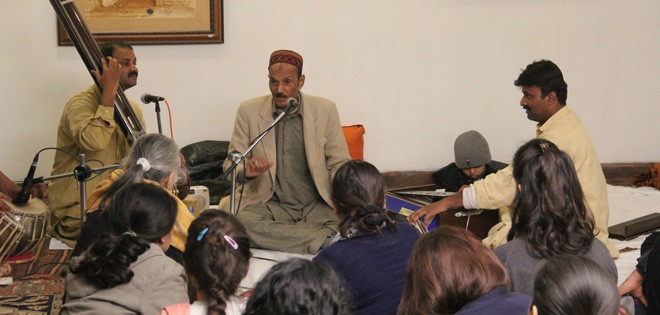
The concert organised by the Lahore Music Forum at the Nairang Galleries last week focused on the musicians of the Delhi gharana. The three representatives chosen for performances were Ustad Naseeruddin Mahmood Sami, Turab Ali and Urooj Sami.
One hears of the other gharanas like Rampur, Patiala, Kirana, Gwalior etc. etc. but not so much of the Delhi gharana and it may be surprising because Delhi was the seat of power for centuries. As it happens, the patronage extended by the court usually results in the top artistes and poets gaggling together for reward and recognition. But perhaps the absence of the Dehli gharana is not surprising because, since the middle of the 18th century, Delhi had started to lose its power and glory. Other centres had started to emerge like Faizabad and Lucknow which offered plusher opportunities.
One has heard of the poets moving out of Delhi for securer and greener pastures of Awadh during the same period. The musicians too were doing the same. Though the court in Delhi lasted till the middle of the 19th century it was basically powerless and running short on wealth. After the formal takeover of the Raj in 1958, the traditional arts and artistes found refuge in the various courts of the hundreds of riyasats that cut across the length and breadth of the colonial subcontinent.
Only with the establishment of the Radio in the 1930s did Delhi again start to attract outstanding talent in music again.
One does not know what happened to the outstanding ustads like the court musician Tan Rus Khan with the dissolution of the Mughal Court. Many say he migrated to Patiala; others say he lays buried in Hyderabad Deccan.
As the history of music does not exist in the form of hard documentation but in hagiographic meanderings, it is difficult to built a case in pure linear fashion. The sarangi and tabla angs are now referred to more by their association with the city of Delhi than the vocalists.
In our times one qawwal who persisted with acceptable definition of the traditional qawwali was the late Munshi Raziuddin Khan as do his progeny now, Farid Ayaz and Abu Muhammed. Listening to them is a throwback to a bygone era when qawwali was basically an extension of the creative expression built round the shrine and, even in its evolved semi-autonomous form, did not sever the umbilical chord with its origins.
Naseeruddin Mahmood Sami being the nephew of Munshi Raziuddin too traces his antecedents back to the era of Amir Khusro and one Ibrahim Samit. In the absence of documented evidence, it seems not all that improbable that they have a long history of being qawwals.
Naseeruddin Mahmood Sami switched to kheyal about thirty years ago from qawwali and, like many before him, is known as the Qawwal Bachon Ka Gharana. He persisted with a form which had few takers, honing his craft to reach a stage where he can be considered to be a significant voice in a genre which has very few practitioners now left in Pakistan.
At partition, Ustad Sardar Khan was the leading exponent of the Delhi gharana in Pakistan. Though he was old and ailing and his days as a performer were long gone, he was considered a jagat ustad -- an undisputed maestro by all the gharanas of kheyal gaiki and some of his talent rubbed on Bundu Khan and Umrao Bundu Khan. It seems that Ustad Naseeruddin Sami is greatly influenced by the gaiki of these musicians.
His repertoire is quite impressive and he can sing a large number of bandishes (compositions) in various raags. Some of the bandishes that he sings are mustanid, travelling over generations with clear and unmistakable characteristics of the Delhi gharana. His performance is refreshing because he is not in a hurry to wrap up the elaboration of the raag in the vilampat lai and move into top gear of taan and sargam as a demonstration of virtuosity. He sang raag behag with the above mentioned characteristics.
Turab Ali played aiman kalyan on sitar. In an earlier article on him I wrote, "Young and enthusiastic, Turab Ali has crossed the initial stages of acquiring the craft. Now this 20-something sitarist is on the verge of becoming the leading sitar player of the country, and if the progress continues without any major hindrance perhaps he will become one of the leading sitar players in the world…
"His paternal side, which migrated from Delhi to Karachi, specialises in the tabla and the maternal side in playing the sitar. His maternal grandfather Ustad Imdad Hussain was a good sitar player who lived and struggled all his life in Karachi. He played occasionally but filled his time by offering tuitions to children of well-to-do families, who he knew would never take up sitar seriously and least of all professionally…
"Turab Ali is still young. But he has been performing on stage now for a few years and at every performance appears to be a notch above the previous one in terms of maturity…One could hear the various influences that were at work in the playing of Turab Ali. He has acquired the craft to be equipped for the assimilation of influences."
I had written that Turab Ali is efficient in managing the meend and the tantkari passages in the drut lai. Urooj Sami sang Raag Malkauns at the concert.