

Print Story
X




Khiva dazzles with history, stillness and a sense of timeless wonder
Sometimes one does not know what awaits one until it arrives. That is how I found myself boarding an Uzbekistan Airways flight to Tashkent in June. The capital was ready to welcome us, even though summer is not usually considered the best season for tourists. Temperatures soared to 35C, and the air felt heavy.
I was travelling with my wife. We were eager to explore the storied cities whose very names evoked childhood memories of fables and fantasy: Khiva, Samarkand and Bukhara. After a day in Tashkent, our next destination was Khiva. We had heard much about it, especially from a friend who had toured several Uzbek cities but missed this one. He urged us not to repeat the mistake and to head there straight after Tashkent.
We booked our tickets with Uzbekistan Airways and were scheduled to depart at 8:05am. Bags packed and excitement high, we arrived at the airport at around 7:15am, only to find that Tashkent was not ready to let us go. As we entered the terminal, an announcement was made that the flight had been delayed by more than three and a half hours.
Uzbekistan Airways, the national flag carrier, seemed to share the familiar quirks of many state-run services. Learning that the new departure time was 11:50am, we quickly realised that we were unprepared for such a long wait. With no breakfast - not even a drink of water - the hours ahead looked distinctly uncomfortable.
The lounge was crowded with weary tourists, most as restless as we were. The small coffee shop was happy to serve at premium prices.
Airports are fascinating places to watch human behaviour. People from across the world gather there, offering one a rare chance to observe how various people express themselves in diverse ways.
The American tourists, carrying oversized backpacks, breezed through security before a couple launched into a game of synchronised movements. Their playful display — part performance, part public affection, quickly drew the attention of the bored lounge audience. For a few minutes, they provided a welcome distraction.
A group of Japanese tourists arrived next, quiet and serious. They immediately settled into their seats once they learnt of the delay. Their composure reflected a striking sense of discipline and order.
The Chinese travellers wheeled in large trolley bags, stacking them neatly in a corner before disappearing into their phones.
By now, enthusiasm was waning. The crowd’s excitement for their next destinations gave way to the dull fatigue of waiting.
With little else to do, passengers either stared at the information screens or quietly observed one another. Most seemed preoccupied looking for a sliver of comfort during the long wait. A few American tourists in bright summer dresses caught the attention of many onlookers, though they themselves appeared unconcerned.
We filled the time by wandering through the lounge, becoming familiar with every ATM and vending machine in sight.
At around 11:15am, boarding began. From our place at the back of the queue, we watched people pull up both their luggage and their spirits. The plane finally took off at 12:15pm, and we were on our way.
A simple sandwich and a glass of juice were served before the crew slipped into a relaxed rhythm. We half-expected some goodwill gesture as compensation for the three-hour delay, but none materialised.
The landing at Urgench International Airport was smooth. As we stepped off the plane, the heat hit us sharply. It eased a little in the shade. The Yandex Go taxi service proved efficient, connecting us to a driver who seemed as enthusiastic about music as he was about conversation. He handed over the car’s touch screen, inviting us to play Pakistani songs on YouTube as we began our journey.
ChatGPT proved a handy tool for translations, helping us converse with our Uzbek-speaking driver, who seemed delighted to have tourists from Pakistan. The road from Urgench to Khiva was one of the most beautiful we had ever travelled: a straight stretch lined with flowers and electric tramway lines, giving the scene an almost surreal quality. Roadside houses proudly displayed the Uzbek national flag. According to our driver, the flags were meant to show visitors just how deeply the people loved their country.
By the time we approached Khiva, the clock had struck 3pm. “We’re late for Khiva since we only have a day here,” my wife remarked. I could only agree.
Finding our hotel was easy. Its location proved to be outstanding. We had booked the guest house Boyjon OTA via Booking.com, relying on its 10/10 location rating. “This place deserves a 15/10 for location,” my wife laughed as we stepped out into Ichan Kala, the old walled city of Khiva.
Ichan Kala has been a UNESCO World Heritage Site since 1990. The old town preserves more than 50 historic monuments and 250 traditional houses, most dating from the 18th and 19th Centuries.
Our guest house was run by a warm, welcoming family. Our room opened onto a small patio shaded by fruit trees and edged with vegetables. Two wooden dewans stood under the trees, perfect for outdoor sitting, lending the place the relaxed atmosphere of a lived-in home.
Khiva dazzles with history, stillness and a sense of timeless wonder Khiva is not just a destination; it is an experience, a living storybook, a history lesson and a reminder that every rise is followed by a fall, and that change is the only constant.
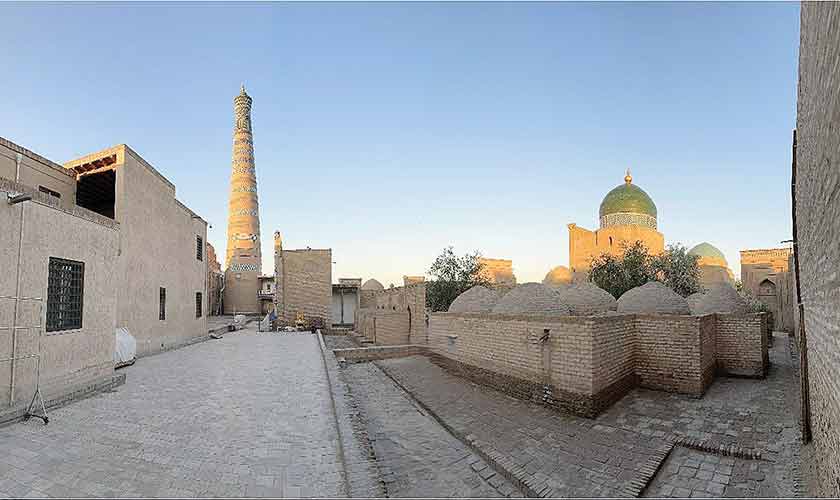
The check-in was quick. Within half an hour, we were ready to explore the old city. What we witnessed was beyond anything we had imagined. Ichan Kala felt like a city frozen in time. The restoration work has been carried out so carefully that the historic atmosphere still lingers in its buildings. Today, many of the old madrassas have been converted into hotels, restaurants or museums.
A striking turquoise dome drew our attention. We followed it until we arrived at the Pahlavon Mahmud Complex (also known as Hazrati Pahlavon Pir). The site, originally built in 1664, is dedicated to Pahlavon Mahmud (1247–1326), a local poet, craftsman, wrestler of legendary strength and healer. In accordance with his will, he was buried in his leather workshop, which later became the heart of this shrine.
Entry cost 25,000 SOM. My wife chose to sit in the corridor, soaking in the atmosphere, while I stepped inside. The main hall was breathtaking: intricate artwork, geometric patterns, floral motifs and pointed arches covered every surface. Shades of green, blue, white and turquoise blended seamlessly; not an inch was left undecorated. The chamber, softly lit, had an almost magical quality.
For a few moments, I was entirely alone inside. The stillness was striking. The space radiated calm and peace. Over the centuries, the complex had become the burial place for Khiva’s khans and their relatives. Offering prayers at the graves felt deeply spiritual, as if the entire walled city of Ichan Kala carried the blessings of this revered saint.
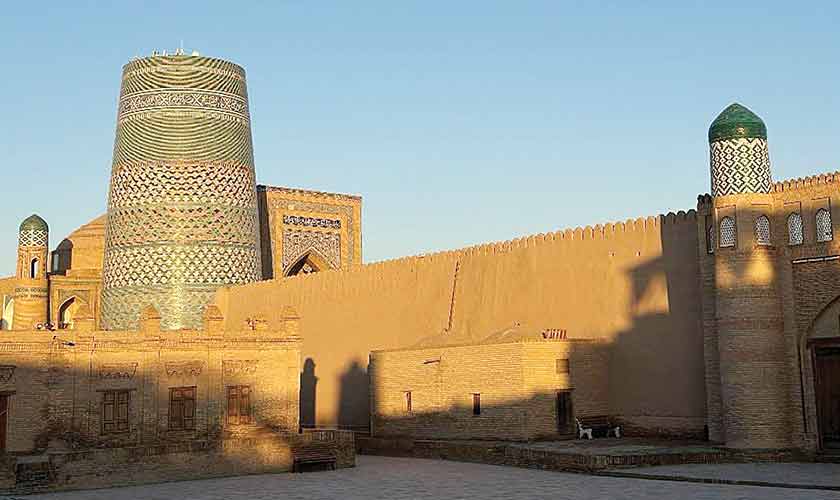
Ichan Kala is dotted with minarets. Three of those dominate the skyline and draw the attention of most visitors: Islam Khodja, Juma Mosque and Kalta. Strolling through the walled city was one of the most unforgettable experiences of our lives. No number of travel v-logs could have prepared us for it. The reality was beyond words, defying any attempt at description.
As evening fell, the golden light transformed the city. On that clear day, it gave even a novice photographer like me the perfect opportunity. The architecture was magnificent, the lighting flawless, all one had to do was press the shutter. There was little need to think about angles or composition; every frame came out perfect. Khiva itself seemed to be offering a simple, effortless lesson in photography.
Around 8pm, the sky was still bright, like a late afternoon in Pakistan. It felt as though Khiva itself had granted us extra time to wander and lose ourselves in the timeless streets of the old city. Hunger eventually drew us to look for a place with dinner and a view. Earlier in the day, we had enjoyed a hearty vegetable pilaf at Sultan Restaurant near the Islam Khodja madrassah. I still remember the waitress who served it with great charm, the dish brimming with apricots, garlic, potatoes, carrots and dried fruits. On our way out, she had, very politely, said, “I will wait for you tonight.” I later used this line with my wife.
When I suggested returning, my wife quickly dismissed the idea and instead pointed towards the well-known Terrassa Hotel near the Kalta Minaret. Conceived as the tallest minaret in the Muslim East, it was planned to reach 70-80 metres in height, narrowing as it rose to ensure durability. Yet construction stopped at just 29 metres. The reason remains uncertain. According to the Khivan historian Muniz, the project was abandoned after the death of ruler, Muhammad Amin Khan, in 1855. Another legend claims the Emir of Bukhara had wanted a similar minaret built and secured the master architect’s agreement, but when the Khan of Khiva discovered this, he ordered the master’s death upon completion. Hearing this, the master fled, leaving the minaret unfinished.
Whatever the truth, its incompleteness is as striking as its beauty. Entirely clad in glazed tiles and majolica, it stands before the façade of the Amin Khan madrassah, arresting the gaze of every visitor. Even in its unfinished state, it is unforgettable.
At the Terrassa Hotel, we asked for a corner table and were granted one. From there, with the old buildings lit up, the first moon of Muharram overhead, a cool breeze drifting through, and my wife beside me, everything felt perfectly placed. Even after finishing our green noodles with beef, we lingered, reluctant to leave.
Time, of course, waits for no one. Yet, against reason, we wished it would.
The next morning promised another wonder. From what we had experienced the day before, I sensed that a walk through Khiva at dawn would be unforgettable. At 5am, I slipped out of the room. After a long previous day, I didn’t want to disturb my wife’s sleep, so I closed the door as gently as possible. I failed. She stirred, nodded with sleepy approval, and let me go on my solo morning walk.
The streets lay empty: no tourists, no vendors, only a blanket of silence. The stillness was broken only by the soft chirping of birds, gently announcing the dawn. Khiva was ready to give another free photography lesson; the only condition was to be present with a camera and the intention to click.
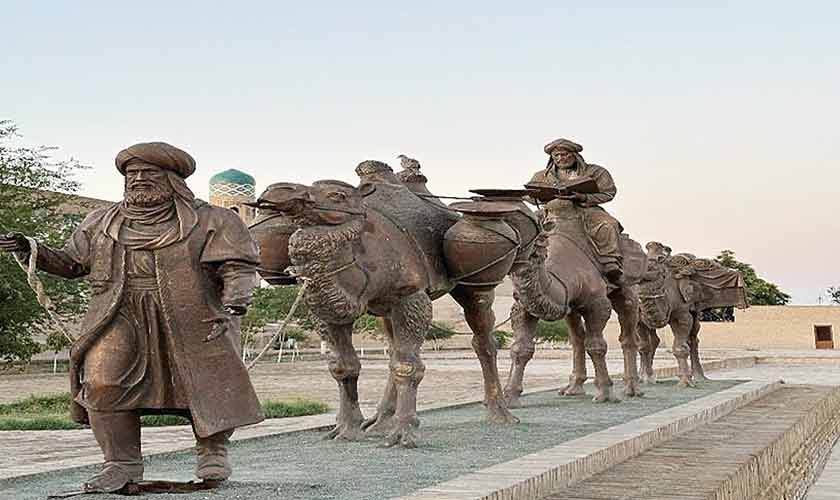
At the city gate near the Kalta Minaret, I came across statues of camels carrying goods, with men in traditional dress representing the caravans that once travelled through Khiva. One figure, perched on a camel, appeared to be reading a book. For a moment, I longed to ask him about his adventures, even to seek his blessings for mine. But the caravan seemed in a hurry. I touched the feet of the man, imagining him as Al-Biruni, but could not utter a word.
The sun was about to rise, and the Kalta Minaret was ready to wear its golden crown for a few minutes. Another wish granted. In that instant, it felt as though the beauty of the city was mine alone. As I strolled through its quiet streets, my mind drifted to the lanes of old Córdoba, a city I had visited several years earlier. For a fleeting moment, it felt as if I were walking in both places at once.
The spell was broken by the clatter of a rubbish bin being dragged along the street. A woman pushed it slowly towards the collection point. From the eastern to the western gate, my walk took an hour, though it felt like a minute. Outside the eastern gate, I saw a mosque where worshippers had lingered after prayers. A young boy sat on a bench under a tree. “Hassan,” he introduced himself. I smiled and told him it was also my son’s name. The coincidence delighted him. “Friday prayers will be at 1:30,” he informed me, a small but thoughtful detail.
After thanking him, I returned to the hotel for a brief nap. At around 8:45am, my wife woke me gently. Breakfast had been laid out in the patio on a wooden dewan with wool-filled cushions. The spread included at least ten dishes, with fresh and dried fruits in abundance. “This is one of the best breakfasts we’ve ever had,” I remarked, and my wife quickly agreed.
Soon after, we ventured back into the streets. Khiva, once silent, was now alive with energy. Near the Kalta Minaret, a group sang and danced, filling the air with joy. The Uzbek people are spirited and know how to embrace the moment. Passing the minarets and monuments one last time, we returned to our room, packed our bags and made our way to the railway station.
The station was spotless, as neat as any airport. Our coupe was built for four, but we were the only occupants. It felt as if my wife’s prayers had been answered. Water bottles, tea bags and sugar cubes awaited us. Freshly packed linen was handed out by the crew as soon as the train began to move.
It was time to bid farewell to Khiva.
Khiva is not just a destination; it is an experience, a living storybook, a history lesson and a reminder that every rise is followed by a fall, and that change is the only constant. As we stretched out in our cabin, weary yet enchanted, we felt that Khiva had left its mark on us, dazzling us far beyond anything we had imagined.
The writer teaches engineering management at the National University of Science and Technology. He can be reached at yasir299@gmail.com