

Print Story
X




Nathiagali’s water system is on the brink of collapse
| N |
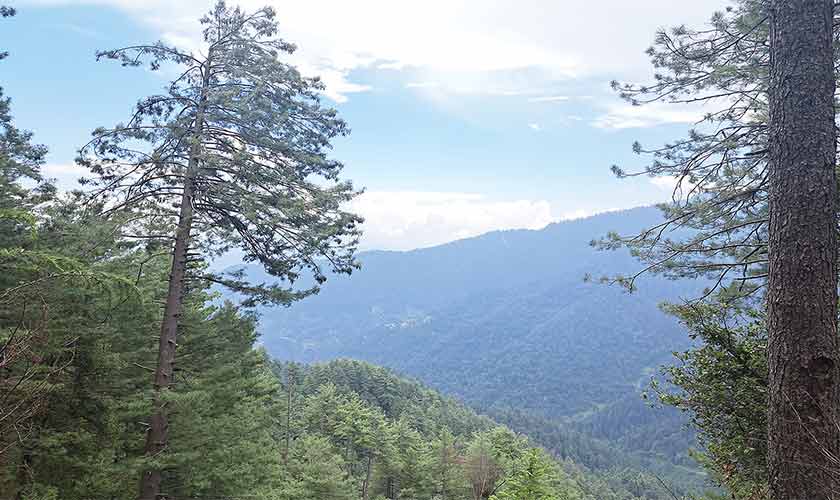
athiagali’s pine-wrapped hills and crisp air lure growing crowds of tourists. But beneath its beauty, the town is parched and pleading. The most basic necessity – water – is scarce and what little flows in is often unfit to use.
Calling Nathigali a disaster-in-the-making may no longer be an exaggeration. Perched at over 7,900 feet in Khyber Pakhtunkhwa’s Galiyat region, “Nathiagali’s grown too fast,” says Shaukat Iqbal, field in-charge at the Galiyat Development Authority, who for 36 years has watching it grow from a quiet hamlet into a buzzing tourist destination. “The supply of water hasn’t kept up,” he points out.
That admission, coming from a GDA official, speaks volumes. In the absence of reliable data, no one knows exactly how many people live in the region or how much water they need to bathe and wash, cook and drink. The last official census in 2017 recorded just 957 residents across the Galiyat union council, which includes Nathiagali, Changlagali, Dungagali, and Ayubia.
Some eight years later, a PowerPoint presentation shared by the Galiyat Development Authority puts the population at 46,000, with Nathiagali’s taking the lead at 11,960. For a population of this size, the authority estimates the daily water demand at 239,200 gallons. However, only 90,000 gallons is pumped, leaving a shortfall of 149,200 gallons a day. Per capita supply comes to only 7.5 gallons of water a day, much below the 26 to 52 gallons per person recommended by the World Health Organisation.
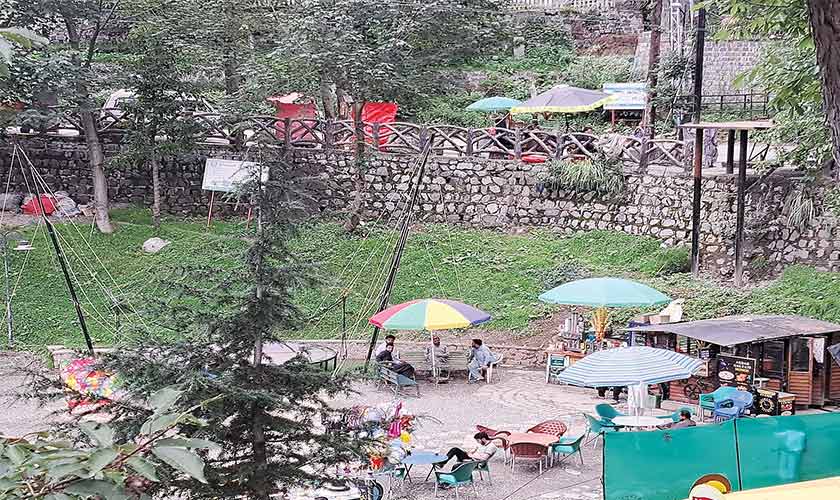
In simple terms, this hill town faces a 62 percent water shortfall, which worsens in peak tourist season (from June to August). That’s when the city comes alive with visitors, their gleaming cars clogging the narrow, winding roads, restaurants spilling over with diners and hotels booked to capacity. Winters tell a similar story. Till only a few years ago, only a few people ventured up to catch a glimpse of snow. Now, it’s a frenzy, because the roads remain open no matter the weather - snow, rain or sunshine.
Residents and water experts familiar with the area say that there has been no addition to Nathiagali’s power supply in the last 25 years. They say the Galiyat Development Authority lacks both the technical expertise and the influence to effectively navigate official corridors. As a result, the town continues to rely on surface water and natural springs.
There is worse news. A 2019 analysis by a local Village Development Committee, formed under the Forest Department, found that over 90 percent of local water sources in Nathiagali (and Dungagali) were microbiologically contaminated, says Hamza Naseer, the site in-charge of Nathiagali, Water Resource Accountability Project, “It exceeded ‘very high risk’ levels of faecal coliform,” he says. The WRAP, funded by the Foreign, Commonwealth and Development Office of the United Kingdom and implemented by the WWF-Pakistan in Nathiagali, aims to boost water security and climate resilience through improved pipe networks, rainwater harvesting and native afforestation.
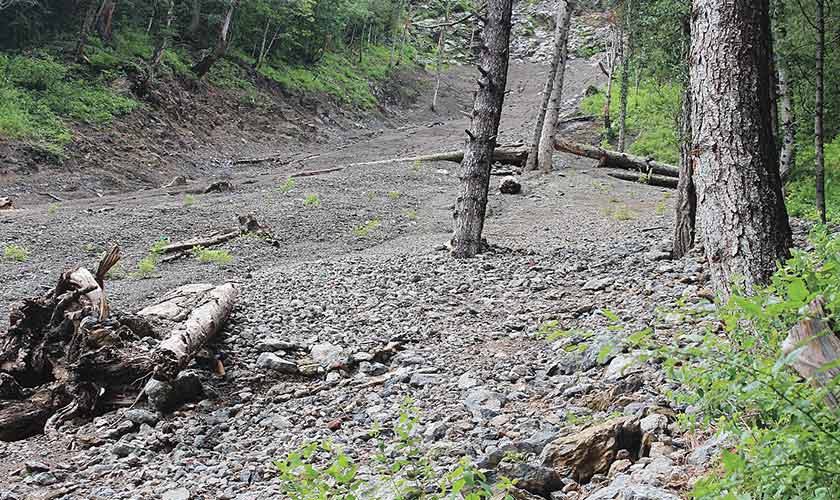
Despite the water crisis, the construction boom is marching on. Half-built hotels, cottages and restaurants are creeping into the greenery; stone crushers are growling on almost every slope and debris from collapsing retaining walls is piling up. A swank new 100 plus-room hotel has shot up, as if to rival the towering pines. The air that once smelled of pine forests now reeks of diesel and dust. Land designated for residential use is being used for commercial purposes, without a credible assessment of its water needs.
A few hotels have turned to conservation. “I’ve had to rethink everything, from how we clean to how we cook,” says the hotel owner who did not wish to be named. He has adapted his kitchen that now runs on automated dishwashers to reduce waste; pressure faucets have been installed in guest toilets and rainwater is collected in underground tanks and used to wash the paved outdoor paths.
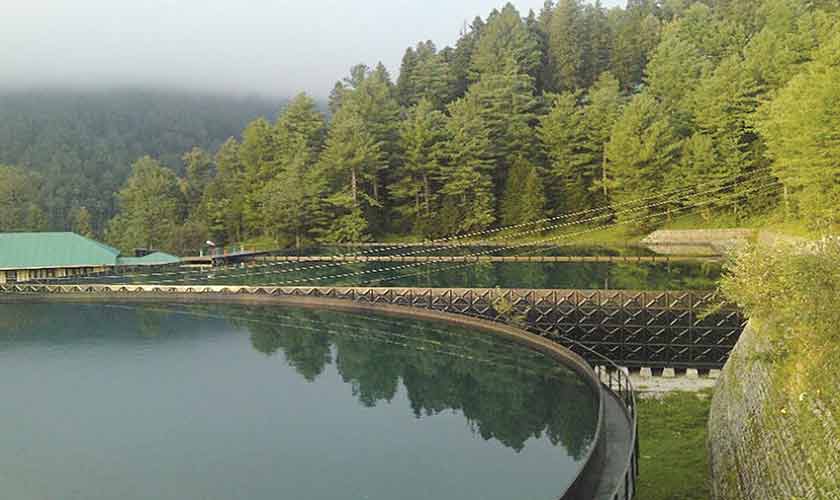
Nathiagali draws its water from nearby springs and natural catchments, which are first channelled to a storage tank in Grang Nullah in Bakote, a village in the Galiyat region. From there, it’s pumped to a mid-level reservoir, then re-pumped to a higher reservoir in Nathiagali. Some areas receive water directly from this reservoir. Most homes and hotels at higher elevations depend on an additional pumping station. The supply is nowhere near enough.
The system is old and overburdened, says the owner of an upscale 37-room hotel with a 400-seat restaurant. “We get just 35 to 40 minutes of supply a day.”
To fill the gap, the hotel buys around 5,000 gallons of water each week from private tankers; more during peak tourist season. This, he says, costs him “an arm and a leg.” A 3,000 gallon tanker may cost between Rs 23,000 and Rs 35,000, depending on the season.
WWF’s Naseer confirms that many hotels and restaurants rely on water tankers, adding that they often source water from untested bore wells or informal hydrants located near Harnol and Khanespur towns, “without any quality testing or oversight, raising serious hygiene concerns.”
Another source is Peter pumps that draw runoff or spring flows from nearby upland catchments. However, “these are labour-intensive, yield variable volumes and depend entirely on seasonal rainfall and terrain,” he says.
Nathiagali’s water woes are as much about scarcity as about access. The broader Galiyat region holds ample reserves. Take Miranjani, the forested ridge just beyond the town. It hosts a spring-fed, gravity-based water system. However, the supply is reserved for the Pakistan Air Force’s Kalabagh Base, known locally as the ‘Green Spot.’
A few kilometres away in Dungagali, another spring feeds a pipeline that runs across provincial border into Murree in the Punjab. The long-standing arrangement is now sharply contested. Officials in Khyber Pakhtunkhwa argue that the original terms are outdated and legally indefensible. Today, the KP government sees the continued diversion of water from Dungagali to Murree as an illegal encroachment.
Even if Nathiagali were to be granted access to water from Miranjani and Dungagali, that will not be enough to meet the hill station’s surging demand, the hotel owner says. “Rainwater harvesting is the only viable path forward. That’s where the government must step in – not just to promote smarter water use, but also to subsidise filtration systems for hotels and other high-demand users.”
Naseer advocates a multi-pronged approach: revive gravity-fed water schemes from nearby springs to provide a low-cost, energy-efficient year-round supply; mandate rainwater harvesting in hotels, guesthouses and public buildings; and construct small check dams and recharge wells to restore groundwater that feeds the Peter pumps.
He also stresses the need to reduce demand by introducing grey-water recycling in hotels and restaurants for non-potable use; strict regulation of private tankers; digital monitoring of water use; and community-led stewardship.
A few hotels have turned to conservation. “I’ve had to rethink everything, from how we clean to how we cook,” says the hotel owner who did not wish to be named. He has adapted his kitchen that now runs on automated dishwashers to reduce waste; pressure faucets have been installed in guest toilets and rainwater is collected in underground tanks and used to wash the paved outdoor paths. “We can’t use grey water for flushing,” he adds. “It leaves stains in the commodes – and guests complain about it.”
This hill town, rich in colonial history, has long served as a discreet retreat for politicians – a place where schemes and intrigues quietly unfolded in private guesthouses or in the iconic Governor’s House. Henry Kissinger was supposed to be resting in the Governor’s House with an upset stomach in 1971, while in reality, he had secretly flown to Beijing to pave the way for US President Richard Nixon’s landmark visit to China in 1972.
Nathiagali, rich in history and beauty, cannot be allowed to fall victim to the ravages of misgovernance, like Naran. The last notable official intervention came on September 26, 2024, during a meeting at the Ministry of Inter-Provincial Coordination, where the worsening water shortage in the Galiyat region was on the agenda. It was decided that a comprehensive survey be commissioned through a reputable firm to assess the crisis in both Galiyat and Murree.
Almost a year on, nothing has changed.
The writer is a freelance journalist based in Lahore