Print Story
X




Romanticised histories, colonial myths and tribal claims have long shaped public memory of Pharwala Fort
| B |
etween tangled pasts and fabled histories, myth and fact, reconstruction and erosion, the site of Pharwala Fort, stretching between Kahuta and Islamabad, quietly awaits exploration. Rich in heritage, the fort remains an underappreciated historical landmark.
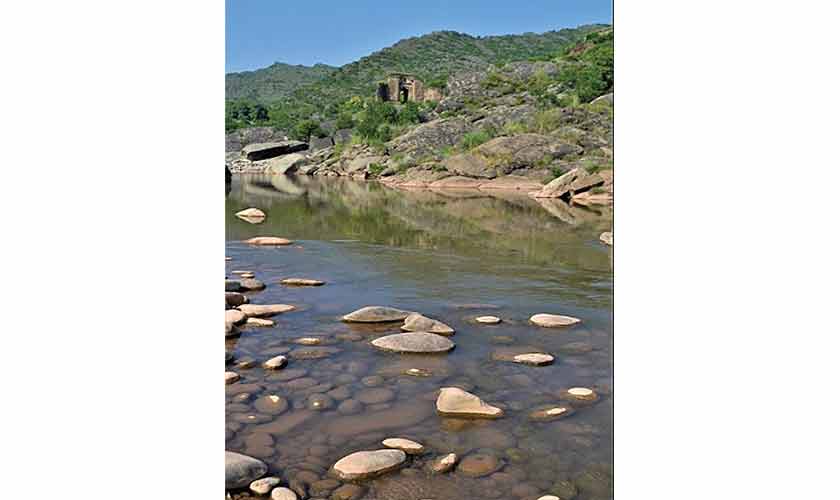
One point of approach is the locally familiar Karamat Na Shed or Karamat’s Poultry Farm, a marker for visitors. From across the Soan River, the fort’s gate comes into view. It appears incongruous with the surrounding landscape, especially when approached through the newly built housing societies. Said to be more than a thousand years old, the site bears the architectural weight of centuries.
Over half a century ago, the fort’s area, divided between two administrative zones, became a den for criminal activity. Even now, the site is occasionally mentioned in news reports linked to crime. This ongoing association has eroded public memory of the fort as a historical treasure, instead casting it as a haven for lawlessness.
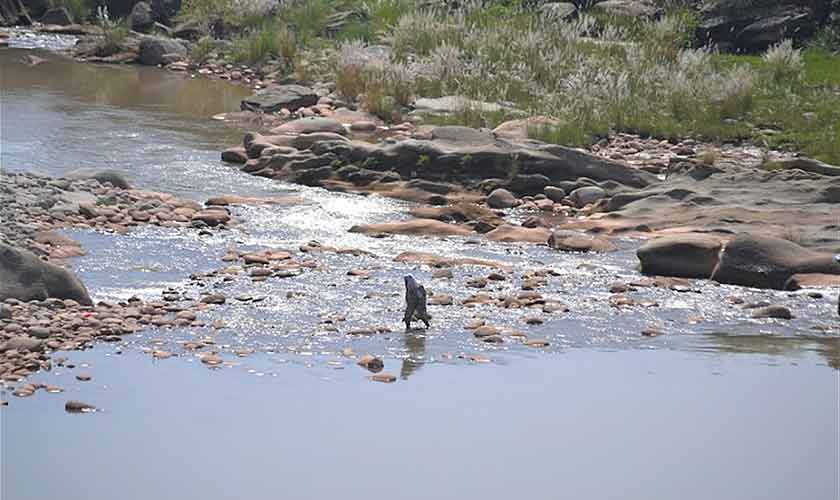
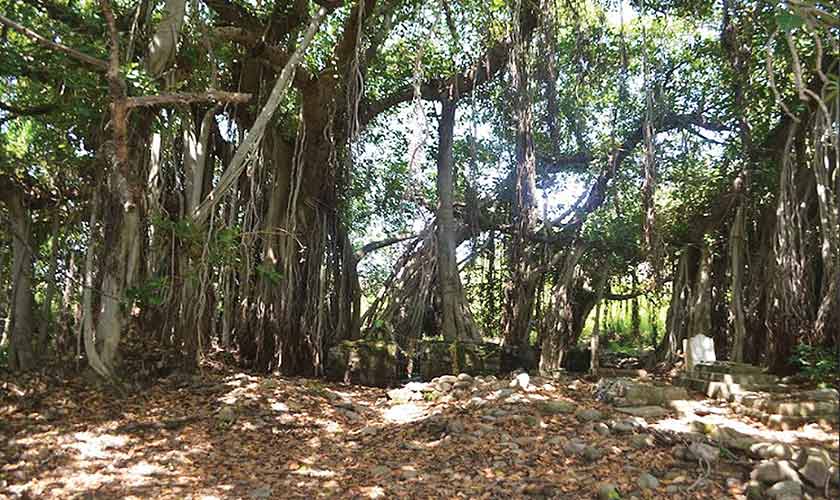
Pharwala Fort can also be approached by retracing the route once taken by Mughal emperor Babur in 1519 CE. Passing through the village of Aliot, located along the road connecting Rawalpindi to Kashmir, visitors will see two large banyan trees, near which stands a rusting iron signboard for Pharwala Fort in Urdu Nastaliq script. The board is frequently vandalised by locals, reflecting long-standing tribal feuds. The fort is not viewed as a shared historical heritage but rather as private land claimed by a tribe and the sign becomes a symbolic outlet for anger and resentment.
Just past Aliot lies the village of Narala, which offers a trekking route to the Hathi (elephant) Gate of the fort. The fort houses the village of Pharwala, inhabited entirely by members of the same tribe, who all trace lineage to the Gakkhar ancestry.
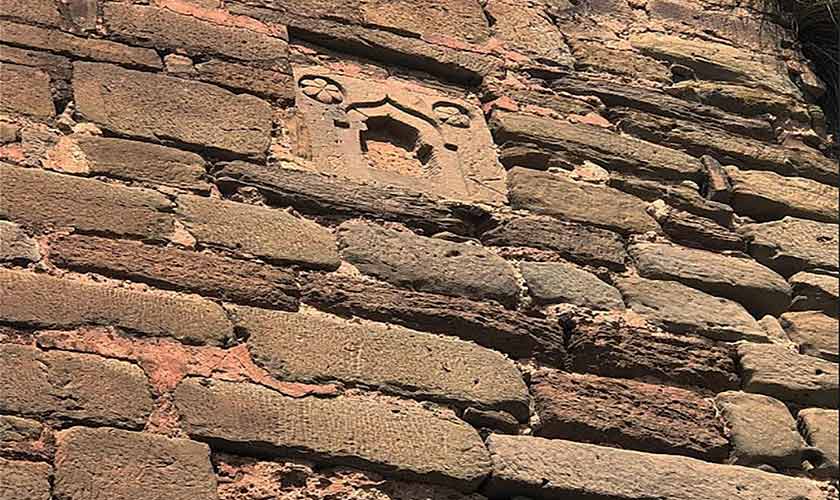
The Hathi Gate, named after Hathi Khan, once ruler of the area, is among the fort’s most well-known features. One of the earliest mentions of Hathi Khan appears in Tuzuk-i-Babri, the memoirs of Babur, where the emperor recounts his encounters in the region.
As a site of historical significance, Pharwala Fort offers much to help us better understand the past.
“Perhaleh (Pharwala) which stands high in the midst of deep valleys and ravines, has two roads leading to it, one of them on the south-east, which was the road that we advanced by. This road runs along the edge of the ravines, and has ravines and precipices on both sides, Within half a kos of Perhaleh the road becomes extremely difficult and continues so up to the very gates of the city; the ravine road, in four or five places, being so narrow and steep, that only one person can go along it at a time, and, for about a bow shot, it is necessary to proceed with the utmost circumspection. The other road is on the north-west. It advances towards Perhaleh through the midst of an open valley. Except these two roads there is no other on any side. Although the place has no breast-work nor battlement, it is so situated that it is not accessible. It is surrounded by a precipice seven or eight yards in perpendicular height. The troops of the left wing, having passed along the narrows, went pouring on towards the gate. Hati with thirty or forty horsemen, all, both man and horse, in complete armour, accompanied by a number of foot soldiers, attacked and drove back the skirmishers, Dost Baig, who commanded the reserve, coming up and falling on the enemy with great impetuosity, brought-down a number of them and routed the rest. Hati Gakkhar, who distinguished himself by his courage and firmness in the action, in spite of all his exertions could not maintain his ground and fled. He was unable to defend the narrows; and, on reaching the fort, found that it was equally out of his power to maintain himself there. The detachment which followed close on his heels, having entered the fort along with him, Hati was compelled to make his escape, nearly alone, by the north-west entrance.”
In the history of Pharwala Fort, apart from a few official government reports and limited academic engagement, the responsibility of documenting its past has largely been taken up by members of the Gakkhar tribe. Much of this writing has appeared in the form of self-published texts with very limited circulation, intended primarily for fellow tribesmen.
Among these, the most notable work is Tarikh-i-Gakkharan (1956) by Yaqoob Tariq, an Urdu translation of the Persian text Kai-Gohar Nama, originally written in the early 18th Century. In 2004, Sultan Zahoor Akhtar, a direct descendant of the last ruler of Pharwala, Sultan Muqarrab Khan, produced an English translation of the text. His book also included biographical profiles of notable individuals and biradaris within the tribe, along with images of historical objects in his possession.
However, Sultan Zahoor’s work cannot be regarded as a rigorous or critical engagement with the past of Pharwala. It includes self-imagined portraits of earlier rulers, presented as authentic historical images. The lofty claims of invincibility and being ‘undefeated,’ common in such accounts, lack historical investigation and are largely detached from credible historiographical practices.
More recently, efforts by a younger generation of Gakkhars to document the fort and its caretakers have focused heavily on tribal pride. These reflections, often taking the form of self-published essays and books, are typically romanticised, ahistorical and filled with eulogy. While they offer insight into the subjective experience of heritage and identity, they rarely provide verifiable historical analysis.
Writers such as Jameel Ahmed, Momin Khan, Farhan Khalid and Saheeb Ahmed, who draw from Persian texts and colonial archives, often express frustration at what they perceive as academic gatekeeping and the absence of Gakkhar history from mainstream South Asian historical discourse. While many of these writings appear hastily compiled and driven by a desire to reclaim lost political relevance, they underscore a deeper need: the urgent demand for serious, critical scholarship on Pharwala Fort — one that can challenge inherited narratives and bring academic rigour to a long-overlooked subject.
Despite these efforts, many basic questions about the origins of the Gakkhars and the actual history of Pharwala Fort remain unanswered. Much of the current literature repeats colonial frameworks as the sole basis for interpreting events associated with the fort, reinforcing rather than challenging outdated historical perspectives.
The recent trend of hero-making surrounding the early caretakers of Pharwala Fort reflects a broader, and often problematic, tendency among public historians who are flourishing in the field of historical writing today. These narratives tend to construct a false binary between the indigenous and the outsider — a theme that can be critically examined through broader conversations about religious minorities in South Asia.
Despite the growing body of literature on the fort, more confusion than clarity has often emerged. For example, colonial-era reports claiming that Pharwala was the birthplace of the Hindu deity Lord Rama are not supported by any credible historical source — not even Hindu religious texts. Why, then, do such unfounded claims continue to circulate, decades after their origin in colonial myth-making?
As a site of historical significance, Pharwala Fort offers much to help us better understand the past. Yet, its history has too often been reduced to a narrow narrative centred on a single tribe, military victories and heroic legends — a framing that erases the wider history of both the fort and the city of Pharwala.
Textual sources offer important insights, but material evidence is scarce. This lack of physical documentation makes it difficult to present the fort as a living, continuous history, rather than a fragmented and forgotten one. Much of the available literature fails to provide an organic or holistic view of the past, instead relying on repetition, romanticism or tribal exceptionalism.
Built in the medieval period, Pharwala Fort is referenced in several historical texts, yet the question of how to interpret and narrate these histories remains pressing. Historian Manan Ahmed Asif offers a compelling framework for reimagining the medieval past. In his landmark work of South Asian intellectual history, The Loss of Hindustan: The Invention of India, he writes:
“If an acknowledgment of loss is one way forward, then the history I have sketched here is a prompt to imagine ways forward that do not yield to the majoritarian present, that do not inherit the past as a certainty and do not romanticise that which is lost. It is essential that, as historians, artists, activists and thinkers we turn to the medieval period and recognise the ways in which it continues to organise how current prejudices are articulated.”
The writer is a historian, travel writer and translator. He researches on intellectual history, Persianate world connections and early Indian cinema