
Failing at education
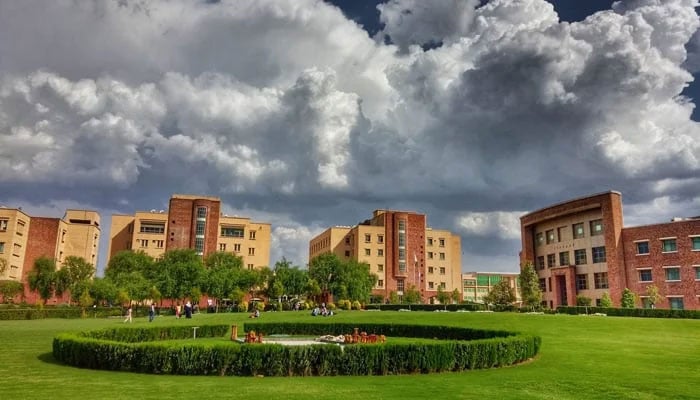
When I got admission to a US university and went there for higher studies, I was in for quite a shock. The campus was open and alive – its lawns and buildings well-maintained, with students and faculty engaged in discussions, seminars, lectures and collaborative work everywhere. No walls, no barbed wire, no special enclosures, no closed doors.
Everyone seemed to be there to learn. The library was breathtaking – brightly lit, airy, filled with books and people reading and working in complete silence. I am sure there must have been office politics there as well – human nature doesn’t vanish in America – but academics were clearly at the centre of campus life. A place of learning where there is an environment to read, discuss, debate, interact and learn. Students eager to learn, badgering professors to tell them more, and faculty members eager to discuss and debate their research and findings with any student who was interested in it.
The shock came from comparing it with my own experience of university life in Pakistan at the so-called number one university in the country at the time. Aside from the fact that the buildings had been designed like bunkers for surviving a nuclear war, there were large tracts of unkempt and wild land stretching long distances, fences everywhere, closed doors that made students think twice before opening them. Seminars seemed to be held once in a blue moon, if that, and no one seemed to attend a lecture just for the sake of it, to learn. Students begging professors to end the lecture early, to shorten the course, give a day off, and faculty members preoccupied with publishing papers and meeting HEC requirements.
However, instead of improving, things have worsened. Entry into the university depends on the mood of security guards – will they open the gate as one approaches and allow passage, or will one have to prove their identity and justify their visit? There are also various offices – some with no direct link to the university – located on campus, and even they are hostage to the prevailing mood on the ground. At the back is a village, accessible through university gates. Those gates are often shut – sometimes in celebration, sometimes in protest – and students feel free to block roads, harass visitors and assert their dominance over the entire premises.
What kind of learning environment is this?
But blaming the students or the university administration alone is missing the point. The rot runs deeper. What we are witnessing is the direct outcome of a long history of neglect, underinvestment and incoherent higher education policy. There has been no consistent effort to create spaces for research, debate, or learning.
Universities are treated as bureaucratic departments, their autonomy undermined, appointments politicised, budgets delayed or denied. Pakistan spends less than 2.0 per cent of its GDP on education overall, compared to over 6.0 per cent in the Middle East or 3.4 per cent in poor countries, and only about 0.08 per cent on higher education. Between 2011 and 2021, public sector development funding for higher education was repeatedly frozen or reallocated, while non-development recurrent costs increased, crowding out investments in labs, libraries and fa-culty development.
The culture among students reflects this vacuum. If there is no encouragement to think, question or engage in serious academic work, then why should we expect anything else? Students are simply responding to the incentives the system has given them. Based on casual observation of student life, it appears that most students prioritise ‘social life’ and ‘degree value for job market’ over their desire to engage with academic content, and few students have meaningful academic interactions with their teachers outside the classroom.
The real question, then, is not why university campuses are dysfunctional. The question is: why has the state failed to establish and maintain institutions of higher learning that can inspire curiosity, foster critical thinking and uphold the integrity of the classroom? This is not an isolated case but really a mirror reflecting the failure of our national education planning.
Why are university campuses dysfunctional when it comes to academic life, and where is the passion to learn in our graduate students? Do our universities instil the feeling in the students, or are they taught and encouraged to do the least amount of thinking, the least amount of effort, and all the focus is on having a good time and just getting a piece of paper in the end?
The fact is that our society has failed to create and sustain institutions of higher learning that can inspire curiosity, foster critical inquiry and uphold the sanctity of the classroom.
The writer is a senior research economist at the Pakistan Institute of Development Economics (PIDE). He tweets/posts @UsmanQEconomist


