
World Population Day: Pakistan adding more people than it can feed, educate, warn leaders
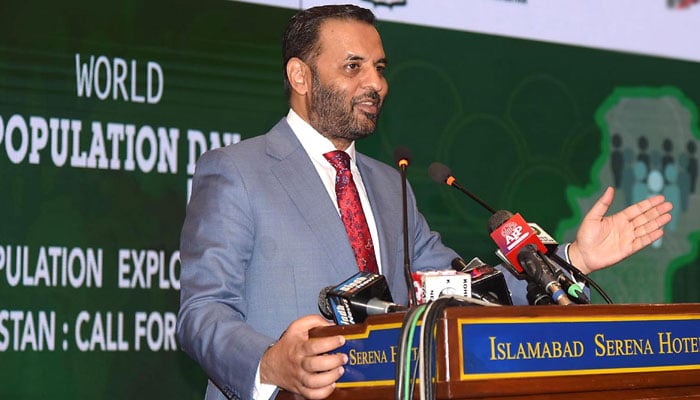
ISLAMABAD: Pakistan is producing more people than it can feed, educate, or treat — and unless urgent action is taken, the country’s economic future, social stability, and human development will collapse under the weight of unchecked population growth.
This was the central warning, issued by top political leaders, policymakers, and religious scholars on World Population Day 2025, observed in Islamabad at a high-level national gathering, organised by the Ministry of National Health Services, Regulations and Coordination.
Federal Minister for Health Syed Mustafa Kamal delivered a powerful keynote, declaring population growth not just a development issue, but a national emergency. “We’re adding more people annually than the population of New Zealand,” he said. “Two crore children are already out of school. Our hospitals look like public rallies, our doctors are overwhelmed, and our sewerage systems are collapsing. This is a national crisis, not a political debate.”
Kamal revealed that Pakistan’s fertility rate stands at 3.6 — the highest in the region — and highlighted its cascading impacts: 40pc of children suffering from stunted growth, 68pc of diseases linked to unsafe drinking water, and a healthcare system stretched far beyond capacity. “One doctor sees up to 250 patients a day instead of 35. Can any system survive like this?” he asked.
He highlighted the link between population and resource allocation, noting that 82pc of the NFC Award is distributed based on population. Kamal proposed that only 50pc of the award be tied to population, with the remaining 32pc used to reward provinces that manage to slow their growth rates. He also announced the formation of a National Task Force on population by Prime Minister Shehbaz Sharif to develop urgent, integrated policy solutions.
Finance Minister Muhammad Aurangzeb echoed the warning, listing population growth alongside climate change as the top two threats to Pakistan’s stability. “Food insecurity, poor sanitation, lack of clean water — they’re all tied to overpopulation,” he said, adding that a third of Pakistan’s 10-year partnership with the World Bank will now go toward population and climate mitigation efforts. “We are committed to working hand in hand with the Ministry of Health on this.”
Planning Minister Ahsan Iqbal said Pakistan has failed to reduce child stunting over the last 40 years due to fragmented efforts. “This is not just a health issue — it’s a national productivity issue. How will our children compete with the world if they are weak, underfed, and uneducated?”
Speaker of the National Assembly Raja Pervaiz Ashraf acknowledged that population pressure has been discussed for decades, yet concrete progress remains elusive. “We’ve failed to reach the villages with facts. We never involved our scholars or localized the message — and now the window is closing.”
Religious scholar Mufti Zubair offered a firm Islamic endorsement of family planning. “There is no contradiction between Islam and responsible parenthood. The health of mothers and children comes first. We need to speak this truth from every pulpit.”
Dr Tariq Fazal Chaudhary recalled how family planning campaigns once dominated Pakistani television — but now, with over 100 channels, the silence is deafening. “We’ve gone from action to apathy. Parliamentarians must lead again. The time for speeches has passed.”
UNFPA’s Country Representative Luay Shabaneh emphasized that international partners are fully aligned with Pakistan’s goals, but warned that rights-based family planning, women’s empowerment, and reproductive health must be prioritized across all policy sectors.
Khyber-Pakhtunkhwa’s Liaquat Ali Khan proposed a Population Fund and greater fiscal autonomy for provinces, while also referencing future projections that show Pakistan heading toward a demographic disaster by 2050 if the current trajectory continues.
The conference concluded with a firm resolve from the Ministry of Health to move beyond rhetoric. Federal Secretary for Health stated that the population crisis requires political will, bold reforms, and consistent public engagement — “because this is not about numbers anymore. It’s about survival.”
From rising poverty to shrinking public services, the consensus was clear: without slowing down its population engine, Pakistan’s development dream may never get off the ground.


