
Gen Sahir urges inclusive stability mechanisms
Gen Mirza raised alarm over India’s actions targeting civilian areas and its threats to abrogate IWT
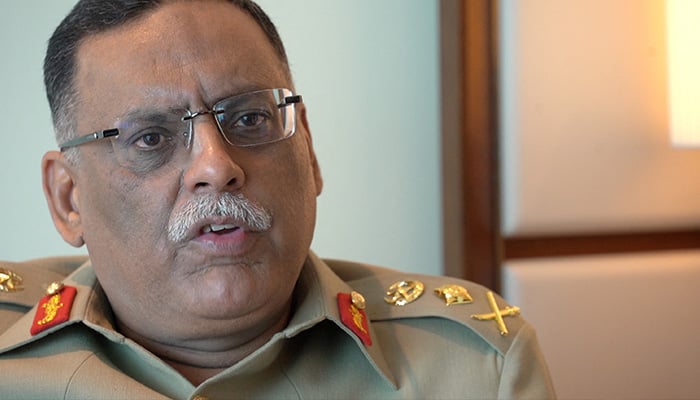
KARACHI: Chairman of Pakistan’s Joint Chiefs of Staff Committee, General Sahir Shamshad Mirza, delivered a wide-ranging and sobering address at the Shangri-La Dialogue in Singapore, warning of the growing risks of conflict in South Asia and emphasising the urgent need for inclusive, institutionalised crisis management frameworks across the Asia-Pacific and beyond.
In a strongly worded speech, Gen Mirza emphasised that strategic stability must be built on trust, restraint and mutual recognition of red lines, rather than dominance or exclusion. “Mechanisms cannot function in a vacuum of trust or amid systemic asymmetries”, he said, stressing that “inclusion is not optional” when it comes to regional security architectures.
Gen Mirza’s remarks came during the prestigious annual security summit, which brings together defence ministers, military leaders and security experts from across the world. Representing Pakistan, Gen Mirza made it clear that both the Asia-Pacific and South Asia face escalating security threats -- driven by power rivalries, lack of dialogue and the failure to resolve long-standing disputes.
Focusing on South Asia, Gen Mirza pointed to the region’s “looming threat of a global scale”, referencing the unresolved Kashmir dispute, worsening India-Pakistan-China dynamics, and Afghanistan’s persistent instability. He warned that nuclearisation has increased the risk of strategic miscalculation, and that functional communication channels are essential in the face of rising tensions.
He criticised India’s growing militarisation and its perceived emboldenment by Western support, stating that “India’s ambition to become a regional hegemon is disincentivising it to engage in conflict management options.”
Referring to the recent Pakistan-India crisis, Gen Mirza warned that the threshold for war between India and Pakistan has dangerously lowered, posing grave risks to the region’s 1.5 billion people. He also raised alarm over India’s actions targeting civilian areas and its threats to abrogate the Indus Waters Treaty, calling such moves “existential threats” to Pakistan and potentially “acts of war”.
“Pakistan has always preferred negotiated and diplomatic solutions”, he said, while reaffirming Islamabad’s position that peace with India must be based on mutual respect, sovereign equality and dignity.
On the broader Asia-Pacific region, Gen Mirza described a trend of rising militarisation and great power contestation. He noted that regional security continues to be shaped by extra-regional powers, with few organic structures in place to manage crises or mediate disputes.
He warned that without local ownership, external security frameworks would lack credibility. “Mechanisms transplanted into this region from outside will not have local respect and recognition”, he said.
Yet, he expressed cautious optimism, acknowledging efforts underway in the Asia-Pacific to improve cooperation and communication. He urged regional states to “move beyond conflict management towards conflict resolution” and to revitalise existing bilateral, regional and multilateral structures, rather than invent new ones.
Gen Mirza offered a pointed critique of the global security environment, noting how “power and interests, not morality or principles, now reign supreme.” He cited the erosion of values such as state sovereignty and international law, and warned that multilateralism is being replaced by “myopic mini-lateralism.”
Amid this backdrop, he stressed the need for institutionalised crisis protocols, pre-agreed deconfliction procedures and joint exercises to avoid miscalculation. The spread of emerging technologies such as AI and cyber tools, he said, is further shrinking the decision-making window and complicating deterrence dynamics.
“Strategic communication matters”, Gen Mirza stressed, adding that “misconception, narrative warfare and information distortion are the oxygen for escalation.”
Gen Mirza reiterated Pakistan’s long-standing position on Kashmir, calling for a resolution in line with United Nations Security Council resolutions and the aspirations of the Kashmiri people. He called it essential for ensuring lasting peace in South Asia.


