
Balancing automation and employment in textile industry
LAHORE: As value addition increases and more advanced technology is integrated into the textile sector, the number of workers required for specific tasks generally decreases. Automation, computerised machinery and efficient production techniques reduce the need for manual labour while enhancing precision, speed and quality.
The global textile industry employs over 70 million workers. India, ranked fifth in global textile exports, has the highest number of textile workers, with 35 million people employed in the sector. In contrast, Germany, the world’s second-largest textile exporter, employs just over 120,000 workers.
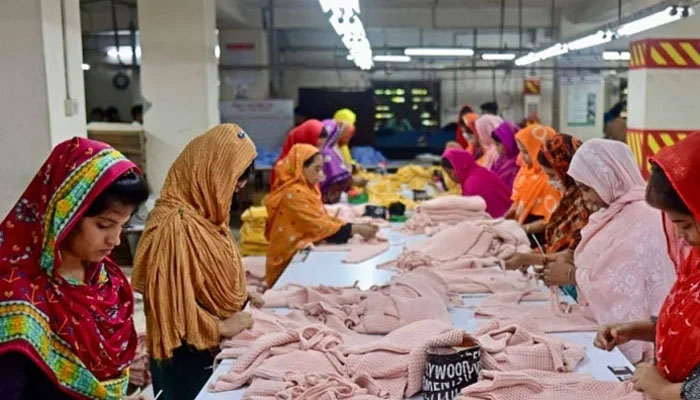
The level of automation required varies across different subsectors of textiles. Basic textile manufacturing (spinning, weaving and knitting) is highly automated in most countries, requiring fewer workers per unit of output. Processing and dyeing are also increasingly automated but still require skilled operators. Garment manufacturing, however, remains labour-intensive, as cutting, stitching and finishing are difficult to fully automate, especially in the fast fashion segment.
Bangladesh and, following the rupee devaluation, Pakistan have some of the lowest labour costs globally, estimated at $100-$110 per month. This makes manual processes more viable, as automation may not always be cost-effective compared to cheap labour. Automation is more logical in regions where labour is expensive, such as Europe and China, which is steadily moving towards automation.
Balancing automation with job creation in Pakistan’s textile sector requires a strategic approach to ensure productivity gains without causing mass unemployment. Textile industry players should segment automation by product category. Instead of focusing on high-end brands, they should target the mass market (fast fashion), which is more labour-intensive and creates employment opportunities.
On the other hand, high-end technical textiles (such as sportswear and medical textiles) require automation to achieve precision, quality, and high investment returns. Pakistani entrepreneurs should adopt a hybrid approach, integrating automation in areas such as cutting, dyeing, and finishing, while keeping stitching largely manual to sustain employment.
Rather than implementing full-scale automation, Pakistan can adopt semi-automated machines that enhance productivity without eliminating jobs. For instance, AI-assisted sewing machines can improve speed while still requiring human operators. Similarly, digital printing and dyeing can reduce water wastage and labour reliance in traditional dyeing processes. Automated fabric cutting can be introduced while manual stitching remains dominant.
Upskilling the existing workforce is essential to minimise job displacement and transition workers into higher-paying, technology-integrated roles. Vietnam successfully upskilled its workforce for semi-automated textile production while simultaneously increasing wages.
The government should encourage small-scale garment manufacturers to produce value-added, handmade or customised textiles instead of focusing solely on mass production. Incentives should be introduced for companies that invest in worker training rather than resorting to layoffs. Technology adoption should be subsidised in a way that preserves jobs rather than simply reducing labour costs.
Among the world’s top ten textile exporters, five are from Asia -- China, Bangladesh, Vietnam, India, Indonesia and Hong Kong -- while four are from Europe: Germany, Italy, Turkey and Spain. The United States is the only representative from the Americas.
Although the bulk of global textile and clothing exports (by volume) originates from Asia, European and US exporters generate higher export proceeds per unit. The majority of employment in the textile industry is concentrated in Asian countries. China, the world’s largest textile exporter, employs 15 million textile workers -- less than half the number employed in India’s textile sector. Bangladesh’s textile labour market consists of over four million workers, with women making up approximately 85 per cent of the workforce.
Indonesia’s textile industry is one of the largest in the world, employing over 2.5 million people. Meanwhile, the US textile industry supply chain—from textile fibres to apparel and other sewn products -- employed 110,000 workers in 2021. In Pakistan, the number of textile workers stands at 2.5 million.
Germany, which exports more textile products than Bangladesh, India, or Indonesia, has wages that are ten times higher than those in these countries. However, it employs 18 times fewer workers than Indonesia, 32 times fewer than Bangladesh, and 315 times fewer than India. This disparity highlights the power of technology and worker efficiency in the textile sector.


