
‘Excessive regulation’ could ‘kill’ AI sector: US VP Vance
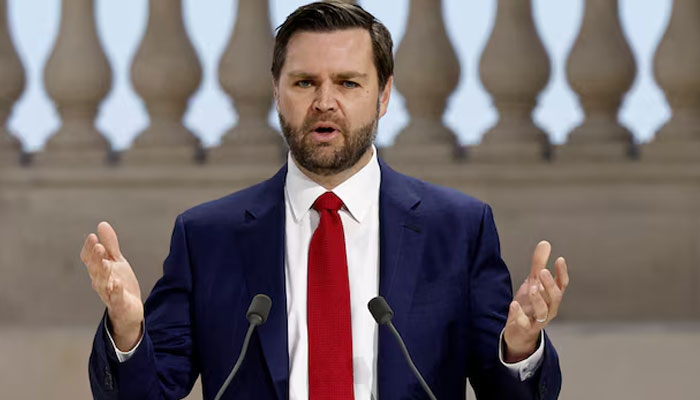
PARIS: US Vice President JD Vance on Tuesday warned against “excessive regulation” of artificial intelligence at a Paris summit on the technology, warning both European allies and rivals like China against tightening governments´ grip.
“Excessive regulation of the AI sector could kill a transformative sector just as it´s taking off,” Vance told global leaders and tech industry chiefs in the opulent surroundings of the French capital´s Grand Palais.
He singled out the European Union´s Digital Services Act by name for criticism over “massive regulations it created about taking down content and policing so-called misinformation” that he said placed an unfair burden on American tech giants.
Vance also jabbed at China as one of several “authoritarian regimes” he said were looking to use AI for increased control of citizens at home and other countries abroad.
“Partnering with them means chaining your nation to an authoritarian master that seeks to infiltrate, dig in and seize your information infrastructure,” Vance said.
He pointed to “cheap tech... heavily subsidised and exported by authoritarian regimes”, referring to surveillance cameras and 5G mobile internet equipment widely sold abroad by China.
European lawmakers last year approved the bloc’s AI Act, the world’s first comprehensive set of rules governing the technology.
Vance is leading the American delegation at the Paris summit. He left just after his speech, without listening to European Commission chief Ursula von der Leyen, who spoke right after him, or French President Emmanuel Macron, who gave the closing speech. He later met separately with each, for talks.
In his speech, Vance also appeared to take aim at China at a delicate moment for the US technology sector.
Last month, Chinese startup DeepSeek freely distributed a powerful AI reasoning model that some said challenged US technology leadership.
“From CCTV to 5G equipment, we’re all familiar with cheap tech in the marketplace that’s been heavily subsidised and exported by authoritarian regimes,” Vance said.
But “partnering with them means chaining your nation to an authoritarian master that seeks to infiltrate, dig in and seize your information infrastructure,” he added.
Vance did not mention DeepSeek by name. There has been no evidence that information could surreptitiously flow through the startup’s technology to China’s government, and the underlying code is freely available to use and view. However, some government organisations have reportedly banned DeepSeek’s use.
Macron told the summit he was in favour of trimming red tape, but stressed that regulation was needed to ensure trust in AI, or people would end up rejecting it. “We need a trustworthy AI,” he said. Von der Leyen also said the EU would reduce bureaucracy and invest more in AI.
The United States and Britain did not immediately explain why they had not signed the AI Summit’s declaration, as shown by a published text, while at least 60 countries including China had done so.
Chinese Vice Premier Zhang Guoqing told the summit that China was willing to work with other countries to safeguard security and share achievements in the field of artificial intelligence to build “a community with a shared future for mankind”.
A source close to organisers said they were not surprised that the United States had not signed, considering their stance on regulation.
A British government source cited concerns about some of the language which Britain could not get changed, and said the approach agreed at the Paris summit was “pretty different” to the first AI Safety summit, which was hosted by Britain in 2023.
“Clearly from JD Vance’s speech, the US policy has an unequivocal shift now,” said Russell Wald, executive director at the Stanford Institute for Human-Centered Artificial Intelligence.
“Safety is not going to be the primary focus but instead it’s going to be accelerated innovation and the belief that the technology is an opportunity, and safety equals regulation, regulation equals losing that opportunity.”
Dario Amodei, chief executive of the OpenAI competitor Anthropic, which has aimed to distinguish its work as more safety-focused, said the summit represented a “missed opportunity” to address supply chain controls, AI’s security risks and expected labour market disruption.





-
 Margaret Cho Finally Reveals Why She Turned Down 'Heated Rivalry' Role
 -
 Hailey Bieber Melts Hearts With Sweet Video Of Son Jack Blue
 -
 Mauricio Umansky Addresses Lala Kent's Claim He Slid Into Her DMs: 'She's A Liar'
 -
 Xi, Trump Hold Friendly Talks As US-China Summit Begins
 -
 Jennifer Lopez Makes Rare Remark About 'Office Romance' Co-star Brett Goldstein
 -
 Late 'Storage Wars' Star Darrell Sheets Receives Emotional Birthday Tribute From Son Brandon
 -
 Kate Middleton Gets Lauded To ‘international Stage’ Representation
 -
 Kate Middleton Shares ‘storytelling’ Glimpses From Time In Italy
 -
 Prince Harry Breaks Silence On Anti Semitic Attacks In Britain
 -
 FIFA World Cup: US Waives Visa Bonds Of Up To $15,000 For Ticket Holders
 -
 Meet Kevin Warsh—The New Fed Chair Confirmed By The US Senate
 -
 Kate Middleton To Italy Trip Could Be Vital For Cancer Recovery
 -
 Prince George Hesitates In Front Of Royal Super Fans
 -
 OpenAI Chief Sam Altman’s Investments Draw Scrutiny In Musk Lawsuit
 -
 King Charles See Driving As ‘sense Of Freedom,’ Says Ex Aide
 -
 How King Charles Leaves Princess Charlotte ‘spellbound’