
Reshaping the labour market
In Pakistan, approximately 17% of jobs, in sectors like customer service, manufacturing, and agriculture, are considered at high risk of automation
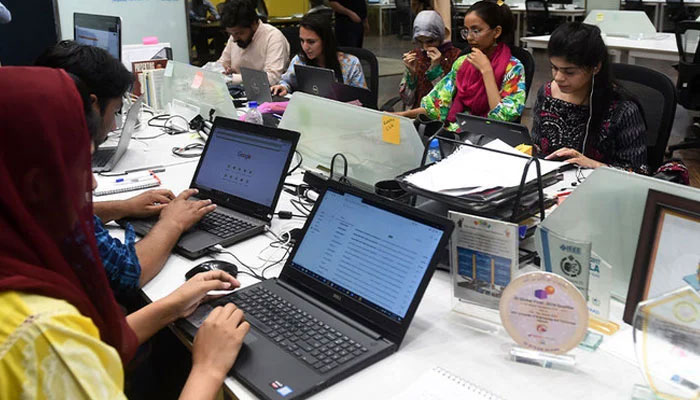
The government of Pakistan recently inaugurated the National Economic Plan (2024-29) under the name of ‘Uraan Pakistan’. The plan, among other things, envisages tackling unemployment and underemployment and creating one million jobs annually.
At a time when emerging technologies, such as artificial intelligence (AI), robotics, and the Internet of Things (IoT), make a significant leap forward, and experts continue to forewarn of their disruptive impact on the labour market, one important question that emerges is: how can employment growth be fostered in this era of transformative change?
In Pakistan, approximately 17 per cent of the jobs, specifically in sectors like customer service, manufacturing, and agriculture, are considered at a high risk of automation. This percentage is likely to increase further as new technological advancements unfold. Unlike a few years back, many Pakistanis also seem willing to accept that advanced automation will lead to job redundancies across various work categories. These specifically include those characterised by predictable and repetitive processes, such as administrative and clerical work, basic content writing, repetitive manufacturing tasks, customer service representation or accounting and auditing.
However, one narrative that still prevails is the ‘too soon to worry’ argument – the idea that automation is unlikely to pose a significant risk to local jobs in the next few years, as penetration of emerging technologies in Pakistan is still limited compared to many other countries across the world.
It is indeed true that advanced automation across various industries in Pakistan is relatively low. Much like in many developing countries, there aren’t prominent examples yet of automated warehouses or stores (like Amazon Go in the US), AI-driven autonomous public transport systems (like the Dubai Autonomous Metro), AI-enhanced healthcare robots (like the Apollo Hospitals’ Robotic Systems), large-scale AI traffic management systems (like the Automated Traffic Surveillance and Control System in Los Angeles), or restaurants staffed by robot chefs (like the BOTS&POTS Sci-Food bistro in Croatia), among others.
However, prospects for accelerated automation in the coming years cannot be underestimated. AI market size in Pakistan is expected to show a Compound Annual Growth Rate (CAGR) of 27.76 per cent from 2025 to 2030, while the AI robotics market is expected to record a CAGR of 24.14 per cent. To put this into perspective, the global AI market and the AI robotics market are projected to show an almost similar CAGR of 27.67 per cent and 23.37 per cent, respectively, during the period.
What’s more, revenue in the overall robotics market in Pakistan is expected to show an annual growth rate of 17.17 per cent from 2025 to 2029 compared to 9.49 per cent globally. Revenue in the industrial IoT market is expected to exhibit a growth rate of 9.59 per cent compared to 13.34 per cent globally. As the penetration of these technologies across various industries increases, more and more jobs in the country that humans do are very likely to be replaced by machines and algorithms.
If one talks about Pakistan’s gig economy, or more specifically, the freelance industry, the impacts of advances in AI on the workforce are already visible. Discussions on employment are incomplete without mentioning this industry, as over 1.5 million Pakistanis are engaged in freelancing, making the country among the largest freelance markets in the world. The government’s recent economic plan has also emphasised leveraging the role of ICT in creating employment opportunities, particularly for youth, women and the marginalised.
Conversations with freelancers reveal that some of them are already experiencing a large drop in bids, as AI is now able to perform many tasks, from creating artistic and realistic images and generating videos with voiceovers to writing complex codes and handling text translations.
Implementing solutions early in the transition is crucial. Much like technological advancements throughout history, the current wave of automation, while putting some occupations at risk, will simultaneously generate new opportunities in the labour market. However, without adequate policy measures, not all population groups would be able to benefit equally from the opportunities, even if those outweigh the number of jobs eliminated by automation.
According to the World Economic Forum (WEF), in the near future, automation is likely to increase demand for AI and machine learning (ML) specialists, big data experts, IoT specialists, information security analysts, robotics engineers, data analysts and scientists, agricultural equipment operators and experts, process automation professionals, and digital transformation specialists, to name a few.
Ensuring that those without specialised academic degrees in these fields can also benefit from the emerging opportunities will require implementing large-scale training and upskilling/reskilling programmes targeting sectors most likely to be affected by automation and developing industry-recognised certification programmes in these domains.
Organisations and industries should be encouraged to adopt competency-based hiring practices and collaborate with vocational training centres to provide on-site skill development plans tailored to their needs. Self-employment opportunities should also be promoted by offering microloans and training, specifically for forward-thinking entrepreneurial initiatives. The way forward is to embrace emerging technologies rather than approaching them with fear and suspicion, while simultaneously devising and implementing proactive strategies to manage and mitigate their risks.
The writer is a research assistant at the Centre for Aerospace & Security Studies (CASS), Islamabad. She can be reached at: cass.thinkers@casstt.com


