
New generation must take up fight against nuclear weapons, says Nobel laureate group
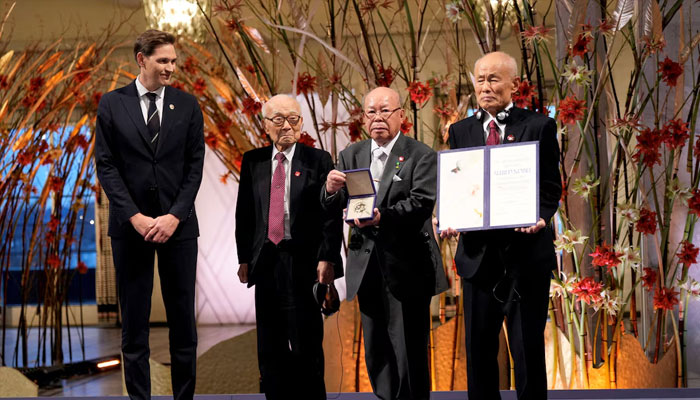
OSLO: Young people must take up the fight for a nuclear-free world, with such weapons many times more powerful than in the past, a representative for this year’s Nobel Peace Prize laureate, atomic bomb survivors’ group Nihon Hidankyo, said on Tuesday.
Nihon Hidankyo, a grassroots movement of survivors of the 1945 nuclear bombings of Japanese cities Hiroshima and Nagasaki, is campaigning for a world free of nuclear weapons using witness testimony.
The average age of Japan’s atomic bomb survivors is now 85, Terumi Tanaka, a co-chair of the group, said when accepting the prize at a ceremony held at Oslo City Hall attended by Norway’s King Harald, Queen Sonja and other dignitaries.
“Any one of you could become either a victim or a perpetrator, at any time,” Tanaka, 92, told the audience.
“Ten years from now, there may only be a handful of us able to give testimony as firsthand survivors. From now on, I hope that the next generation will find ways to build on our efforts and develop the movement even further.”
His group had “undoubtedly” played a major role in creating the worldwide standard that it was unacceptable to use atomic weapons, or ‘nuclear taboo’, he said. But that standard was being weakened, he added.
“In addition to the civilian casualties, I am infinitely saddened and angered that the ‘nuclear taboo’ risks being broken,” he said.
Threats to use nuclear weapons had been made in the ongoing wars in Ukraine and Gaza, Tanaka said, warning that 4,000 nuclear warheads were ready to be launched immediately around the world.
Nihon Hidankyo is also represented at the ceremony by its two other co-chairs, Shigemitsu Tanaka, 84, and Toshiyuki Mimaki, 82.
An estimated 210,000 people died, either immediately or over time, as a result of the bombs dropped in 1945 on Hiroshima and Nagasaki on Aug 6 and Aug 9, respectively. Today’s nuclear weapons are far more powerful than those used at that time.
Tanaka was 13 years old at the time of the Nagasaki bombing, and although he survived the explosion almost unharmed at his home some 3-kms from ground zero, he lost five family members and recalled harrowing encounters.
“The deaths I witnessed at that time could hardly be described as human deaths. There were hundreds of people suffering in agony, unable to receive any kind of medical attention,” Tanaka told the audience. “I strongly felt that even in war, such killing and maiming must never be allowed to happen.”


