
Does SC order pull the plug on amendment push?
Top court judges criticise the ECP for allegedly trying to create confusion about the SC’s July 12 ruling
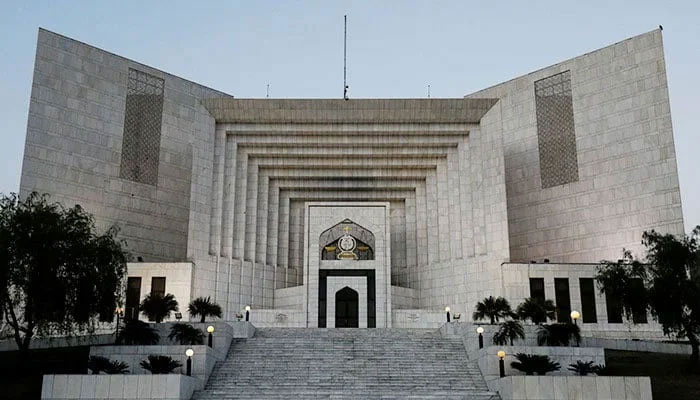
KARACHI: Legal experts say the Supreme Court’s Saturday order can be seen as a ‘constitutional showdown’ between the ECP and the apex court, and will make the passing of a constitutional amendment difficult while also bringing certain MNAs under Article 63A, potentially exposing them to consequences for floor crossing or voting against the party line.
On Saturday, eight judges of the Supreme Court issued a written order or clarification criticizing the ECP for allegedly trying to create confusion about the SC’s July 12 ruling that declared the PTI eligible for reserved seats in parliament, saying that the ECP’s request for clarification was an attempt to delay implementing the decision. The ECP had previously notified 39 out of 80 PTI members of the National Assembly and sought further guidance regarding other lawmakers. The July 12 ruling, passed by an 8-5 majority, had overturned the Peshawar High Court’s decision that had denied reserved seats to the PTI.
Saturday’s order also came a day after reports said the government was planning to table a set of judicial reforms, rumoured to include a provision to extend the retirement age of superior court judges.
For Barrister Rida Hosain, Saturday’s order is “another damning indictment of the ECP’s conduct”. Explaining that the court noted that “in numerous documents, the ECP itself recognised Barrister Gohar Ali Khan as the PTI chairman”, she adds that the SC has found that “the ECP took shifting stances, adopting various positions to suit its immediate purpose”. Crucially, says Hosain, “the SC held that the returned candidates who filed their certificates were deemed to be PTI candidates upon filing of such certificates. The ECP’s inaction has no substantive effect, and the ECP’s role was simply a ‘ministerial’ one.”
Lawyer Abdul Moiz Jaferii agrees with the SC’s finding and says that “it is clear that there is a deliberate delay and design to frustrate here. The court has noted this and clarified that all the paperwork related to notifying members by the ECP was just that: mere paperwork. The decision that they belong to the PTI has already been made and the court has now further clarified that these individuals are deemed to belong to the PTI.”
But perhaps the most important part of Saturday’s written order is -- as Jaferii says -- that “any attempt now to turn these members, to coerce them or cajole them has been rendered naught. Their votes won’t count and the government doesn’t have the numbers to ensure that October doesn’t bring a change of chief justice.”
This refers to the much-talked-about ‘constitutional package’ the government is hoping to get passed, some say with the help of ‘PTI members’. By most accounts, Saturday’s order may just have defeated that attempt by placing voting parliamentarians in the cross-hairs of Article 63A.
Says high court advocate Hassan Abdullah Niazi, “the SC’s clarification leaves very little ambiguity within which the ECP and the government can manoeuvre” with the most salient part being “the court’s stance that once the independent candidates filed their affidavit of affiliation with the ECP they became the PTI’s members of parliament. The ECP cannot alter this fact.”
What does this mean? Niazi explains that “these parliamentarians are now bound by party discipline on matters where Article 63A of the constitution applies -- this includes a constitutional amendment. If they vote against the party line, then that vote will not be counted.”
According to Supreme Court advocate Basil Nabi Malik, the SC “has attempted to frustrate a very apparent attempt by the executive, and those behind it, to scuttle the effects of its judgment. And frankly, it is doing so as openly and blatantly as were the attempts to render its verdicts redundant. The effect, it appears, is in making the passing of a constitutional amendment difficult, if not unlikely. Additionally, this order also seemingly brings certain MNAs potentially in the crosshairs of Article 63A of the constitution, thereby possibly exposing them to consequences connected with floor crossing and/ or voting against the party line.”
All this has the making of “what is known as a ‘constitutional showdown’ between the ECP and the Supreme Court”, says Niazi who feels that “the only resolution to this is for one side to back down -- so far, the Supreme Court has shown that it is unlikely to be the one to do so.”
Summarising the entire situation, Malik asks: “What happens when the constitution becomes a tool to benefit oneself at the expense of others, by hook or by crook?” His answer: “You get blowback, and blowback which may appear unconventional, but for which blame cannot be attributed to anyone but yourself.”


