
India takes another hit
Bangladesh becomes another case of growing sentiments against New Delhi in region after Hasina's ouster
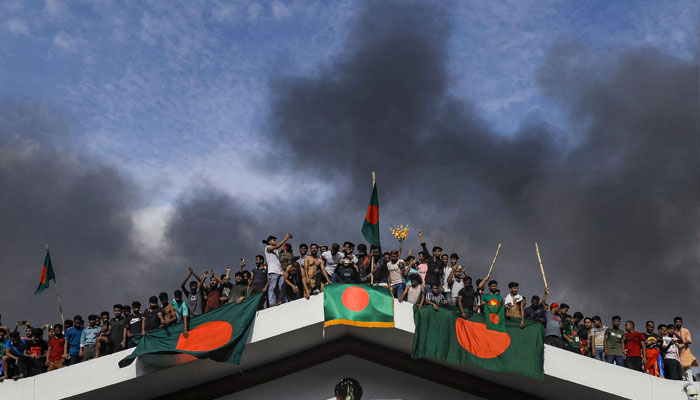
India’s regional approach is lagging and is not being able to deliver its desired outcome. After Maldivian President Muhammad Muizu’s victory based on an India Out campaign and Nepal’s resentment due to the controversial mural installed in the Indian parliament, Bangladesh has become another case of growing anti-India sentiments in the region.
India has boasted its so-called ‘neighbourhood policy’ which attempts to dominate neighbouring states in its desire to act as a regional hegemon. However, the events that unfolded on August 5 in Dhaka demonstrate that these neighbouring states reject this kind of politics of dominance by India.
Sheikh Hasina, a close friend of India and Bangladesh’s ruler for the past 15 years, was ousted from power by student protesters who flooded the streets of Dhaka for weeks demanding civil service quotas. After her drastic death-dealing orders that killed 450 people, Hasina was forced to flee to India on a helicopter as protesters stormed her residence. This was a ‘nightmare for New Delhi’, say Indian analysts.
Historically, India has maintained an overbearing influence on Bangladesh since it provoked the dismemberment of East Pakistan (now Bangladesh) in 1971. India maintained its supremacy over its ties with Sheikh Mujibur Rehman and then his daughter Sheikh Hasina.
Despite her growing unpopularity, Indian Prime Minister Narendra Modi continued his relentless support for Sheikh Hasina since she first took office in 2009. On her historic fifth term in office on January 7, 2024, PM Modi welcomed Sheikh Hasina as the first state guest after he was reelected for the third time. This shows the significance and priority India gave to maintaining a favouring leader in Bangladesh.
However, this support was to use the country as a strategic backyard. Hasina’s resignation from office means India loses a pro-India ruler in the region, ultimately damping India’s influence in the region. It also demonstrates that the people of Bangladesh reject India’s meddling in their country.
India is now looking for a scapegoat by pinning the blame for its loss of a supportive leader in Bangladesh on the US, China and Pakistan. India believes it is one of the US’s ways to get back at it for its mounting blunders under the so-called strategic autonomy and its growing ties with Russia. India speculates that both the US and China are trying to destabilize it by destabilizing the region. For China, Dhaka’s fall is a way to swoop into Bangladesh to enhance its footprint, per India. On Pakistan, India thinks this is a way to take revenge for 1971.
Analysts believe that whether or not external forces had any role in Dhaka’s fall remains unclear and it takes decades to unveil such information. Regardless, India has no one to blame but itself for turning a blind eye to the brewing resentment. It is India’s own failure; it continuously endorsed Hasina’s government when the people and political parties of Bangladesh did not. During the last elections, even the opposition party boycotted the elections, showcasing the tyranny of Hasina’s stronghold on the country.
The people of Bangladesh have not favoured India much and now India fears that Bangladesh could be another anti-India country in the region. Regardless of the truth in these speculations, India’s options are limited in the region now.
India cannot afford to abandon the new setup in Dhaka. However, it remains unlikely that it will be able to seek goodwill from the new Bangladeshi governing setup and its people. Especially as long as it provides refuge to Hasina. Things could get worse if Hasina continues her politics from India.
India would be sandwiched between Bangladesh on the west, China on the north and Pakistan on the east. Souring ties with Nepal, Maldives and Myanmar also add to New Delhi’s worries. India has deliberately derailed Saarc, a platform that could have provided for effective regional cooperation. Likewise, India’s weak structure and internal disputes are derailing the BIMSTEC.
The people of Bangladesh, Nepal and Sri Lanka say New Delhi can contribute to stable polities and long-lasting peace in South Asia by abandoning its overt and covert interference in the internal affairs of its neighbours. They say that India’s interference weakens neighbouring democracies and contradicts the principle of peaceful coexistence once advocated by India while also going against the Modi government’s much-publicized ‘Neighborhood First’ policy. This implies that there is a simmering criticism against India’s illusion of smoothly orchestrating its politics of dominance in South Asia.
This shows that India’s regional policy failures are mounting due to its desire for an upper hand in relations rather than treating others as equal and sovereign nations. These failures dictate that New Delhi must revise its regional policies to support cooperative, stable and good neighbourly relations with all South Asian states.
The writer is a research analyst in emerging technologies and
international security. She tweets/posts @MaheenShafeeq


