
Azm-e-Istehkam operation: Terrorist hideouts may be hit on Afghan soil, says minister
"Reservations on Azm-e-Istehkam will be addressed and discussed in parliament," says defence minister
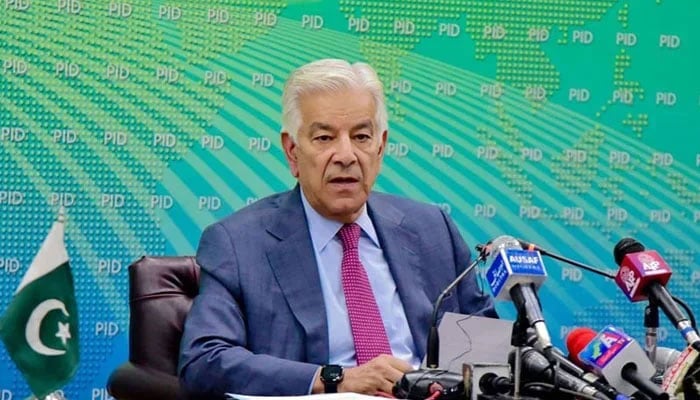
ISLAMABAD: Defence Minister Khawaja Muhammad Asif has said that under the Operation Azm-e-Istehkam, Pakistan could target terrorist hideouts across the border in Afghanistan.
In an interview with the Voice of America (VoA) on Thursday, he explained that the decision for Operation Azm-e-Istehkam was not made hastily. However, he acknowledged a political environment where parties are reluctant to give space to the government decisions.
Asif promised that any political parties’ concerns about the operation would be addressed, and the government would bring the matter to the assembly to answer questions and build trust among members.
The minister dismissed the possibility of negotiations with the banned TTP, stating, “There is no ground for dialogue.” He questioned the success of the PTI government’s reintegration of 4,000 to 5,000 TTP militants, asking, “If that experiment was successful, let us know so we can follow suit.”
Asif claimed the previous operations were successful, with the Pakistan armed forces being the main stakeholders then and now. However, he criticised successive civilian governments for failing to play their part post-operation.
Kh Asif expressed the desire to engage with the opposition and all political parties to ensure the success of Operation Azm-e-Istehkam, informing them of its contours. He noted the cabinet had approved the operation and discussions could take place in the assembly or an all-parties conference.
He observed that the Chief Minister of Khyber-Pakhtunkhwa, Ali Amin Gandapur, had not opposed the operation at any stage. The decision was driven by economic difficulties and was aimed at targeting the TTP hideouts across the border because, as Asif stated, “Nothing is more important than the country’s integrity.”
Asif justified targeting terrorist sanctuaries in Afghanistan, arguing it does not violate international laws since terrorism was being exported to Pakistan from there. He blamed the 4,000 sleeper cell members brought back on Imran Khan’s orders for spreading unrest in Pakistan. He said Pakistan had decided to stringently enforce international laws at its borders with Afghanistan to restrict the influx of militants and smuggled goods into the country.
The government seeks not only to curb economic losses caused by the smuggling of oil, fertilizer, and other goods from Afghanistan into Pakistan but also to thwart the infiltration of terrorists, avert potential breaches and implement security checks at the borders.
“All traffic from Afghanistan will only be allowed entry into Pakistan with a valid passport and visa,” Asif told Geo News, hinting at the end of the longstanding practice of Afghans entering Pakistan without proper documentation. “We must secure our country, and these crossing points have been compromising our security,” the defence minister said.
He pointed out that after the withdrawal of US troops from Afghanistan, there had been a spike in terrorism, with most incidents tracing back to the Afghan soil. “Currently, all terrorism is emanating from the Afghan territory.” Asif said that formal borders, where passports were required for crossing, were a standard global practice, noting that despite Pakistan’s repeated requests for cooperation, Kabul was yet to respond adequately. “Our borders with China, Iran, and India operate with strict regulations and it should be the same with Afghanistan,” he asserted.
Replying to a question, Kh Asif said they were cognizant of the fact that there were families on both sides of the Pakistan-Afghanistan border. Rationalising the decision to implement visa and passport restrictions, he compared them to the families divided in Kashmir since the Partition of the Subcontinent.
Addressing other divided borders, Kh Asif mentioned that similar issues exist along the Sialkot borders with India and the working boundary, where families are split.
Responding to recent comments by Jamiat Ulema-e-Islam-Fazl (JUIF) chief Maulana Fazlur Rehman, the defence minister said he respected the Maulana but did not agree with his statements on China. “I accompanied Prime Minister Shehbaz Sharif on his visit to China, and I was present during his meetings with the Chinese president and prime minister. China’s commitment to cooperation with Pakistan is unequivocal,” Asif said, making it clear that no one should have any confusion about it.
“I have verified that Maulana [Fazl] has not had any recent discussions with any diplomat. I believe he is mistaken, and we are ready to furnish him with complete information on China’s cooperation and assurances,” Asif added. Terming the prime minister’s visit to China a success, Asif said the revival of the China-Pakistan Economic Corridor (CPEC) was a testament to Beijing’s commitment. “There are certain strategic matters that cannot be made public; however, the prime minister’s recent visit to Beijing has strengthened Pak-China friendship and relations further,” Asif concluded.


