
Bhutto’s legacy
With his exemplary courage, Bhutto proved his saying right that he would never shy away from laying down his life for the cause of the nation and his people
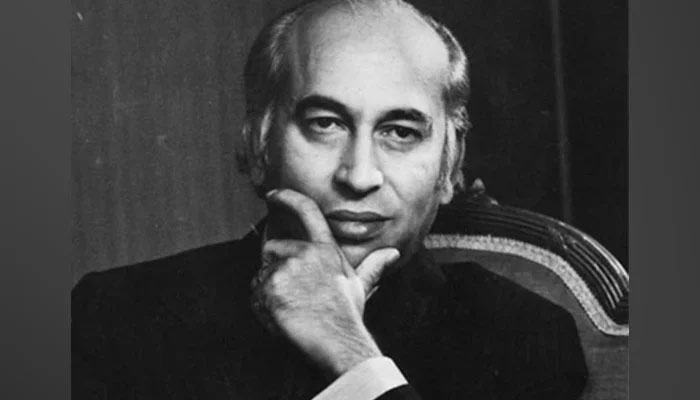
April 4, 1979 was the day of the judicial murder of the elected prime minister of Pakistan, Zulfikar Ali Bhutto. This was based on a split 4-3 court decision and remains the darkest and most brutal chapter of our history.
A dictator, in his quest for personal rule, was determined to make a horrible example of a popular leader who ruled the hearts of the people of Pakistan. Bhutto was subjected to months of abuse and humiliation in dark prison cells before his execution, but the brave leader remained defiant and refused to give up his principles for his life.
With his exemplary courage, Bhutto proved his saying right that he would never shy away from laying down his life for the cause of the nation and his people.
The judicial murder of an elected prime minister drew strong condemnation from around the world. In his short life, Bhutto left an un-erasable footprint on the global stage. Even today, his contributions to the progress of Pakistan are revered and remain matchless.
Zulfikar Ali Bhutto took the reins of a divided nation after the fall of Dhaka in 1971. The separation of East Pakistan had largely encouraged vested interests who were against the very existence of Pakistan, and they were anticipating and awaiting the further division and destruction of the country, which was very much in sight.
Bhutto changed all that and achieved even more. He soon inspired and revitalized a defeated nation, and made it rise again within a few years. He gave the people of Pakistan a sense of security and put to rest all doubts about the integrity and viability of Pakistan as a united, independent country.
On December 8, 1973, just two years after the formation of Bangladesh, the New York Times rightly noted that Pakistan had regained its health from the injuries of the 1971 war, and that Zulfikar Ali Bhutto was an able politician who gave the country its constitution and democratic institutions. The paper further noted that Pakistan, two years after the war with India, had won the war of wits and was successful in getting thousands of its prisoners back.
The New York Times also commented that Pakistan appeared to be the most hopeful and stable nation in the Subcontinent, and credit for these achievements went to prime minister Zulfikar Ali Bhutto.
He brought back more than 93,000 prisoners of war, ended their trials for war crimes, and freed 5,000 square miles of lost territory from India. Under Bhutto, Pakistan had become one of the most stable and promising countries in South Asia. Pakistanis could again take pride in their nation and could exude confidence, as was evident during the Islamic Conference of Lahore.
Bhutto made historic achievements on the global front as well. The Islamic Conference in 1974 instilled a new sense of unity and shared destiny among Islamic nations, and spearheaded the Muslim Ummah into a new era of friendship and cooperation.
April 4, 1979 will forever remain etched in our memory. With his exemplary sacrifice and martyrdom, Zulfikar Ali Bhutto gave us his final lesson, which was to never compromise on principles and to never shy away from any sacrifice for the progress and prosperity of our nation.
This year’s commemoration is special because recently, Pakistan’s Supreme Court’s unanimous ruling acknowledged that Mr Bhutto was not given a fair trial in a murder case that led to his hanging. It took nearly 44 years, but the courts have finally endorsed what legal experts have deemed a judicial murder. The decision came in response to a reference filed by Mr Asif Ali Zardari, the current president and son-in-law of Mr Bhutto.
Those who wanted to erase Bhutto’s name must be disappointed because his name lives on and his work is being carried forward by his grandchildren.
Bilawal has already served as the foreign minister of Pakistan, and Aseefa has recently been elected as a member of the National Assembly. Bhutto’s legacy lives on.
The writer is the former press-secretary for Benazir Bhutto.


