
SC to hear ECP plea against PHC verdict on ‘bat’ today
A three-member bench of apex court headed will hear electoral body’s appeal
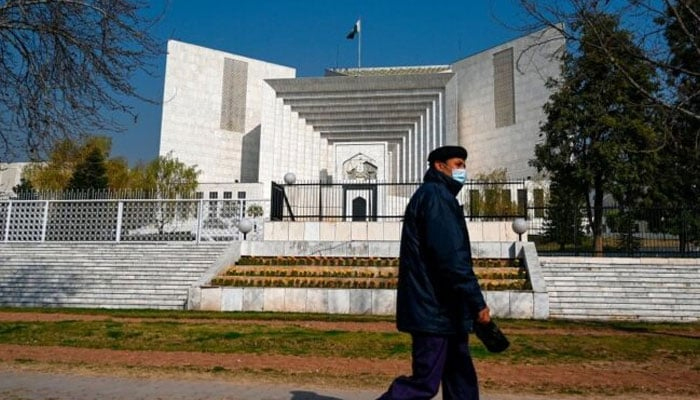
ISLAMABAD: The Supreme Court will take up today (Friday) appeal of Election Commission of Pakistan (ECP) against the order of Peshawar High Court (PHC) restoring the cricket bat as the electoral symbol of Pakistan Tehreek-e-Insaf (PTI).
A three-member bench of the apex court headed by Chief Justice Qazi Faez Isa and comprising Justice Muhammad Ali Mazhar and Justice Musarat Hilali will hear the electoral body’s appeal. A two-member bench of the PHC on Wednesday overturned the ECP decision revoking election symbol ‘bat’ and rejecting PTI intra-party elections.
PTI leader Barrister Gohar Ali Khan and six other party leaders had filed a joint petition in the high court praying for declaring the ECP decision as illegal and without jurisdiction.
The ECP, however, on Thursday approached the Supreme Court and field a petition for leave to appeal under Article 185(3) of the Constitution against the PHC short order.
In the appeal, the electoral body questioned as to whether considering the importance of the matter the high court was justified in disposing of writ petition through a short order, without giving detailed reasons.
The appeal further questioned as to whether the ECP was authorised under Sections 208, 209 and 215 of the Elections Act 2017 and Rules 157 and 158 of the Elections Rules 2017 to: (a) scrutinise and satisfy itself as to the correctness, truthfulness and validity of any intra-party election conducted by a political party; (b) scrutinise and satisfy itself as to the correctness, truthfulness and validity of any certification submitted on behalf of a political party under Section 209 of the Elections Act 2017 in respect of conduct of an intra-party election; and (c) ascertain and satisfy itself as to whether any intra-party election conducted by a political party was in fact and in law conducted in accordance with the constitution of such political party; and if so, whether satisfaction of the ECP of the matters mentioned at (a), (b) and (c) is a condition precedent to entitlement of a political party to allocation of a common election symbol.
“What is the true object, meaning, import and scope of Sections 208, 209 and 215 of the Elections Act 2017 and Rules 157 and 158 of the Elections Rules 2017 and whether the same have been correctly construed and applied in the impugned judgment,” the ECP questioned.
It further asked as to whether the order had rendered the supervisory and regulatory duties, powers, functions and jurisdiction of the ECP in respect of intra-party elections by political parties, redundant, nugatory and ineffective.
The ECP contended that the PHC short order is liable to be set aside as it was handed down without first issuing notice to the Attorney General for Pakistan under the mandatory requirements, adding that the writ petition before the high court clearly involved interpretation of Article 17 of the Constitution and the question whether the ECP’s order of Dec 22 was violative of the Article 17, rights of the PTI.
The PHC judgment is liable to be set aside as it was handed down without first ensuring confirmation of completion of service of notice of writ petition on the parties arrayed as respondents, it said.
The order is erroneous as it holds that the ECP could not or did not possess jurisdiction to scrutinise and inquire into the correctness and truthfulness of the Form 65 filed by the party head, the appeal said.
The PHC order is in direct conflict with the law laid down by the apex court which is binding on the PHC. The order also fails to take into account the fact that the Elections Act 2017 was passed during a democratic dispensation. Through this Act various election laws, including those enacted during extra-constitutional dispensations were repealed. Having remained in power for almost four years, the PTI did not seek to amend the provisions of the Elections Act 2017.
The ECP prayed the apex court that in the interest of justice the PHC order should be suspended.
Earlier, Chief Election Commissioner (CEC) Sikandar Sultan Raja presided over an ECP meeting that decided to file an appeal against the PHC verdict.
Sources said that the ECP legal branch gave a detailed overview of the PHC judgement and recommended adopting the legal option of knocking at the doors of the apex court.
Meanwhile, the ECs accepted the appeal of the Balochistan Awami Party and allotted ‘cow’ as its election symbol. Earlier, in the lists, which were sent to the returning officers, BAP was given ‘human eye’ as the election symbol, which is now available for independent candidates. The ECP would allot election symbols to political parties tomorrow (January 13).
The PTI, meanwhile, filed a contempt of court petition in the PHC against the ECP inaction which was fixed for a hearing today (Friday).
A two-member bench comprising Justice Shakil Ahmad and Justice Waqar Ahmad will hear the petition.
The PTI filed the contempt petition in the PHC through Qazi Muhammad Anwar and Shah Faisal Ilyas.
The petition said that the PHC had on Wednesday termed illegal the ECP decision of December 22, 2023 wherein the latter had invalidated the intra-party elections of the PTI and deprived it of its electoral symbol “bat”.
The petition said the PHC had overturned the ECP decision and directed the election watchdog to publish the certificate of the PTI intra-party election on its website but that was not done.
The PTI requested the court to initiate the contempt of court proceedings against the ECP for non-compliance with the court directives.
Earlier, PTI senior leader Barrister Gohar Ali Khan said that the ECP should respect the court’s order, and it was mandatory for it to follow the PHC decision immediately.
Talking to the media outside Adiala Jail, Gohar insisted that it was the ECP responsibility to conduct transparent elections and if it wanted to go to the Supreme Court against the PHC decision, then it was its right.
He said that the consultation regarding tickets for the elections has been completed and he will announce the tickets soon, while the election campaign would start in three to four days.
Gohar claimed that permission was not given to him to meet PTI founder Imran Khan separately, NAB’s trial is being carried out fast, the Islamabad High Court has declared the hearings of the cipher case illegal, similarly the trial of NAB court will also be declared illegal.
Meanwhile, the PTI moved the ECP to publish certificate on its website in relation to its intra-party elections with reference to the PHC order.
PTI Chief Election Commissioner Niaz Ullah Khan Niazi wrote a letter to the ECP secretary and requested for publishing of its certificate.
“With reference to writ petition… filed before the Honourable Peshawar High Court, the attested copies of judgement dated January 10, 2024, is attached herewith for your kind information. As per para II of the judgement, the Election Commission is requested to publish the certificate filed by the petitioner (Pakistan Tehreek-e-Insaf) on the official website in terms of Section 209 of the Elections Act 2017,” said the letter.
Section 209 of the Act says, “Certification by the political party.— (1) A political party shall, within seven days from completion of the intra-party elections, submit a certificate signed by an office-bearer authorised by the Party Head, to the Commission to the effect that the elections were held in accordance with the constitution of the political party and this Act to elect the office-bearers at the Federal, Provincial and local levels, wherever applicable.
“(2) The certificate under sub-section (1) shall contain the following information— (a) the date of the last intra-party elections; (b) the names, designations and addresses of office-bearers elected at the Federal, Provincial and local levels, wherever applicable; (c) the election results; and (d) copy of the political party’s notifications declaring the results of the election. (3) The Commission shall, within seven days from the receipt of the certificate of a political party under sub-section (1), publish the certificate on its website,” the section explains.


