Study finds women’s role unseen in country’s economy
Islamabad:Two ground-breaking studies, “Provincial Transfer Accounts -Generational Economy in Punjab, Sindh, Khyber Pakhtunkhwa, and Balochistan” and “Making Women’s Work Count in Pakistan,” provide profound insights into Pakistan’s economic fabric, unveiling the underappreciated roles of women in the economy and the intricate dynamics of intergenerational wealth transfers across the provinces.
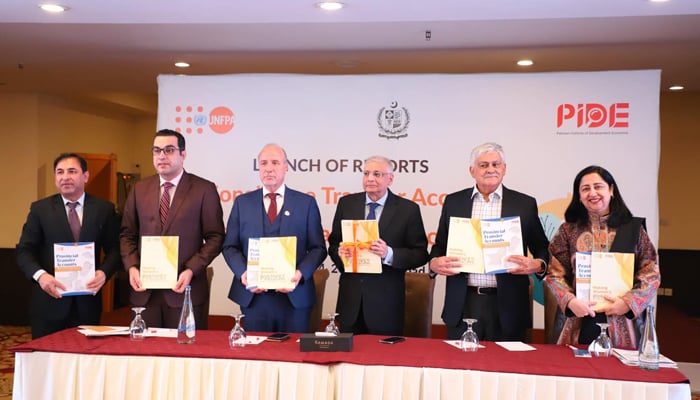
The studies carried out by Pakistan Institute of Development Economics (PIDE) and UN Population Fund (UNFPA) were launched Friday in a ceremony.
In a comprehensive study, Pakistani women’s often invisible economic contributions have been highlighted. Utilizing the National Transfer Accounts (NTA) methodology, the study delves into income, consumption, and lifecycle deficits across genders, revealing critical disparities and untapped potential.
While addressing the launching ceremony the Federal Minister for Planning and Development and Special Initiatives (PD& SI) said that we are a populous country and there is a large segment of young population, any research that analyses the inter-generational dynamics and computes the unpaid work that women contribute is very useful. “I am glad to know that we are first in the region to do this kind if research. I would like to congratulate UNFPA and PIDE” he added.
Speaking at the occasion Dr. Luay Shabaneh, UNFPA Representative said this research is an important piece of work which signifies that we are moving from demographic anxiety to demographic resilience where we understand the demographic shifts and appropriate policies to accommodate these shifts. In addition, these researches link population changes with the economy and analyse how changes in the ages and distribution of workload between men and women may affect the account.
Dr. Durr-e-Nayab, Director of Reserachat PIDE presented the study findings. The study found that in Pakistan, men typically commence their working lives at the age of 10 and reach the peak of their earnings by the age of 49. However, their consumption frequently eclipses their income during both early and later years, a gap often compensated for by other household members who possess a surplus. In stark contrast, women consistently experience a trend where their consumption surpasses their income at all ages, primarily due to their limited participation in the labour force.
The report explains that while men dominate formal market-based economic contributions, accounting for 78 percent of such activities, women take the lead in the informal non-market activities, frequently overlooked by traditional economic metrics. Women’s per capita annual production value in non-market work significantly exceeds that of men, highlighting their critical role in household and caregiving activities and underlining their substantial yet often unrecognized contributions to the economy. These findings challenge the conventional understanding of financial contribution and participation, urging a broader recognition of diverse roles across gender lines in both market and non-market sectors, emphasized at the launch.
The “Provincial Transfer Accounts” study, offering a granular view of Pakistan’s generational economy, highlights unique demographic patterns and economic structures in each province. This analysis is essential for effective policymaking, especially after the devolution of significant subjects like health and education to the provinces.
Speaking at the occasion, Dr. Nadeem ul Haq the Vice Chancellor, PIDE said that reports tell us how economy is distributed among generations and gender-divide. We all know the importance of inclusions of women but this is the first time we have a research to see in economic terms how women contribute to the economy.
The study offers significant insights, emphasizing the crucial role of unpaid labor, especially in Balochistan, where it constitutes a substantial segment of the economy. It highlights a striking disparity in consumption levels among provinces; Punjab and Sindh exhibit higher consumption rates than KP and Balochistan.