
PM Shehbaz deplores ruling after SC axe falls on review law
PM Shehbaz regretted that the Supreme Court has given a verdict on Review of Judgments and Order Act following the departure of the government but underlined it has nothing to do with the return of PMLN Quaid Nawaz Sharif to the country
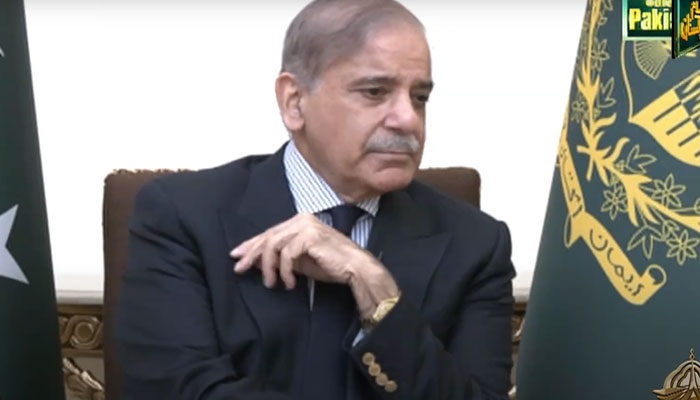
ISLAMABAD: Prime Minister Shehbaz Sharif has regretted that the Supreme Court has given a verdict on Review of Judgments and Order Act following the departure of the government but underlined it has nothing to do with the return of PMLN Quaid Nawaz Sharif to the country.
Earlier, the Supreme Court declared the Supreme Court (Review of Judgments and Orders) Act 2023 as unconstitutional and held that parliament was not competent to legislate with respect to Article 188 of the Constitution in the manner that it has done by way of the new Act.
The premier, during an interview with the state-run TV channel, said, “As far as Nawaz Sharif’s return is concerned, the [SC] decision has no link to it.” He added that his elder brother, a three-time prime minister, has completed the five-year disqualification period. “The law which is in the field right now states that the maximum period for disqualification is five years. Nawaz Sharif will return and this verdict will not be an obstruction,” the PM said.
Meanwhile, talking informally to newspersons here at the PM House, the outgoing prime minister said that Nawaz Sharif would return to the country and face the law. He maintained that the name of the caretaker prime minister would be finalised by Saturday (today) and he would also meet the opposition leader.
Asked to comment on President Alvi’s letter, Shehbaz asked as to why the president was in a hurry, adding that he should have gone through the Constitution where according to Article 58, the appointment of caretaker premier could take eight days. “President should read the Constitution and I can continue as prime minister for eight days following the dissolution of the National Assembly,” he said. Shehbaz reminded the president that after three days of consultation between the outgoing prime minister and outgoing opposition leader, the parliamentary party would have another three days, followed by two days for the Election Commission of Pakistan.
Meanwhile, speaking to Geo News, former law minister Azam Nazeer Tarar termed the Supreme Court ruling on the judgments review law “very unfortunate”, but said that it would not affect former premier Nawaz Sharif’s prospects of returning to electoral politics anytime soon.
He said the Constitution had laid down rules of the game for all state organs, which was also called trichotomy of powers. “Courts interfere in the parliament’s jurisdiction again and again and give verdicts that put a curb on its supremacy [...] this is not a good tradition,” he said, adding that this has happened in the past and “it only weakens the state’s institutions and does not strengthen them”.
Tarar added that the timing of the verdict was also painful for him as the verdict was announced after the dissolution of National Assembly. Therefore, new legislation couldn’t be done in the light of apex court’s directives. “The law was enacted on the demand of bar councils which were of the view that the scope of the review was so narrow that it would be an injustice to many people,” he said, adding the decision gives the impression that advantage had been taken of the absence of parliament.
He further explained that the new law had made it mandatory for the top court to form a bench larger than the one that gave the original verdict. “Another good thing was that it provided an option to change the lawyer,” he said.
After the SC’s verdict, it was widely believed that the doors on Nawaz Sharif’s electoral politics had been closed. “This will not affect the prospects of Nawaz Sharif’s return to electoral politics as his lifetime disqualification was undone by an amendment to Election Act 2017,” he clarified. The disqualification clause in Article 62 of the Constitution was amended and now the disqualification would not be more than five years. Tarar asserted that it would be against the fundamental rights to bar anyone from seeking votes and going to people.
Earlier, the Supreme Court declared the Supreme Court (Review of Judgments and Orders) Act 2023 unconstitutional and held that parliament was not competent to legislate with respect to Article 188 of the Constitution in the manner that it has done by way of the new Act.
A three-member bench of the apex court, headed by Chief Justice of Pakistan Umar Ata Bandial and comprising Justice Ijazul Ahsen and Justice Munib Akhtar, announced a unanimous verdict in the identical petitions challenging the vires of Supreme Court (Review of Judgments and Orders) Act 2023, which expands the scope of a review petition.
The piece of legislation was introduced by the former coalition government through parliament on April 14 this year, aimed to widen the scope of review jurisdiction in cases decided under Article 184(3) of the Constitution.
The law provides the right to file a review petition to an aggrieved person against whom an order has been made under clause (3) of the Article 184 of the Constitution, prior to this legislation.
Similarly, the law also states for reviewing a suo motu judgment, a bigger bench than the one that issued the order, will hear the case. According to the law, a petition should be filed by the person within 60 days of the commencement of this legislation. The law provides the right of an appeal against conviction by the Supreme Court under its original jurisdiction under Article 184(3) of the Constitution.
The court had reserved the verdict on June 19 after hearing all the parties with an observation that the decision on the case would determine the fate of Election Commission of Pakistan (ECP)’s review against the court verdict announced on April 4, fixing May 14 as the date for holding the Punjab Assembly elections.
Pakistan Tehreek-e-Insaf (PTI), as well as Ghulam Mohiuddin, Zaman Khan Vardak and the Jurists Foundation, had challenged the vires of the Supreme Court (Review of Judgments and Orders) 2023, praying to declare it as ultra vires to the Constitution. “For the reasons recorded, the instant petitions are allowed and it is declared that these petitions are maintainable for the purposes of Article 184(3) of the Constitution,” the CJP announced the judgment in an open court.
The court held that the Supreme Court (Review of Judgments and Orders) Act 2023 is repugnant to and ultra vires the Constitution being beyond the legislative competence of parliament. “It is accordingly struck down as null and void and of no legal effect,” the court held.
Justice Bandial announced that the decision is unanimous with an additional note from Justice Munib Akhtar.
For the avoidance of doubt, the court held and declared that all review petitions, whether filed against judgments and orders passed under the original or appellate jurisdiction of the apex court, are and shall continue to be governed by the provisions of Article 188 of the 1973 Constitution read with the 1980 Rules, which were, are and continue to be the governing law on the subject for all intents and purposes.
The court also found sections 2 and 3 of the 2023 Act going against the basic principle of separation of powers and offend against articles 175(2), 175(3), 184(3), 185 and 188 of the 1973 Constitution by unduly intruding into and interfering with the independence of the judiciary, and therefore, diminish the mandate of the SC to protect and enforce the fundamental rights of the people of Pakistan, says the judgment. “We therefore find that, in the instant matter, parliament was not competent to legislate with respect to Article 188 in the manner that it has done by way of the 2023 Act,” says the judgment.
The court held that where such rule-making power has been exercised by the apex court, any legislation by placing reliance on Entry 55 under the garb of “enlargement of jurisdiction of the Supreme Court” is indisputably unconstitutional and an intrusion in the independence of the judiciary, specifically so where a right of appeal is sought to be provided when none has been provided by the Constitution. “The so-called ‘enlargement’ has no constitutional sanction or basis and is not anchored in any provision of the 1973 Constitution relating to the judicature or the Supreme Court of Pakistan,” it said.
The court noted that Section 2 conflates the Appellate jurisdiction of the Supreme Court with that of review jurisdiction under Article 188 and thereby renders Article 188 to the extent of orders/ judgments passed under Article 184(3) redundant by providing an appeal for all intents and purposes under the facade of review. “This appears to be an attempt to remodel the Constitutional scheme relating to judicature and potentially opening the door for diminishing, undermining and eroding the power and jurisdiction of the apex court of the country,” the court held. The court held that under the Constitution, orders and judgments passed by the Supreme Court under Article 184(3) are final except to the limited extent that the same may be subject to review jurisdiction under Article 188.
The court noted that Section 2, by providing an appeal on facts and law against the judgments and orders passed under Article 184(3), reduces rather than enlarges the jurisdiction of the Supreme Court under Article 184(3) since such judgments and orders are now subject to a rehearing and re-appraisal by a larger bench hearing the review as an appeal thereby destroying the finality of such judgments or orders. “It may be noted that looked at from another angle, an expansion of review jurisdiction and converting it into an appeal would necessitate amending various Constitutional Articles (including Articles 184(3), 185 and 188) as well as modification of the 1980 Rules,” said the judgment.
The court held that the 2023 Act alone, and by itself, cannot alter, modify or amend Constitutional provisions without adhering to the mandatory requirements set forth in articles 238, 239 and 269 of the 1973 Constitution. “If there was any doubt in anybody’s mind (there is none in ours) that the real purpose of the 2023 Act is to provide for an appeal against judgments and orders passed by this Court in exercise of its power under Article 184(3) of the 1973 Constitution (where the Constitution does not provide for an appeal), Section 3 of the 2023 Act should be enough to unravel the thin veil of trying to ‘facilitate and strengthen the power [of review]’ and ‘enlarge jurisdiction of the Supreme Court’,” said the judgment
The court noted that to allow a party to substitute its counsel in the review proceedings and to raise new points of facts and law would be tantamount to allowing litigants to get another shot at overturning a judgment of the apex court not to mention offend the principles laid down by the court relating to finality attached to the SC judgments.
The judgment held that since the apex court has declared that under the 1980 Rules, it is the sole prerogative of the Chief Justice of Pakistan to constitute benches, to fix the number of judges who constitute the said benches, it would veer towards irrationality to hold that while the original exercise and invocation of jurisdiction under Article 184(3) is the sole prerogative of the chief justice under the 1980 Rules, the legislature lacks the authority to supersede the chief justice and enact a law taking away the prerogative of the chief justice of nominating and fixing the number judges to hear a review petition.
The court held that the power to constitute benches has always vested with the judicial branch of the State and to suggest that the legislature can legislate on the issue of the mode and manner of composition and strength of benches to hear certain matters (in this case review petitions) would be a gross intrusion and incursion in the judicial exercise of powers under the Constitution. Therefore, the court noted that the said Section violates the express command of the 1973 Constitution.
“In order to understand the scope of Article 187, it is relevant to elaborate the difference between ‘jurisdiction’ and ‘power’. Jurisdiction of a Court is a well-understood concept which means the capacity of a court to decide a dispute arising before it,” the court held. With respect to Section 5, the court noted that the purpose behind the said section is to allow those who may be aggrieved by a judgment rendered by the apex court with respect to any order passed in the exercise of the jurisdiction conferred under Article 184(3) to file a review petition on both facts and law, the scope of which shall be the same as an appeal under Article 185 of the Constitution.
“Besides and in addition to other reasons including our finding that the 2023 Act in effect purports to amend the Constitution, the effect of the said Section would be to open a floodgate of litigation and to allow filing of review petitions irrespective of the date when the order complained against had been passed,” the judgment held.
The court noted that this would be notwithstanding the fact that such an order had become a past and closed transaction by reason of the expiry of the period of limitation to file a review petition under Article 188 read with the 1980 Rules. It goes without saying that the threshold, requirement and scope under Article 188 in terms of the criterion laid down by this Court in the 1980 Rules rests on a higher pedestal than ordinary legislation.
“We are mindful of the fact that although the constitutional Courts have a duty to protect and defend the Constitution and have been conferred with the power to rule on the vires of laws on the touchstone of the Constitution, the power of striking down laws, has to be exercised with a great deal of care and caution,” the judgment said. The court noted that a law should not be struck down unless no alternate interpretation is available that can harmonise the Statute with the provisions of the Constitution.
The court noted that it had carefully examined the 2023 Act and placed it next to the Constitution as well as applied the settled principles for discharging the solemn duty of whether or not to declare the 2023 Act unconstitutional, as spelt out in the judgment of this Court reported as Lahore Development Authority v. Imrana Tiwana (2015 SCMR 1739). “However, despite our earnest effort to harmonise the Act with the provisions of the Constitution, we have concluded that 2023 Act is so patently, manifestly and irretrievably in conflict with and violative of various Articles of the 1973 Constitution that it is not possible to harmonise the two in any manner whatsoever,” the court noted.
It further said that any legislation interfering with the independence of the judiciary, would by its nature and from its very inception, be “unconstitutional, null, void and of no legal effect”. It said that a constitutional amendment was needed to convert the court’s review jurisdiction into an appellate jurisdiction. “It is a well-recognised principle that ordinary law cannot amend, change, delete of add to the Constitution,” the order said.
The order said that the so-called “enlargement” of the court’s jurisdiction had “no constitutional sanction or basis” and was not anchored in any provision of the Constitution relating to the judicature or the SC.
In his additional note, Justice Munib Akhtar held that a review is not an appeal. “Indeed, it is quite different and distinct from it, so says conventional wisdom,” the judge held.
“Nonetheless, can the review jurisdiction of this Court under Article 188 of the Constitution, at least in respect of a judgment or order under Article 184, be directed by legislative fiat to be so exercised that “the scope of review on both facts and law, shall be the same as an appeal under Article 185 of the Constitution”?
Justice Munib Akhtar held that the 2023 Act is a brief enactment, comprising all seven sections. Sections 4 to 7 are clearly ancillary to section 2 and are, essentially, in the nature of adjuncts thereto. The judge noted that the question of the Act’s vires turns primarily on sub section 2 and 3 both of which have, as will be seen, their own problems and difficulties on the plane of constitutional principle.
“In my view, review jurisdiction, whether that conferred constitutionally on this Court or by statute on other courts, is inextricably linked with and cannot be understood without keeping in mind one of the most basic and fundamental principles that underpin the whole of the legal system,” Justice Akhtar held. The judge noted that even if somehow the review bench could be formed comprising of some members of the “original” bench and other judges who were not members thereof, the result would be strange. “Those members of the review bench who had earlier heard the matter would exercise review jurisdiction properly so called, i.e. in terms of O. 26, R. 1 since they would be precluded from hearing it in any manner as an appeal,” Justice Munib held.
“Since the other provisions of the 2023 Act stand or fall with these two sections, the Act as a whole fails, the 2023 Act is hereby declared as ultra vires the Constitution, being repugnant thereto, and without legal effect,” the judge concluded.


