Holy Quran desecrated outside Stockholm mosque
Turkey’s foreign minister condemns the act as ‘vile’ and ‘despicable
STOCKHOLM: A man set fire to several pages of the Holy Quran outside Stockholm’s main mosque Wednesday, after Swedish police granted a permit for the protest which coincided with the start of Eid-ul-Azha.
The action was also slammed by Turkey, which is holding up Sweden’s pending NATO bid. Turkish Foreign Minister Hakan Fidan condemned it as “despicable.” “It is unacceptable to allow these anti-Islamic actions under the pretext of freedom of expression,” Fidan said on Twitter. “Turning a blind eye to such atrocious acts is to be complicit.”
Turkey is blocking the country’s NATO bid due to what it perceives as Stockholm´s failure to crack down on Kurdish groups it considers “terrorists,” and took particular offence to another Holy Quran burning outside its Stockholm embassy in January.
A meeting between the countries’ top diplomats is scheduled for July 6 at the NATO headquarters in Brussels, with NATO counterparts pushing for Turkey to grant the green light to Sweden by the time a summit is held in Lithuania on July 11-12.
The police said in its written decision that the security risks associated with the burning “were not of a nature that could justify, under current laws, a decision to reject the request”.
Salwan Momika, 37, who fled from Iraq to Sweden several years ago, had asked police for permission to burn the Muslim holy book “to express my opinion about the Holy Quran”. Ahead of the protest, Momika told news agency TT he also wanted to highlight the importance of freedom of speech. “This is democracy. It is in danger if they tell us we can’t do this,” Momika said.
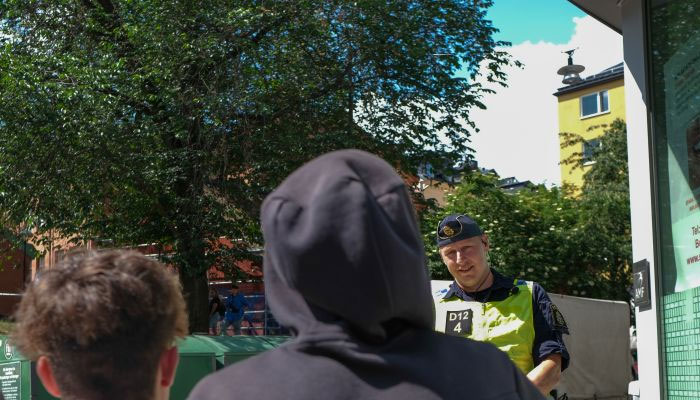
Under a heavy police presence and with around a dozen opponents shouting at him in Arabic, Momika, dressed in beige trousers and a shirt, addressed the crowd of several dozen through a megaphone.
Police had cordoned off an area in a park next to the mosque separating Momika and a co-protester from the crowd. Noa Omran, a 32-year-old artist from Stockholm, called the protest “absolutely insane”.
“It’s just hatred masquerading in the name of democracy and freedom which it isn’t,” the woman, who said her mother was from a Muslim background, told AFP at the scene. Social worker Lotta Jahn, 43, also said the burning should not be tolerated. “We just have to say stop. It’s not OK to humiliate other people,” she said.
The police authorization for the protest came two weeks after a Swedish appeals court rejected the police’s decision to deny permits for two demonstrations in Stockholm which were to include Holy Quran burnings. Police had at the time cited security concerns, following a burning of the Muslim holy book outside Turkey’s embassy in January which led to weeks of protests, calls for a boycott of Swedish goods and further stalled Sweden’s NATO membership bid.
Similar acts have in the past sparked violent protests and outrage across the Muslim world. Police argued the January protest had made Sweden “a higher priority target for attacks”.Police then banned two subsequent requests for protests involving Holy Quran burnings -- one by Momika and one by an organisation, outside the Turkish and Iraqi embassies in Stockholm in February.
The appeals court in mid-June ruled that police were wrong to ban those, saying the security concerns cited by police were not sufficient to ban the events. Swedish police had granted a permit for the January protest, which was organised by Rasmus Paludan, a Swedish-Danish activist who has already been convicted of racist abuse.
Paludan also provoked rioting in Sweden last year when he went on a tour of the country and publicly burned copies of Islam’s holy book. Politicians in the Nordic country have criticized Holy Quran burnings but have also adamantly defended the right to freedom of expression.-