
‘Can AI be equaliser for access and equity in education?’
Khan introduced over a hundred participants attending webinar to various AI tools, such as Google Assistant, Wolfram Alpha and ChatGPT
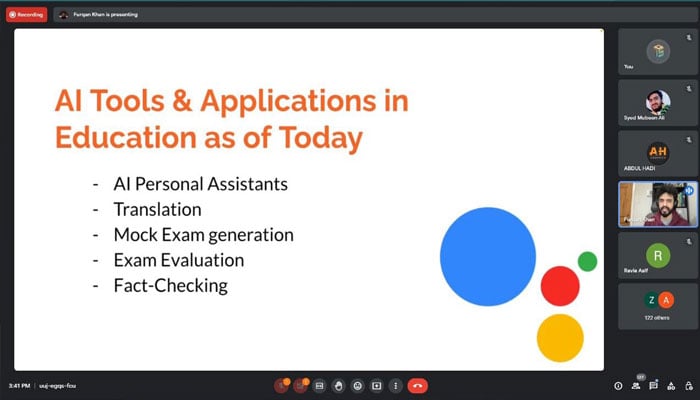
Artificial intelligence (AI) is more than just a technological solution. It is a tool that we can use to progress as humanity, just like we did with the fire, the wheel, the electricity and the internet, said Furqan Khan, a software engineer based in Canada, on Saturday.
He was speaking in a webinar on the inaugural day of a hybrid ‘AI and Education Conference’ hosted by the non-profit organisation Off The School (OTS).
“A glimpse of the future shows us AI software being used for generating 3D videos to assist in explaining complex ideas or processes, software for self-paced learning, and real-time speech-to-speech translation that can bridge language barriers in education,” said Khan.
He discussed the potential areas where AI can be used to bridge the accessibility of education, such as AI personal assistants, remote learning, translation, mock exam generation, exam evaluation, and fact-checking, particularly in the context of Pakistan’s educational crisis. Khan also introduced over a hundred participants attending the webinar from several countries to various AI tools, such as Google Assistant, Wolfram Alpha, Otter, and ChatGPT.
Regarding AI helping school children, Pakistani computer scientist Ahsun Tariq, who has a master’s degree in AI from the University of Edinburgh, discussed the potential for AI in middle school to college level education.
“We need systems to support scaffolding attributes,” he said. “There is work done in this domain, such as developing an Algorithm Visualisation (ALVIS) software which helps kids visualise how algorithms work. These systems help people visualise and develop better mental models of algorithms, addressing the problem of creating a better teaching environment.”
Tariq, a researcher at Oregon State University in the US, highlighted the limitations of “Pakistan’s rigid and doctrinaire education system”. Still, he saw the potential for AI as a recommendation engine that can learn students’ strengths and recommend various themes from around the world. He also mentioned that the current AI systems like chat GPT can help students seek quick solutions but stressed the importance of data acquisition, annotation, and debiasing for AI to be truly effective.
Addressing the webinar, OTS founder and journalist Najam Soharwardi said it was a tragedy that 22.8 million children in Pakistan were not in school, and the recent climate disasters had only compounded this crisis.
“Innovation is key to overcoming the challenges facing education in Pakistan. Without it, the cycle of poverty and inequality will continue, leaving countless children without the opportunities they deserve,” said Soharwardi.
“The use of AI-powered chatbots is just one example of the innovative solutions needed to address the issue of out-of-school children. By creating customised lesson plans and educational materials, we at OTS are giving these children a chance to break the cycle of poverty and achieve their full potential.”
Syed Kazim Jamal, digital and technology transformation consultant at Ernst & Young Global Limited, spoke about the importance of using AI to address educational inequities and ensure access and equity for all. “Education is often touted as the great equaliser, the key to upward mobility and a better life. However, the reality is that not everyone has access to quality education, and many are left behind due to systemic inequalities. We cannot afford to leave anyone behind,” said Jamal.
He also spoke about AI’s great promise for addressing these inequities and how it is not just a technological solution but a moral imperative.
Waqas Ansari, an engineer at the American company Motive, emphasised the potential of AI in solving complex problems and improving efficiency in various industries. He highlighted the importance of deep learning and reinforcement learning in AI and spoke about the recent advancements in AI technology due to improved hardware, software, and data availability.
However, Waqas also acknowledged the ethical concerns surrounding the use of AI, such as its impact on jobs and privacy. He emphasised the need for professionals with AI-related skills and the importance of continued education and research in AI to unlock its full potential and mitigate potential risks.
Entrepreneur and digital marketer Mubashir Sakhi and OTS Edtech head Omama Ansari also addressed the webinar, which was concluded with a question-and-answer session from educators, parents and students. The two-day conference will end today (Sunday) with an on-campus workshop on the use of AI-powered chatbots at OTS.


