Fix, expand, build: PM approves 5-year flood management strategy
ISLAMABAD: Prime Minister Shehbaz Sharif has approved a five-year flood management strategy — fix, expand and rebuild, Federal Minister for Climate Change Musadik Malik said on Wednesday. The minister revealed this during a press conference, alongside the National Disaster Management Authority (NDMA) chief, outlining Pakistan’s flood management strategy following heavy losses from recent floods.
Malik said the 2022 floods caused damage equivalent to nine percent of the country’s GDP. Over the past three to four major floods, more than 4,500 people have died, and around 40 million were displaced. This year alone, 3.1 million people lost their homes, the minister said, adding that the current drainage system cannot cope with the intensity of present-day monsoons.
Malik said that the government has prepared a 250-day monsoon plan to deal with short-term challenges and will implement integrated measures over the next 200 days.
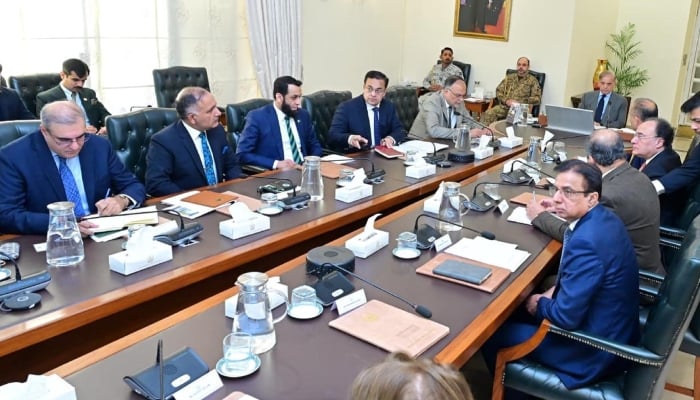
“If similar floods occur next year, we must be ready,” he added. He said that a meeting chaired by PM Shehbaz made key decisions on a three-phase strategy of flood management. The first phase focuses on repairing damaged infrastructure, including dykes, flood gates and other critical systems, within 200-250 days, before the next monsoon.
He said that the prime minister directed early warning systems be immediately integrated at the district and tehsil levels. Officers at the AC and DC offices will screen incoming data, ensuring alerts reach vulnerable areas first.
Malik further said that the premier also called for formulating plans to establish temporary schools and mobile healthcare units in flood-hit areas to prevent disruption to education and healthcare.
The medium-term plan aims to expand existing drainage and flood management systems over the next three years. Meanwhile, the long-term strategy, spanning five years, envisions climate-resilient infrastructure capable of withstanding extreme weather events, he added.
He said the premier will personally lead the programme, review updates on implementation and integration to ensure Pakistan is better prepared for extreme weather conditions, both hot and cold.
On the occasion, NDMA Chairman Lt Gen Inam Haider Malik said that next year’s monsoon will be 26 percent more intense than this year’s. He said that the intensity of climate change is increasing in Pakistan every year, and preparations are needed before the next monsoon. He stated that the next year’s monsoon season will arrive with greater intensity, and by 2026, the intensity of the monsoon will be 20 to 26 percent higher.
He said that effective measures can reduce the damages of climate change. The rate of glacier melt is increasing by up to three percent. They will deal with potential floods in the Ravi, Chenab and Sutlej rivers through various methods. The travel and movement of tourists will be restricted during flood days.
As per the details from the meeting, PM Shehbaz directed the relevant authorities to ensure early preparedness to avert rain-related losses in next year’s monsoon and implement the short-term plan presented by the Climate Change Ministry.
The prime minister, chairing the meeting to review measures to prevent damages from next year’s monsoon, approved the short-term plan and instructed its immediate implementation. He asked the Ministry of Climate Change, Ministry of Planning and NDMA to work in coordination with provincial governments for integrated planning on climate change. He also called for preparations to convene a meeting of the National Water Council to carry out national-level planning on water management.
Separately, Sindh Chief Minister Syed Murad Ali Shah called on the prime minister. Both discussed overall political situation and provincial affairs, PM Office Media Wing said in a press release.
Meanwhile, on World Children’s Day, the prime minister reaffirmed the country’s commitment to child welfare, protection, and education. In his message for the Children’s Day, he highlighted this year’s theme, ‘My Day, My Rights,’ underscoring the importance of recognising children’s individual and collective rights at national and international levels.
Meanwhile, addressing a ceremony to mark the International Day of Tolerance, the prime minister emphasised the importance of promoting Islamic values of tolerance, patience and forbearance, saying these values along with co-existence were behind creation of Pakistan.


-
 Aurangzeb confirms Saudi Arabia $10bn interest, says B2B shift ongoing
 -
 Pakistan to build artificial island to boost oil exploration
 -
 Special pink bus service launched for women on Green Line route
 -
 Same number plates from other provinces lead to wrong e-challans for Karachiites
 -
 State institutions ‘fail’ to perform constitutional duties: KP CM
 -
 CTD orders psychological testing of police on VVIP security duty
 -
 Navy busts drug consignment valued at $130m
 -
 Three ex-secretaries in race for ETPB chief post