EU envoy backs Pakistan’s concerns over Afghan militants but presses Islamabad on human rights
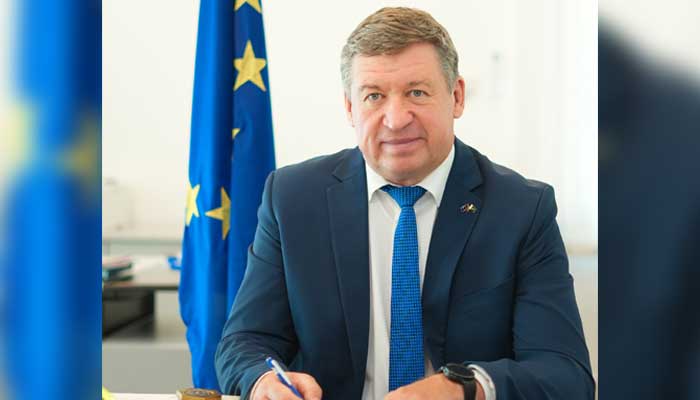
ISLAMABAD: The European Union’s ambassador to Pakistan has voiced support for Islamabad’s claims that militants operating from Afghanistan are responsible for recent attacks inside the country, while cautioning that Pakistan must pair its security demands with measurable progress on human rights and democratic freedoms.
In an interview with The News / Geo News, newly appointed Ambassador Raimundas Karoblis said that Pakistan’s insistence that the Taliban prevent the Tehreek-e-Taliban Pakistan (TTP) from using Afghan territory was “valid” and rooted in real security concerns. “We condemn terrorism in all forms without exception”, he said. “Pakistan’s demands that Afghanistan act against the TTP are reasonable.”
But Karoblis also emphasised that the EU was urging Islamabad to keep diplomatic channels open, pointing to Turkey’s ongoing mediation between the two sides. On whether the Taliban were honouring their Doha pledge not to allow Afghan soil to be used against neighbouring states, he said he lacked independent intelligence to judge compliance. “It is too early for a definitive conclusion”, he said.
A strategic dialogue amid geopolitical flux: The ambassador confirmed that a high-level Pakistan-EU Strategic Dialogue will take place in the coming weeks, led by EU foreign policy chief Kaja Kallas and Deputy Prime Minister Ishaq Dar. The talks will cover Afghanistan, the Russia-Ukraine war, regional security and Pakistan’s role at the UN. Other issues, including trade, migration and counterterrorism, will be handled in separate forums.
The dialogue comes as Pakistan seeks to preserve its preferential trade status under the GSP Plus programme, which grants duty-free access to European markets in exchange for compliance with international human rights treaties.
Rights and religion -- a test under GSP Plus: Karoblis said the EU remains deeply concerned about rising blasphemy accusations inside Pakistan, particularly against young people and religious minorities. “Europe does not support blasphemy laws”, he said, adding that false accusations and “blasphemy business networks” must be addressed. One option, he suggested, would be to criminalise fabricated allegations.
Enforced disappearances, long documented in Balochistan but now increasingly reported from Punjab and Sindh, will also be among the “top priorities” of the EU’s monitoring review. The envoy said the bloc expected to evaluate the performance of Pakistan’s Commission of Inquiry on Enforced Disappearances during the upcoming assessments.
Democracy in question: Asked about Pakistan’s last two elections, both widely criticised by the opposition, Karoblis avoided declaring them illegitimate but acknowledged that problems existed. “No system is perfect, but irregularities must be addressed so they are not repeated”, he said. The EU recognised the current parliament and government, he added, but concerns about electoral transparency remain on its radar.
Karoblis similarly declined to endorse or condemn recent constitutional amendments affecting judicial powers, though he noted that Brussels was listening to critics. Compliance with UN conventions, he said, was the key test the EU would apply.
On Imran Khan’s detention -- “for the courts to decide”: When asked whether the imprisonment of former prime minister Imran Khan was impeding democratic normalisation, Karoblis refused to enter the debate. “I may have personal views, but this is a matter for Pakistan’s judicial authorities”, he said. “Political pluralism is important, but it must be discussed through the rule of law”.
Floods, climate and the future of aid: Karoblis said the EU and its member states have mobilised nearly one billion euros in assistance following Pakistan’s devastating 2022 floods, including an initial one million euro tranche for emergency relief. Under the EU’s Global Gateway strategy, climate adaptation will remain a priority sector for future cooperation.
But his message also carried a warning. Whether on blasphemy laws, enforced disappearances or media freedom, Pakistan’s standing under GSP+ could be at risk if reforms stall. “The question”, he said, “is whether the glass is half full or half empty. What matters is making sure it doesn’t run dry”.


-
 Aurangzeb confirms Saudi Arabia $10bn interest, says B2B shift ongoing
 -
 Pakistan to build artificial island to boost oil exploration
 -
 Special pink bus service launched for women on Green Line route
 -
 Same number plates from other provinces lead to wrong e-challans for Karachiites
 -
 State institutions ‘fail’ to perform constitutional duties: KP CM
 -
 CTD orders psychological testing of police on VVIP security duty
 -
 Navy busts drug consignment valued at $130m
 -
 Three ex-secretaries in race for ETPB chief post