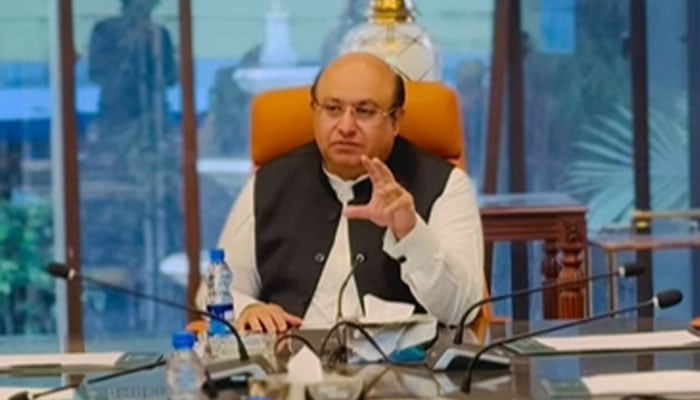
LAHORE: Punjab’s top civil and security leadership met under the chairmanship of provincial finance minister to review implementation of key action points under the Revised National Action Plan (R-NAP 2021), with departments presenting wide-ranging updates on development spending, local government empowerment, madrassah reforms and counter-extremism efforts. The high-level meeting was held as a follow-up to the 6th Federal Steering/Review Committee meeting chaired by the Federal Minister for Planning and Development.
Senior officials, including the additional chief secretary, chief economist of the P&D Board, representatives of the provincial corps, and special secretaries from the Home, Finance, Higher Education and Local Government departments attended the session. The chair noted that the provincial committee was formed on the direction of Central Apex Committee led by the prime minister and approved by the cabinet’s Standing Committee on Law & Order. The committee meets monthly to monitor progress and ensure R-NAP decisions are implemented in letter and spirit.
The meeting reviewed the Federal Steering Committee’s action points, including equitable socio-economic development across under-served regions, revisiting PSDP allocations to strengthen district and tehsil administrations, examining the 18th Amendment and NFC Award, formalizing madrassah registration and reforms, promoting religious harmony through anti-hate measures, safeguarding minority rights and enhancing public engagement, especially of youth, through local leadership.
Punjab’s revised Annual Development Programme (ADP) for 2025-26 stands at Rs1,255 billion, with 37% utilization to-date. South Punjab’s share has risen to Rs402 billion — 42% of which has already been utilized marking a notable increase from Rs207 billion in FY 2021-22. Officials reported that a wide portfolio of CM-led initiatives is underway across health, agriculture, education, infrastructure, renewable energy and climate resilience. Key schemes include the Kissan Card, Green Tractor Programme, Free Solar Panel Scheme, Smart Safe Cities initiative, student laptop and scholarship programmes, upgrades of rural health facilities, the Apni Chat Apna Ghar housing initiative, and the rollout of eco-friendly electric buses. The additional chief secretary added that the government’s agenda is strongly pro-poor and the finance minister said additional allocations have been directed toward marginalized districts in the current financial year.
The Finance Department reported that the PFC share for FY 2025-26 has risen to Rs934.678 billion, an increase of 9.01% compared to the previous year. Municipal Committees, District Councils, DHA/DEA and waste management companies have received enhanced financial support, while Rs118 billion has already been released under the Suthra Punjab Programme for urban cleanliness and service provision. Since FY2016-17, Rs195.47 billion has been transferred to entities performing local government functions, reflecting the government’s focus on financially strengthening grassroots institutions. Non-development allocations in health, welfare and public service delivery total Rs160.22 billion, covering major initiatives such as the National Health Support Programme, Clinic on Wheels, Maryam Nawaz Health Clinics, Collective Marriage Programme and Nawaz Sharif Center of Excellence for Early Childhood Education.
The Local Government Department reported that the Punjab Local Government Act 2025 had been notified on 20 October, and the Election Commission of Pakistan has confirmed that local government elections will be conducted under this new framework. Work is underway on demarcation rules, urban-rural classification, formation of Town Corporations, delimitation of Union Councils and related structures. The Act grants LGs greater financial autonomy, including the right to levy and collect taxes, receive shares of provincial allocable amounts, benefit from cattle market revenues and claim specified percentages from land-use and building control entities.
The Home Department informed the committee that regular engagement with all schools of thought is underway through madrassah coordination committees, Religious Dispute Committees and district-level peace committees. The Punjab Center of Excellence on Countering Violent Extremism Act 2025 has been notified to establish a research-driven institution dedicated to understanding and countering extremism, radicalisation, misuse of charities and glorification of banned entities.
The Higher Education Department said adequate funding has been earmarked for several youth-focused initiatives including the CM Laptop Programme, Scooty Scheme 2025, Honhar Scholarship Programme, Asaan Karobar Card loan support and the Social Security Ration Card for secure workers.
The finance minister stressed the urgent need for all departments to ensure full and timely implementation of the seven R-NAP action points and directed them to submit monthly progress reports. The Finance Department was instructed to consolidate data for submission to the P&D Board ahead of the upcoming 7th Federal Steering/Review Committee meeting.


-
 Aurangzeb confirms Saudi Arabia $10bn interest, says B2B shift ongoing
 -
 Pakistan to build artificial island to boost oil exploration
 -
 Special pink bus service launched for women on Green Line route
 -
 Same number plates from other provinces lead to wrong e-challans for Karachiites
 -
 State institutions ‘fail’ to perform constitutional duties: KP CM
 -
 CTD orders psychological testing of police on VVIP security duty
 -
 Navy busts drug consignment valued at $130m
 -
 Three ex-secretaries in race for ETPB chief post