Pakistan’s public debt hits record Rs80.5tr, NA told
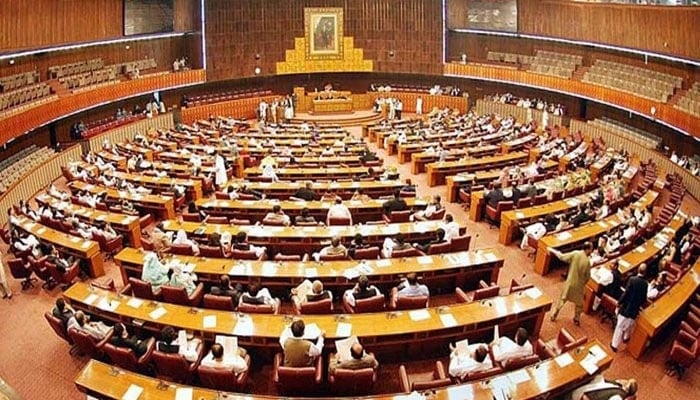
ISLAMABAD: The Finance Ministry told the National Assembly on Friday that Pakistan’s public debt stood at Rupees 80.5 trillion at the end of June 2025.
In a written reply to a question from Asif Khan, the Ministry clarified that the total public debt was Rs73.2 trillion at the end of June 2025. This definition includes debt owed by the federal and provincial governments serviced from the Consolidated Fund, plus debt owed to the International Monetary Fund (IMF), minus accumulated government deposits with the banking system.
The Assembly was told that the total public debt increased by Rupees9.3 trillion during FY25, representing a daily increase of Rupees 25.4 bn. However, based on the FRDLA debt definition, the debt increased by Rs8.2tr during FY25, which represents a daily increase of Rupees 22.3bn, based on 365 days. The gross public debt-to-GDP ratio stood at 70.8pc in FY25, compared to 67.8pc the previous year. As per the FRDLA definition of total public debt, the debt-to-GDP ratio stood at 64.4pc in FY25.
While the present level of public debt exceeds the limits prescribed under the FRDLA, the deviation primarily reflects the cumulative impact of past fiscal pressures and external shocks. The FRDLA recognises exceptional circumstances such as unforeseen demands on public finances arising from national security needs or natural calamities, subject to determination by the National Assembly.
In this regard, a Debt Policy Statement submitted to the National Assembly by January, provides an assessment of the federal government’s performance in meeting the debt-to-GDP targets. With sustained macroeconomic stability, the medium-term fiscal framework envisages a gradual reduction in the debt-to-GDP ratio in line with the FRDLA trajectory.
To address the increase, the government has undertaken a series of fiscal consolidation and debt management measures including generating primary surpluses for two consecutive fiscal years to contain deficit financing; making a strategic shift in borrowing toward medium- and long-term securities while curtailing short-term issuance to reduce refinancing risk; conducting its first-ever sovereign debt buybacks (amounting to Rupees 1.5 trillion in FY25 and Rupees 1.1 trillion planned for FY26) to manage and lengthen the debt profile, which raised the average time to maturity (ATM) of domestic debt from 2.8 to 3.8 years; introducing long-term zero-coupon bonds to reduce near-term interest expense; and realising interest expense savings of over PKR 880 billion in FY25.
In another written reply to a question from Syeda Ammah Batool, who asked about government measures to reduce Pakistan’s external and domestic debt burden and improve fiscal discipline, the Finance Ministry stated proactive debt management strategies were adopted. These include enhanced reliance on medium- to long-term instruments, a gradual lengthening of the debt maturity profile, debt buybacks, and the introduction of new instruments to diversify the domestic investor base.
On the external side, the government has followed a prudent borrowing approach by avoiding new external loans and primarily relying on the refinancing and rollover of existing obligations. This policy has stabilised external debt at around 23pc of GDP over the past two fiscal years, compared to 29pc in FY23. The share of external debt in total public debt has also remained stable at approximately 32pc, which is well below the 40pc ceiling stipulated in the Medium-Term Debt Management Strategy (MTDS).


-
 Aurangzeb confirms Saudi Arabia $10bn interest, says B2B shift ongoing
 -
 Pakistan to build artificial island to boost oil exploration
 -
 Special pink bus service launched for women on Green Line route
 -
 Same number plates from other provinces lead to wrong e-challans for Karachiites
 -
 State institutions ‘fail’ to perform constitutional duties: KP CM
 -
 CTD orders psychological testing of police on VVIP security duty
 -
 Navy busts drug consignment valued at $130m
 -
 Three ex-secretaries in race for ETPB chief post