Ahsan defends donors’ inclusion in poverty estimation panel
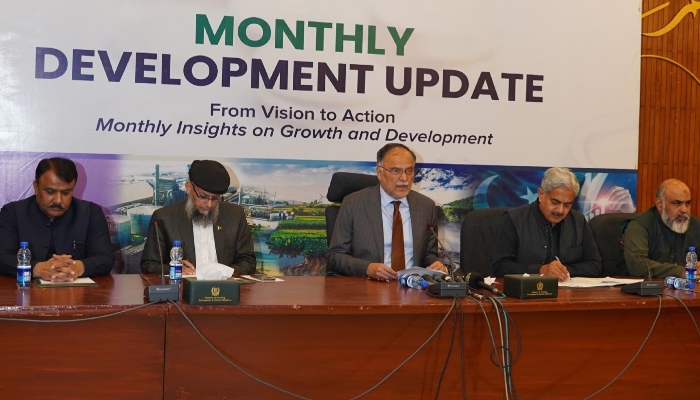
ISLAMABAD: Minister for Planning Ahsan Iqbal defended the decision to include donors’ representatives in the newly constituted Poverty Estimation Committee first time in the country’s history, arguing that they did not want discrepancies in poverty figures and would cross-check before its release.
Addressing a news conference on the Monthly Development Update on Friday, Ahsan Iqbal said that the incumbent government would not “drop the catch of CPEC”, adding that it was the PTI-led regime that had scandalised the CPEC in 2018, due to which Pakistan could not attract investment. Multi-billion dollar investment was diverted to other countries such as Cambodia, Laos, and other places due to brakes put by the PTI from 2018 to 2022, he added.
He said that China invested $25 billion under the China-Pakistan Economic Corridor (CPEC), but the PTI placed the brakes on it during 2018-2022. “Now the government has kick-started from ground zero, and this catch will not be dropped,” he added.
The present government negotiated with China to grant 10,000 scholarships for PhD in Artificial Intelligence (AI), engineering, and other fields. Pakistan is also negotiating the Knowledge Corridor with the United States for another 10,000 scholarships for the next 10-year period, he added.
He said that the government assigned the Higher Education Commission (HEC) to undertake a Performance Audit of all universities on seven parameters to gauge their evaluation, while a Memorandum of Understanding (MoU) with Cambridge to promote entrepreneurial knowledge among students.
Talking about the 27th Constitutional Amendment, the minister said that the amendment implemented the Judiciary-related clauses on which both the PMLN and PPP struck a deal under the Charter of Democracy (CoD). He said he was the fortunate one among those four leaders of both parties to draft the CoD. Related to the Armed Forces, he said that this amendment integrated the Armed Forces, keeping in view the new requirements of warfare. The minister said that in order to curb corruption in developmental projects, the government established a helpline to empower the masses to report any wrongdoings, and they would take prompt action against it. He said that the Monitoring and Evaluation Wing evaluated 22 projects in October 2025. Highlighting the resilience of Pakistan’s economy, he noted that despite the devastating floods of 2025, timely government interventions—including NDMA-led evacuations, coordinated relief operations, and proactive contingency planning—ensured continuity in critical sectors, safeguarded livelihoods, and reinforced the nation’s commitment to sustainable economic recovery.
Inflation, he said, remained on a declining trajectory, with July at 4.1 per cent and August at 3.0 per cent, reflecting early price stability. Flood-related disruptions caused a temporary increase, pushing inflation to 5.6 per cent in September and 6.2 per cent in October. Overall, the July–October average inflation stood at 4.7 per cent, significantly lower than 8.7 per cent in the same period last year.
After two consecutive years of contraction, large-scale manufacturing has entered a recovery phase, boosting demand for raw materials and fuel, and revitalizing industrial activity. The Federal Board of Revenue recorded Rs. 3.8 trillion in tax collections for July–October, marking an 11.4 per cent increase compared to the same period last year.
Goods exports, after an initial increase of 0.7 per cent in July–August, faced temporary setbacks due to flood-induced supply disruptions, resulting in a 4 per cent decline for July–October. Export of services grew by 14.7 per cent ($2.2 billion), with IT exports rising 20.5 per cent ($1.1 billion). Imports increased to $23 billion, up 15.1 per cent, reflecting industrial growth, trade liberalisation, and higher demand for capital goods. Remittances from overseas Pakistanis reached $13.0 billion, a 9.3 per cent increase over last year, signaling growing confidence in economic stability.


-
 Aurangzeb confirms Saudi Arabia $10bn interest, says B2B shift ongoing
 -
 Pakistan to build artificial island to boost oil exploration
 -
 Special pink bus service launched for women on Green Line route
 -
 Same number plates from other provinces lead to wrong e-challans for Karachiites
 -
 State institutions ‘fail’ to perform constitutional duties: KP CM
 -
 CTD orders psychological testing of police on VVIP security duty
 -
 Navy busts drug consignment valued at $130m
 -
 Three ex-secretaries in race for ETPB chief post