PM stresses need for NFC formula tweak after NA passes 27th Amendment
"We will not take any step that is not agreed upon by all the four units," says premier
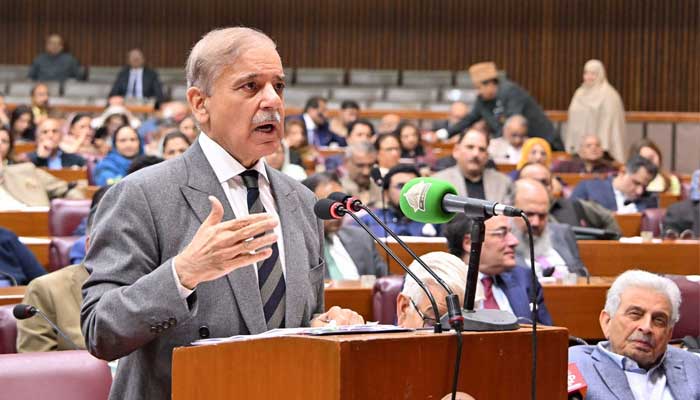
ISLAMABAD: Prime Minister Shehbaz Sharif on Wednesday said there could not be any change in the 18th Amendment without consultations.
“There are not two opinions that provinces, whether it is Balochistan or Sindh, should make progress,” he said, adding that he would oppose any measure that weakens the federation. He said that although the Kalabagh Dam is very important for the country, he would not support it if it weakens the federation. “My request is that we sit together and talk; we will not take any step that is not agreed upon by all the four units.” The prime minister said that we, together with the Pakistan Armed Forces and law enforcement agencies, are fighting terrorism. They are making the greatest sacrifices.
He condemned the terror attack at Islamabad’s district courts and said Pakistan is fully aware of its enemies’ activities and will deliver a befitting response. Terrorist groups, including TTP and BLA, backed by foreign elements, will not be allowed to obstruct peace, progress and development in Pakistan. The prime minister reiterated Pakistan’s desire for peace in Afghanistan, offering full support and inviting sincere dialogue to rein in terrorists operating from its soil. “Let us sit together with a sincere heart, rein in terrorists and commit to regional peace and progress.”
Referring to peace talks in Doha and Istanbul, the prime minister said the Afghan regime is regularly urged to rein in terrorists operating from its soil. He said that all Khwarij who attacked the Cadet College in Wana—who belong to Afghanistan—were killed, and all cadets rescued safely. “I congratulate the nation and thank the armed forces and law enforcement agencies for their high professionalism,” he said in the National Assembly after the 27th Amendment’s passage.
He said that while India rejected Pakistan’s claims, the terrorists who hijacked the Jaffar Express in Balochistan were in contact with handlers in India. “I can say with full belief that Pakistan knew your deeds already and will respond strongly, not allowing hurdles to the country’s progress,” he said.
Regarding the constitutional amendment, the prime minister said parliament has demonstrated national unity and solidarity, thanking coalition partners for their contributions and consultations. He noted that the Charter of Democracy clearly mandates establishing a federal constitutional court, adding that while the opposition has the right to differ, abusive language must end. “I do not understand why the opposition is unhappy with the constitutional courts,” he said.
He emphasized national solidarity and unity for economic growth, and thanked President Asif Zardari and PMLN Quaid Nawaz Sharif for their support. The nation appreciated granting Field Marshal rank to COAS Asim Munir, now constitutionally protected, underscoring that nations honour their heroes. The amendment also includes Marshal of the Air Force and Admiral of the Fleet. “What is wrong in this? This is how we honour our heroes,” he said. The victory in ‘Maarka-e-Haq’ enhanced Pakistan’s prestige, with leaders now warmly welcomed abroad. The prime minister also praised the Chief Justice of Pakistan, Yahya Afridi, for his outstanding reputation. “I also want to clarify here that he will also continue to head the Supreme Judicial Council, Judicial Commission, and Law and Justice Commission, and we also seek his guidance,” he said.
Earlier, the National Assembly passed the Constitution (27th) Amendment Bill, 2025 with more than a two-thirds majority, sending the amended bill back to the Senate with eight changes. The lower house passed the amendment with 234 MNAs in favour and four from the JUIF present in the House opposed. Except for four JUIF MNAs left in the House to vote against the 27th amendment, all the opposition parliamentarians walked out of the House after staging a protest. JUIF members Maulana Misbahuddin, Naeema Kishwar Khan, Shahida Akhtar Ali and Aliya Kamran were present in the House.
The rest of the opposition members, including those supported by the Pakistan Tehreek-e-Insaf (PTI), refrained from voting while staging a protest in front of the Speaker’s dais.
According to an insertion in the bill and Article 260 of the Constitution, the senior-most judge between the Chief Justice of Supreme Court and the Chief Justice of the Federal Constitutional Court shall be the Chief Justice of Pakistan. As per an amendment to Article 176, the incumbent chief justice shall continue to be known as the Chief Justice of Pakistan during his term. The 27th Amendment establishes a Federal Constitutional Court with equal provincial representation for constitutional matters, leaving other cases with the Supreme Court. Under the amendment, the President will appoint the Chief of Army Staff concurrently as Chief of Defence Forces on the Prime Minister’s advice, with the same process applying to other service chiefs. The office of Chairman Joint Chiefs of Staff Committee will be abolished effective November 27, 2025.
The House also approved the omission of three clauses passed by the Senate, meaning Articles 42, 214, and 255 will remain unchanged. Consequently, the Chief Justice of Pakistan will administer the oath to the president, election commissioner and any other constitutional office. Another omitted clause ensures Article 168 remains intact, meaning the Chief Justice of Pakistan will also administer the oath to the Auditor General of Pakistan. The House amended Article 6 to state that the Federal Constitutional Court, Supreme Court and high court shall not validate an act of high treason, inserting the Federal Constitutional Court’s name into the clause.
Minister for Information and Broadcasting Attaullah Tarar stated the amendment aims to strengthen governance, defence and the justice system. He criticised the opposition for “selective morality” and refusing to engage in the legislative process. Without naming Imran Khan, the minister questioned whether he would apologise for his role in a past referendum and the 2018 elections.
In a dramatic protest, opposition leader Mahmood Khan Achakzai tore up a copy of the 27th Amendment bill while declaring, “This government was established on Form 47.” He questioned the legitimacy of parliament to amend the Constitution. Achakzai called for a national government and transparent elections, and urged regional dialogue between Pakistan, India, Afghanistan and Iran to prevent the region from becoming a battlefield.
PTI Chairman Barrister Gohar Ali Khan condemned the Islamabad bombing as tragic and protested restrictions on meetings with PTI’s founder, noting their MNAs were arrested from parliament. He affirmed PTI’s continued commitment to Pakistan.
PPP Chairman Bilawal Bhutto Zardari declared the 27th Amendment ends suo motu powers, removing what he called the “Sword of Damocles” over governments. Bilawal emphasized implementing remaining Charter of Democracy provisions and pursuing Truth and Reconciliation to overcome national crises. He stressed ending political polarization and fostering mutual respect among politicians. The PPP chairman urged opposition parties to maintain parliamentary engagement emphasizing that legislation must emerge from thorough consensus, not surprise. He noted the PPP’s consistent role in building consensus, citing the 1973 Constitution and 18th Amendment as examples, and revealed PTI’s indirect involvement in previous constitutional negotiations through Maulana Fazlur Rehman.
Bilawal noted that the 18th Amendment, passed with broad political consensus after the defeat of a dictator, ensured fundamental democratic reforms and provincial autonomy. He contrasted this with the current 27th Amendment, lamenting its lack of similar all-party consensus despite its constitutional significance. He further stated that the Field Marshal and Armed Forces of Pakistan are being commended globally for inflicting a historic defeat on Modi’s regime by downing six Indian jets. “We are also witnessing the aftermath of India hosting the foreign minister of Afghanistan on our other border,” he noted. In this context, he said the PPP has decided to support the government’s recommendations regarding Article 243.
Bilawal confirmed the government consulted his party on the amendment leading to PPP’s conditional support after internal deliberation. He criticized the opposition parties for prioritizing protests over parliamentary engagement and failing to contribute through proper legislative channels.
Bilawal stated the 27th Amendment fulfills Charter of Democracy commitments by establishing a constitutional court and granting constitutional protection to the rank of Field Marshal following Pakistan’s historic military success.
Bilawal welcomed the government’s acceptance of PPP’s demand for equal provincial representation in the new constitutional courts. He contrasted this with Zulfikar Ali Bhutto’s trial, where unequal representation shook the federation’s foundations, and urged critics like Achakzai to acknowledge this achievement in provincial equality.
He said that in its initial draft, the government had proposed removing the protection granted to provincial governments under the NFC Award. The PPP firmly rejected this proposal, he stated, adding, “As long as I am the leader of this party, I will never support taking back the constitutional protections given to the provinces.”
He said that while everyone wishes for the country to overcome its financial crisis, such proposals imply a willingness to compromise on provincial rights simply because the FBR has failed to meet its targets. He said that the provinces of Punjab, Sindh, Khyber Pakhtunkhwa and Balochistan should not be penalised for the shortcomings of FBR or other federal financial institutions. Instead, he emphasized, all provinces should be empowered and entrusted with the responsibility to perform better than these institutions. He further said that the government had proposed reversing the devolution of the Education and Population departments, powers that were transferred under the 18th Amendment, which helped bury the politics of separatism.
He reaffirmed the PPP’s commitment to strengthening local governments and building consensus on South Punjab, while pledging to help resolve the ECP appointment deadlock democratically. The chairman strongly condemned the recent terrorist attacks, urging all political forces to unite against terrorism.
Later, after the passage of 27th Constitutional Amendment in the National Assembly, the head of the opposition alliance, Tehreek-e-Tahafuz Aayeen-e-Pakistan (TTAP), Mahmood Khan Achakzai, announced launching a public movement against the tweaks from Friday.
Achakzai, along with PTI Chairman Barrister Gohar, held a press conference in the Parliament House where they strongly criticised the newly-approved constitutional amendment. The TTAP head said that they are ready to hold talks with the incumbent government; however, it would be organised to discuss returning the stolen mandate.
PTI Chairman Barrister Gohar Ali Khan condemned the constitutional amendments as hastily passed measures serving personal interests. He criticized the restructuring of the Chief Justice position as a “musical chair” arrangement where Justice Afridi would serve until 2027, followed by the Federal Constitutional Court’s top judge. Gohar vowed to reverse these changes if PTI returns to power and denounced the presidential immunity clause, warning that while rulers might enjoy legal protection, they would ultimately face public accountability.


-
 Aurangzeb confirms Saudi Arabia $10bn interest, says B2B shift ongoing
 -
 Pakistan to build artificial island to boost oil exploration
 -
 Special pink bus service launched for women on Green Line route
 -
 Same number plates from other provinces lead to wrong e-challans for Karachiites
 -
 State institutions ‘fail’ to perform constitutional duties: KP CM
 -
 CTD orders psychological testing of police on VVIP security duty
 -
 Navy busts drug consignment valued at $130m
 -
 Three ex-secretaries in race for ETPB chief post