
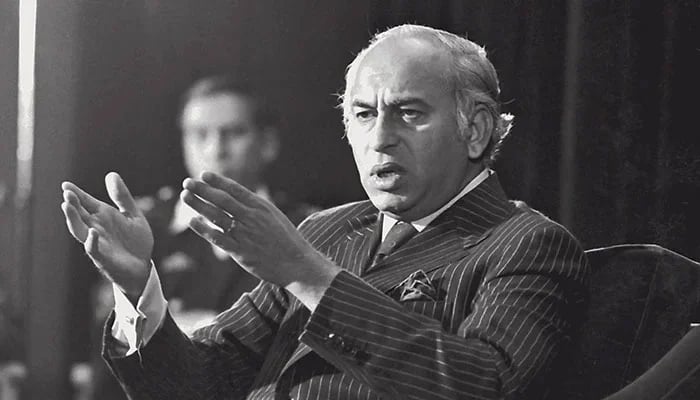
ISLAMABAD: The National Assembly on Monday passed a resolution recommending the federal government to officially declare former prime minister Zulfikar Ali Bhutto as a national martyr.
The resolution, moved by Jam Abdul Karim Bijar, stated that Zulfikar Ali Bhutto, founder of the Pakistan Peoples Party, former president, and former prime minister of Pakistan, made outstanding contributions to the country’s political, democratic, social, and nuclear development.
The resolution was adopted a day before the National Assembly is set to pass the 27th Amendment Bill on Tuesday, which envisages 48 changes to the 1973 Constitution. The House also suspended the private members’ day scheduled for Tuesday.
The resolution urged the federal government to issue an official notification recognizing Bhutto’s martyrdom in the national historical and democratic record. It further proposed that relevant federal institutions, educational curricula, and archives should reflect his contributions and services to the nation.
The House noted that millions of Pakistanis regard Bhutto as a national leader who sacrificed his life for democracy and people’s rights. “His efforts for national unity, empowerment of the common people, strengthening of democratic institutions, and establishment of Pakistan’s independent foreign policy are widely acknowledged,” the resolution stated. It recalled that ZAB was executed on April 4, 1979, following a judicial process that has since been widely criticized both nationally and internationally. The Supreme Court of Pakistan, it noted, recently observed that Bhutto did not receive a fair trial.
Following the resolution’s adoption, former Speaker Asad Qaiser remarked that while Zulfikar Ali Bhutto gifted the 1973 Constitution to the nation, his grandson was “playing havoc” with the same document.
He questioned how Bilawal Bhutto would face the people, claiming that even Sindh would reject his party. Criticizing the Awami National Party (ANP), Qaiser said Aimal Wali had deviated from his father’s path. He questioned how justice could prevail when the prime minister appoints the head of the Constitutional Court, adding, “Now we will have to move the International Court of Justice”.
Former prime minister Raja Pervaiz Ashraf, responding to critics of the 27th Amendment, asked whether a military commander who responded strongly to India should not be respected. He said those involved in the May 9 violence were “not bold enough to face martyrs and heroes of democracy and the armed forces.”
Ashraf defended the amendment process, saying PPP Chairman Bilawal Bhutto had reviewed each clause of the 27th Amendment. “I invite critics to point out a single weakness in the amendment,” he said, emphasizing that constitutional amendments require a two-thirds majority. He also defended immunity for the president, saying that heads of state worldwide enjoy such privileges. “The PPP’s founders created the Constitution, and now we are defending it,” he added.
JUIF parliamentarian Aliya Kamran questioned the government’s urgency in passing the amendment, asking, “Why are you in such a hurry when you already control all institutions?” She criticized the plan to amend 48 constitutional articles, calling it tampering with a sacred document, and expressed opposition to raising the retirement age of judges.
Minister for Railways Hanif Abbasi praised Field Marshal Asim Munir for his services, alleging that the PTI leadership prioritized personal over national interests. He condemned remarks by the KP chief minister and accused the PTI of acting as a “proxy for the country’s enemies”.
Opposition member Sher Afzal Marwat urged lawmakers to avoid blame games and indecent language, focusing instead on discussing the 27th Amendment. He also objected to certain proposed changes to Article 243 of the Constitution but condemned the opposition’s uproar during Raja Pervaiz Ashraf’s speech, calling it disrespectful to a former prime minister.




-
 State institutions ‘fail’ to perform constitutional duties: KP CM
 -
 CTD orders psychological testing of police on VVIP security duty
 -
 Navy busts drug consignment valued at $130m
 -
 Three ex-secretaries in race for ETPB chief post
 -
 Punjab govt forms 71 JITs to probe cases against banned TLP
 -
 Some UNSC members ignoring broader reforms, seeking privilege: Pakistan
 -
 PAC body discusses non-recovery of Rs15bn gas cess
 -
 Pakistan received $2.29bn foreign loans in first 4 months of 2025