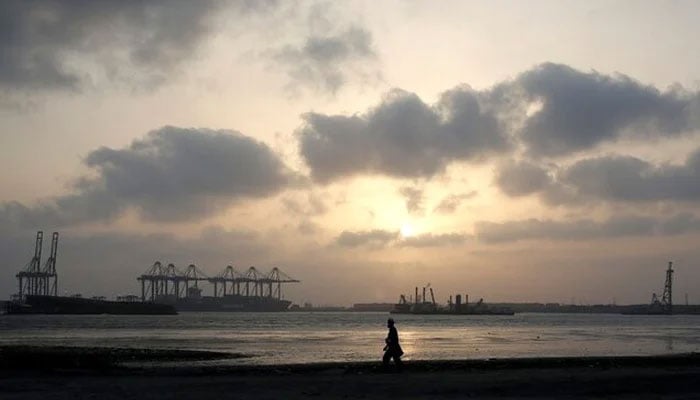
In 2022, industry experts and the government shifted their focus to Pakistan’s ‘blue economy’ soon after a Sindh-based mangrove restoration project was able to sell 50,000 tonnes of carbon-removal credits at a Singapore-based carbon exchange. But the focus soon lost its steam as the country and the experts moved on to other topics. The blue economy, and the benefits it carries for Pakistan, is now again in the spotlight. This time, Finance Minister Muhammad Aurangzeb has said that the blue economy is a ‘game-changer’ for the economy. He was speaking (virtually) at the Maritime Expo in Karachi this week. Pakistan’s ambition to grow the sector from a modest $1 billion contribution to an impressive $100 billion by 2047 may deserve applause, but it does raise questions over the country’s ability to reach its goal. Earlier this week, Aurangzeb termed the external deficit “manageable” and announced that the National Finance Commission (NFC) will begin its deliberations on the resource distribution formula. This is yet again a list of promises announced with almost no follow-up on how far the work has been done.
Growing the blue economy to $100 billion will require more than policy statements. It will demand continuity, capital and competent governance. Fisheries remain poorly regulated. Although the authorities have announced plans to invest in modernising ports, there is no roadmap. Without addressing these structural challenges, the blue economy will remain an unfulfilled promise. It is also important for Pakistan to ensure that its ambitious planning does not hurt both marine life and local communities. A few years ago, people in Balochistan protested against the use of big trawlers to catch fish. This practice would leave local fisherpeople without any catch. Whatever investment is made in the sector should have the local angle in focus. Equally important is the environment. Responsible fishing, renewable energy and green port operations must be central to any blue economy plan. The country has already witnessed the apocalyptic effects of climate change; any experiments with the natural ecosystem can cost it a lot if it does not exercise caution.
The recent goals suggest that collaboration will be key. Partnerships with countries such as China, the UAE and now European states like Romania can help integrate Pakistan into wider trade and energy networks. But trade pacts must not be one-sided. The World Bank has asked Pakistan to improve its skewed preferential trade agreements with 10 bilateral partners, ensure a market-determined and flexible exchange rate and push deeper reforms to lower energy and other input costs to turbocharge over three decades of declining exports for sustainable economic growth. Most experts are of the view that the country’s trade pacts do not favour Pakistan. As a result, goods of other countries dominate the Pakistani market while local manufacturers slowly leave the field. Pakistan’s deficit is manageable, and its blue economy goal is attainable. All we need is strong execution. Without institutional discipline and political consensus, the deeper reforms required to end the boom-and-bust cycle will remain out of reach.


-
 Aurangzeb confirms Saudi Arabia $10bn interest, says B2B shift ongoing
 -
 Pakistan to build artificial island to boost oil exploration
 -
 Special pink bus service launched for women on Green Line route
 -
 Same number plates from other provinces lead to wrong e-challans for Karachiites
 -
 State institutions ‘fail’ to perform constitutional duties: KP CM
 -
 CTD orders psychological testing of police on VVIP security duty
 -
 Navy busts drug consignment valued at $130m
 -
 Three ex-secretaries in race for ETPB chief post