ISLAMABAD: The rising debt burden has eaten away a major chunk of fiscal space and the government is proposing capping the share of the provinces under the National Finance Commission (NFC) Award.
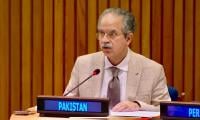
Major political parties, including the PMLN, PPP, PTI and MQM Pakistan, as well as economists and experts debated these issues during a SDPI conference on “Strengthening the Role of Parliament in Public Debt Management in Pakistan” on Wednesday.
Khyber Pakhtunkhwa’s Finance Adviser, Muzammil Aslam, pointed out that his province received Rs64 billion less than its due share from the Federal Divisible Pool (FDP) in the first four months (July-October) of the current financial year. Based on this assumption, he said this discrepancy might have resulted in Rs100 billion less being released for Sindh and Rs200 billion less for Punjab.
The political parties, economists and experts were unanimous on the need for a unified definition of public debt and liabilities in accordance with international standards and the establishment of an Independent Debt and Liabilities Office, free from the control of the Finance Division. The definition of public debt and liabilities has so far excluded the circular debt of both power and gas, unfunded pension liabilities ballooning to Rs50 trillion, commodities operations and some other liabilities. “At the end of the day, there are accounting issues and all these liabilities are part of the country’s debt, which is becoming unsustainable. The ratification of parliament for securing international and domestic borrowing must be made mandatory for transparency,” said former finance minister and PPP leader Syed Naveed Qamar while chairing the roundtable conference. He said that the executive had assumed the powers to secure borrowing and bypassed parliament. It is the discretion of parliament to get accurate information, and in case of its being withheld, it possesses the power to penalise those involved.
Rana Ihsaan Afzal, Coordinator to the Prime Minister, conceded that pension liabilities are piling up, which will become a headache after 25 to 30 years, although the government has proposed a solution for the new entrants. He raised the question about the sustainability of the increasing debt after the expiry of the IMF programme. The consumption and import-dependent growth model, he said, has resulted in boom and bust cycles.
Muzammil Aslam, KP’s Finance Adviser, proposed an autonomous body modelled on the Pakistan Bureau of Statistics (PBS) for devising strategy on debt, or an independent department to consolidate all debt and liabilities.
Meanwhile, in a separate press briefing, the Khyber Pakhtunkhwa government accused the federal authorities of worsening the country’s economic crisis through poor policies, warning that the proposed 27th Constitutional Amendment aims to reduce provincial shares and will not be accepted. KP’s Adviser on Finance Muzammil Aslam said the Centre is avoiding the National Finance Commission (NFC) meeting while floating the idea of changing the Constitution to curtail provincial funding.
Speaking at a press briefing in Islamabad, Muzammil Aslam stated that the federal government has floated the idea of the 27th Amendment while failing to reconvene the 11th NFC meeting originally scheduled for August. He accused the Centre of reducing provincial funds rather than cutting its own spending, highlighting that Rs 5,147 billion in non-tax revenue is retained entirely by the federal government and not shared with provinces. He argued that the claim provinces receive 41.5% of revenue is misleading for this reason.
Regarding federal finances, he noted expenditures of Rs17,593 billion, with only Rs1,000 billion allocated for development—far below the recommended 15-20%. He questioned the Centre’s financial management, pointing to a pension bill of Rs1,055 billion, grants of Rs1,928 billion, and subsidies of Rs1,186 billion, arguing these expenditures deepen the financial crisis instead of enabling reform.


-
 Aurangzeb confirms Saudi Arabia $10bn interest, says B2B shift ongoing
 -
 Pakistan to build artificial island to boost oil exploration
 -
 Special pink bus service launched for women on Green Line route
 -
 Same number plates from other provinces lead to wrong e-challans for Karachiites
 -
 State institutions ‘fail’ to perform constitutional duties: KP CM
 -
 CTD orders psychological testing of police on VVIP security duty
 -
 Navy busts drug consignment valued at $130m
 -
 Three ex-secretaries in race for ETPB chief post