
Governance, institutional reforms stressed to tap Loss & Damage Fund
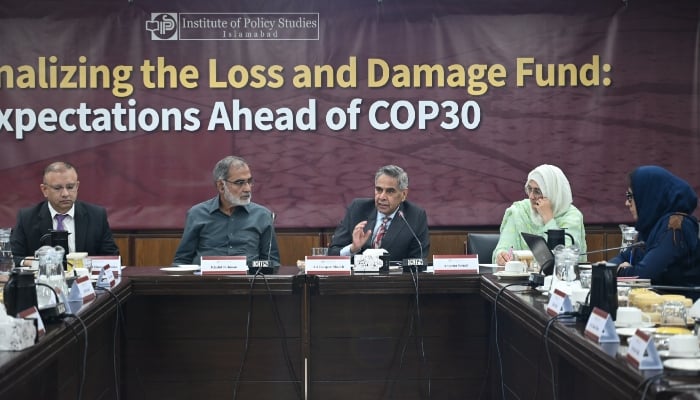
Islamabad:As the global community gears up for COP30, Pakistan faces an urgent need to strengthen governance, institutional readiness, and local resilience, and clarify access mechanisms to effectively benefit from the Fund for Responding to Loss and Damage (FRLD). While the fund presents a critical opportunity for Pakistan, persistent gaps in governance, capacity, accreditation and project preparedness continue to impede timely access.
Building climate resilience demands integrated planning, a better understanding of financing processes, bankable projects, and locally driven approaches. Without these, Pakistan risks remaining on the margins of emerging global climate finance flows, designed to compensate developing nations for climate-induced losses. These insights were voiced by climate experts at a roundtable titled ‘Operationalising the Loss and Damage Fund -- Expectations Ahead of COP30,’ held at the Institute of Policy Studies here on Tuesday.
IPS Chairman Khalid Rahman said Pakistan’s effective engagement with the Loss and Damage Fund depends on proactive preparation, good governance and institutional strengthening. He emphasised the importance of designing a coherent national strategy that bridges policy, technical and financial dimensions to build sustainable climate resilience.
Speaking on the evolving global framework of the Loss and Damage Fund, Ali Tauqeer Shaikh, senior climate expert and FRLD board member, said loss and damage financing is distinct from mitigation and adaptation efforts, as it compensates developing countries for the costs of building resilience.
He added that direct budget support under the fund had been confirmed but remained non-operational, pending adoption of the risk management framework. “Procedural obstructions are slowing direct access to the fund, and until national accreditation is achieved, countries will have to rely on multilateral entities for access,” he said. Shaikh said projects must demonstrate country ownership, measurable results and complementarity with national systems, with 50 percent allocation for least developed countries and geographic balance as guiding principles.
Senior energy economist Afia Malik said extreme weather events are already imposing heavy costs on Pakistan’s energy infrastructure. She pointed out that power distribution companies have not upgraded their systems to make them climate-resilient, emphasizing the need for climate risk assessments in procurement processes and least-cost planning that accounts for resilience. Dr Irfan Yousaf, climate expert and consultant, World Bank, noted that gaps in education, mindset and institutional readiness hinder effective responses to climate extremes.




-
 State institutions ‘fail’ to perform constitutional duties: KP CM
 -
 CTD orders psychological testing of police on VVIP security duty
 -
 Navy busts drug consignment valued at $130m
 -
 Three ex-secretaries in race for ETPB chief post
 -
 Punjab govt forms 71 JITs to probe cases against banned TLP
 -
 Some UNSC members ignoring broader reforms, seeking privilege: Pakistan
 -
 PAC body discusses non-recovery of Rs15bn gas cess
 -
 Pakistan received $2.29bn foreign loans in first 4 months of 2025