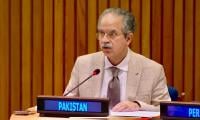
‘Demanding poor nations to go greener a global hypocrisy’
_updates.jpg)
Islamabad: Federal Minister for Climate Change Musadik Malik has accused the wealthy nations of ‘global hypocrisy’ for demanding developing countries go greener while withholding climate finance, saying nations like Pakistan, among the lowest carbon emitters but hardest hit by climate disasters, are being unfairly punished in the new world order.
Mr Malik was speaking at the inaugural plenary of the 4-day 28th Sustainable Development Conference organised by Sustainable Development Policy Institute in collaboration with Allama Iqbal Open University here Tuesday.
Alongside this mega event, 16th South Asia Economic Summit (SAES), 3rd Sustainability Investment Expo (SIE) and 9th South and South-West Asia Subregional Forum on Sustainable Development were also the part of the conference.
The Minister said that despite Pakistan emits less than 1 per cent of global greenhouse gases, it is bearing the brunt of floods, droughts and debt pressures. “Forty percent of emissions come from just two countries and 10 nations are responsible for 75 percent — yet they receive 85 per cent of global green financing,” Malik said. Meanwhile, countries like ours are told to be greener or face carbon taxes. What a hypocrisy, he asked.
Mr Malik criticised international lenders for asking Pakistan to “repurpose” funds meant for education and social welfare to rebuild infrastructure destroyed by climate disasters. When we ask for support, they tell us to redirect what little we have,” he lamented.
Bangladesh’s Advisor to the Ministry of Environment, Forest and Climate Change Syeda Rizwana Hasan echoed the concerns, warning that multilateralism is “losing ground” amid growing political unrest in South Asia. She said worsening natural disasters, soil degradation and regional disputes — particularly between upper and lower riparian nations — threaten millions of lives. “Pakistan has seen actions by upper riparian that violate international law,” she noted.
Earlier, in his welcome address, SDPI Executive Director Dr Abid Qaiyum Suleri said that the conference serves the region’s intellectual purpose where research meets policy, ideas meet responsibility and optimism meets realism.
This year’s theme captures the mood of our times, he said, adding that today, uncertainty prevailed across every front. “The familiar pillars of progress such as trade integration, multilateralism and predictable growth are weakening. Geopolitical alignments are shifting faster than our institutions can adapt. Climate extremes have become more frequent, costly, and political.” From the Himalayan glaciers to the Bay of Bengal, the climate crisis, debt stress and digital divides became our shared realities.


-
 Aurangzeb confirms Saudi Arabia $10bn interest, says B2B shift ongoing
 -
 Pakistan to build artificial island to boost oil exploration
 -
 Special pink bus service launched for women on Green Line route
 -
 Same number plates from other provinces lead to wrong e-challans for Karachiites
 -
 State institutions ‘fail’ to perform constitutional duties: KP CM
 -
 CTD orders psychological testing of police on VVIP security duty
 -
 Navy busts drug consignment valued at $130m
 -
 Three ex-secretaries in race for ETPB chief post