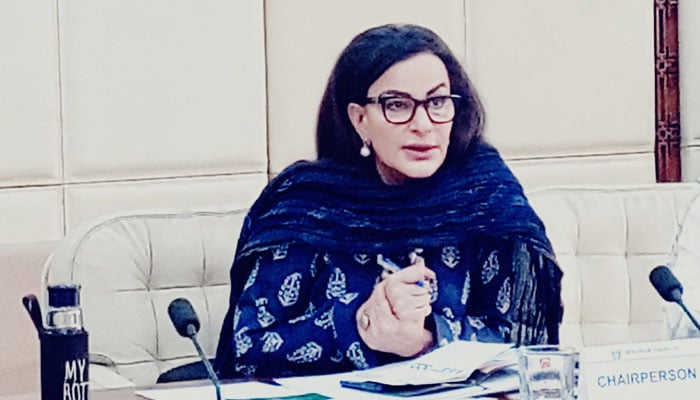
ISLAMABAD: Chairperson of the Senate Standing Committee on Climate Change and Environmental Coordination Senator Sherry Rehman has called for a bold regional approach to achieving a just and inclusive energy transition. She emphasised that the Pakistan-C2 region - comprising Pakistan, Kazakhstan, and Uzbekistan - with a combined population of 308.25 million and a GDP of US$848 billion (IMF), has the scale, capacity, and shared challenges to lead the Global South in defining a collective transition pathway.”We must dream the same green dream.
This transition cannot happen in silos. Pakistan and Central Asia must bargain collectively, build regional consensus, and move forward together in this defining decade. We hope to meet the challenge at multilateral forums together - not in isolation,” she said while speaking as the chief guest at the Pre-COP30 Pak-C2 Energy Transition Dialogue organised by the Institute of Regional Studies (IRS).Senator Sherry Rehman emphasised that “domestic climate governance responsibilities cannot be confused with climate justice at the multilateral level.
The world must not ask the most climate-vulnerable nations to carry the burden of others’ emissions.”She stated, “Anger at inaction at home should not stop the search for climate justice at global forums, as sharing responsibility is the very essence of climate politics - especially after the Paris Agreement.”Senator Rehman underscored that the global energy system remains dangerously unbalanced, with fossil fuels still receiving US$7 trillion in subsidies annually despite record renewable energy deployment.
“The world is adding renewables but not replacing fossil fuels,” she said. “This dual expansion is pushing frontline countries like Pakistan - where temperatures have reached 53°C - closer to the brink.”She warned that developing countries are “paying rent with human costs” for emissions they did not cause. “Pakistan emits less than one percent of global GHG emissions,” she reminded, “yet it bears the brunt of climate disasters, with floods, droughts, and crop losses destroying lives and livelihoods.”Drawing attention to the International Energy Agency’s (IEA) estimate that the world needs US$4.5 trillion per year in clean energy investments by 2030 to stay below 1.5°C, she said developing countries face high capital costs, limited de-risking tools, and fragmented institutions that constrain the energy transition.”Climate finance is not charity - it is justice,” Rehman stressed. “We must decolonise our thinking and demand equity in the global energy transition.”
She said that Pakistan has already updated its NDCs 3.0, seeking US$565.7 billion in climate finance by 2035 to cut its emissions from 2.559 billion tons to 1.28 billion tons.
Between 2021 and 2025, the country achieved a 37% emissions reduction - without significant external aid.However, she cautioned that domestic reforms must align with transition goals. “Our new net-metering policy, if not carefully designed, could disincentivise solarisation,” she said, referring to Pakistan’s aging grid, capacity payments, and inefficiencies. “Yet despite these challenges, Pakistan remains among the six most solarised markets globally - a testament to our people’s innovation and resilience.”Calling for structured regional collaboration, Senator Rehman proposed the creation of a “Pak-C2 Regional Energy Transition Taskforce” to coordinate cross-border action and unlock shared opportunities. The Taskforce, she suggested, should focus on: Joint R&D in renewable technologies and green hydrogen; regional grid integration under CASA-1000 and other corridors; unified green finance frameworks to attract large-scale climate investment; and transparent tariff and policy mechanisms to ensure predictability for investors.
“Technology offers common ground where politics falters,” she said. “When regions move together, critical mass becomes power - and that’s how real change happens.”She underscored that Pakistan and Uzbekistan have pledged carbon neutrality by 2050, while Kazakhstan - a manufacturing powerhouse - can play a leading role in low-emission industrial processes. “This debate must connect to our lived realities,” she said. “Energy justice and climate finance are not distant ideals - they are about the right to a liveable future.”
“Pakistanis are problem-solvers,” Senator Rehman concluded. “Give us one enabling policy - and we build, we fix, we innovate. That’s the hope we take to COP30.”


-
 Aurangzeb confirms Saudi Arabia $10bn interest, says B2B shift ongoing
 -
 Pakistan to build artificial island to boost oil exploration
 -
 Special pink bus service launched for women on Green Line route
 -
 Same number plates from other provinces lead to wrong e-challans for Karachiites
 -
 State institutions ‘fail’ to perform constitutional duties: KP CM
 -
 CTD orders psychological testing of police on VVIP security duty
 -
 Navy busts drug consignment valued at $130m
 -
 Three ex-secretaries in race for ETPB chief post