Understanding radicalisation: a conversation with Dr Clark McCauley
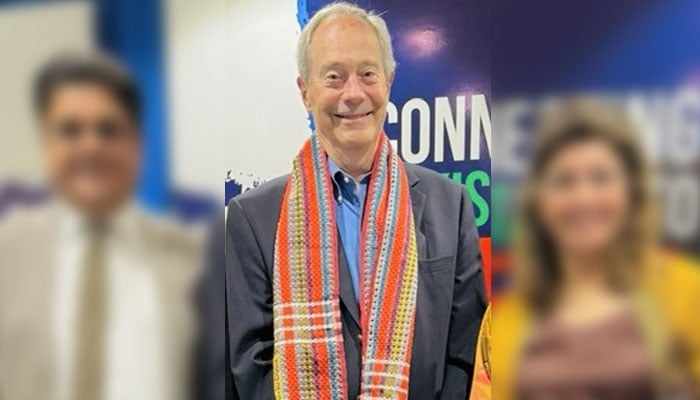
KARACHI: What began as a brief meeting with Professor Dr Clark McCauley on a warm October afternoon turned into an engrossing journey through the psychology of radicalisation -- its roots, its realities and the myths that cloud it.
Dr McCauley, an American social psychologist and long-time professor at Bryn Mawr College, has spent decades studying group dynamics, stereotypes and the psychological foundations of ethnic conflict, terrorism and genocide. On his first visit to Pakistan a couple of weeks back, he shared insights drawn from years of research and reflection on the psychology of political violence.
Political psychology, he explained, “is particularly relevant to all kinds of intergroup conflict, but especially those that involve violence”. As he put it, “I guess you could say I’m a specialist on terrorism and genocide -- or mass political murder, you could say”.
When The News asked how he defines “radicalisation”, Dr McCauley was quick to clarify that the term is often used loosely. “I try to have a consistent meaning”, he said. “My meaning is a change in beliefs, feelings or attitudes”. But even that, he noted, can be too broad: “I came to realise that actually the radicalisation of beliefs is a different problem -- a different psychology -- than the radicalisation to action.”
This distinction is at the heart of the ‘Two Pyramids Model’, which helps explain how people’s opinions and actions evolve -- or don’t. “In the opinion pyramid”, he explained, “at the bottom are people who have no opinion about a conflict, then there’s the layer above who sympathise, then those that support, then those who are ready to do something illegal, and the very top are people who are ready to kill civilians on the other side”.
In contrast, ‘the action pyramid’ begins with those doing nothing, then moves up to those taking legal action for a cause -- through politics, humanitarian work, or education -- followed by those who act illegally, and finally, those who turn to killing.
But, he cautioned, “These are not stages. It’s not true that in order to get up to a more extreme opinion, you have to go through the lower ones. Many people move immediately… There are people, for instance, who join a terrorist group because somebody they know and care about asked them to come and help. They could have no previous political ideas at all”.
When asked what drives people towards radicalisation, Dr McCauley offered a counter-intuitive insight: it’s not hate, but love. “Most people think that group conflict depends on hate”, he said, but really “, at the bottom is love. We have love for our own people -- our ethnicity, our nationality, our religion -- and with that love comes vulnerability. When we see the people we love being hurt or threatened by another group, we feel anger and fear. Those emotions push us toward both extreme ideas and extreme actions”.
Economic deprivation, he suggested, plays a subtler role. “What matters is not the level of economic success or failure.
What matters is a comparison”, he said. “When people feel that they are economically worse than another group and that this is unfair, that’s when the economic difference produces political conflict”.
This, he clarified, is why radicalisation is not simply a problem of the poor: “those who become violent actors or terrorists often turn out to be middle-class people… It’s middle-class people who are engaged with ideas, who can feel the suffering of other people that they care about”.
On the subject of ‘Jujitsu politics’ -- a term he coined -- Dr McCauley described how weaker actors provoke stronger ones into overreaction. “In our context, it’s a tactic of the terrorists. They attack to produce outrage, hoping that outrage will produce an overreaction -- and the overreaction will create new sympathy, new support, new recruits”. The US response after 9/11, he said, was a textbook example. “They [Al Qaeda] hoped to bring the US out from behind its stooges, as they saw the leaders of Muslim countries. And the US gave them what they wanted in Afghanistan -- and then we gave it to them some more in Iraq”.
Asked whether any state had successfully handled terrorism without resorting to heavy-handed security measures, Dr McCauley pointed to America’s response to the first World Trade Centre attack in 1993. “The US response was criminal justice”, he said. “We extradited people, tracked down others in our own country and abroad, brought them to trial, and they’re in jail right now”. He contrasted that restraint with the far more militarised reaction after 9/11: “Why didn’t the US behave like that again? I don’t have a good answer for that”.
The News asked whether states have become more securitised over time. “You know, in the UK they have this whole Prevent programme”, he said. “They’ve tried to make teachers agents of state security.”
He traced this growing securitisation to post-9/11 fears. “Each European country in turn has had an excuse to turn to increased security”, he noted. “Sometimes in very exaggerated form… You let a few bad actors turn the state and the people against all the Muslims in their midst, and the state goes around arresting people”. Talking about Le Pen and France, he said: “What is the effect of that on the integration of Muslims in France? This is going to create new sympathy, new support, new recruits another day”.
When asked about the increasing focus on ‘radicalisation of opinion’ -- people expressing extreme ideas online without acting on them -- Dr McCauley was sceptical. “That’s now the target,” he acknowledged. “I think it’s a very inefficient and ineffective way of trying to combat terrorism. It’s not focused on the action; it’s focused on the ideas”.
The conversation then turned to media narratives. When we asked whether journalism amplifies radical or extremist ideas, he replied by first challenging the vagueness of the terms. “There is no consensus in the definition of ideology or narrative...very few people have even tried to measure ideology in a poll… So, what I have tried to suggest is that there are three concepts from social movement theory that are more specific and measurable -- the motivational, diagnostic and prognostic frames”.
He broke these down: “The diagnostic asks what’s wrong and who’s responsible. The prognostic asks what we should do about it -- violence, politics, education, service. And the motivational asks who should act and why”. These, he said, offer a clearer lens through which to assess how media can either reinforce or challenge extremist narratives. Answering the original question through this lens, he added: “It depends on which media you’re talking about... In social media, you can find everything -- from the most peaceful things to the most horrific, violent, hateful things”.
On the question of whether journalism simplifies complex subjects like radicalisation, Dr McCauley offered: “Well, it usually favours the government”, recalling how coverage of the Irish Republican Army changed over time. “First, they were always ‘terrorists’.
Then they became ‘militants’. It seemed to be a step toward being less judgmental, less governmental”.
As our conversation drew to a close, The News asked for his impressions of Pakistan. “It’s hard to be an expert in just five or six days”, he said, smiling. “But I have learned a lot -- the complexity of the ethnic, language and historical divisions, the differences between those who came in 1947 and those who were already here”.
And yet, he added, “after meeting some young people during my time here, I do feel hope for this place”.


-
 Aurangzeb confirms Saudi Arabia $10bn interest, says B2B shift ongoing
 -
 Pakistan to build artificial island to boost oil exploration
 -
 Special pink bus service launched for women on Green Line route
 -
 Same number plates from other provinces lead to wrong e-challans for Karachiites
 -
 State institutions ‘fail’ to perform constitutional duties: KP CM
 -
 CTD orders psychological testing of police on VVIP security duty
 -
 Navy busts drug consignment valued at $130m
 -
 Three ex-secretaries in race for ETPB chief post