
Administration in Kabul blamed for ‘deadlock’ in Istanbul talks
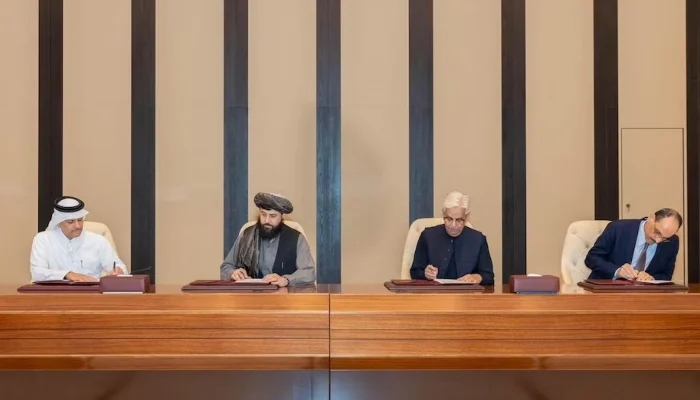
ISTANBUL/ ISLAMABAD: After two inconclusive rounds, the latest round of Pak-Afghan talks in Istanbul is also facing difficulties, sources said on Monday, as the Afghan Taliban delegation is not ready to fully accept Pakistan’s “legitimate” demands, and there is no encouraging response from the Kabul administration, which is creating a deadlock.
The sources noted that the Afghan Taliban delegation itself, interestingly, also believes that it is right to accept these demands, so it would be fair to say they are being controlled from Kabul. “The Afghan Taliban delegation has repeatedly contacted the Kabul administration and is moving forward according to their orders,” the sources added.
The sources emphasised that the logical and reasoned demands that Pakistan has presented are legitimate, but the Afghan Taliban delegation is not ready to fully accept these demands. “The host countries also admit that these demands of Pakistan are reasonable and legitimate,” they added.
The Pakistani delegation has repeatedly made it clear that accepting these demands is in everyone’s interest, and that the host countries have also explained the same thing to the Afghan delegation, the sources said.
However, they added, there is no encouraging response from the Kabul administration, which is creating a deadlock. “It seems that some elements in Kabul are working on some other agenda.” The Pakistani delegation’s position remains logical, strong and indispensable for peace, the sources stressed.
After two previous inconclusive sittings, Pakistan and the Afghan Taliban commenced their third round of talks in Turkiye’s capital, Istanbul, in the aftermath of the recent border skirmishes and clashes between the two sides in the ongoing month.
Islamabad reiterated its principled stance, urging the Taliban regime to end its patronage of the khawarij — a term commonly used for outlawed Tehrik-i-Taliban Pakistan (TTP) — which is involved in carrying out deadly attacks in Pakistan, as well as cross-border attacks from Afghanistan. Pakistan asked the Taliban regime to prevent the use of Afghan soil for terrorist activities against Pakistan.
Despite negative and external influences, Pakistan and friendly countries are making serious efforts to advance the dialogue, while the latter remain sincerely engaged in moving the talks forward in a positive direction.
After agreeing to a ceasefire, brokered by Qatar and Turkiye, both nations have held two rounds of negotiations — with no result so far — and have now commenced a fresh round of talks, said sources.
Pakistan launched a retaliatory campaign after the Taliban, aided by their affiliated militants, resorted to unprovoked firing along the border earlier this month.
Pakistan Armed Forces repelled multiple attacks on their border posts, killing over 200 Taliban and affiliated militants. However, 23 soldiers embraced martyrdom during the border clashes. Pakistan also conducted “precision strikes” in Afghanistan’s Kandahar province and Kabul, destroying terrorists’ multiple strongholds.
Following the clashes, Pakistan closed its border crossings with the neighbouring country, saying that the lives of Pakistanis were more important than the movement of goods or trade. Meanwhile, Islamabad continues to raise its concerns over the Taliban regime acting as an Indian proxy against it.
During the second round of talks, Pakistan urged the Taliban regime to take concrete and definitive steps to dismantle terrorist networks operating from Afghan soil. Security sources said the Taliban’s arguments during the exchanges were “illogical and detached from ground realities”, reinforcing doubts about their willingness to work towards genuine regional stability.
They added that further progress in the talks hinges entirely on the Taliban’s attitude and readiness to cooperate in good faith. Pakistan has presented its final position to the Afghan side, making it clear that any tolerance or shelter for militants targeting Pakistan would not be acceptable.
However, the Afghan Taliban have shown inflexibility to cooperate or acknowledge ground realities, a stance that has become increasingly clear to other mediating parties as well. The sources had earlier said that Turkiye was trying to bridge the gap by helping the Taliban delegation grasp the evidence and the gravity of Pakistan’s concerns. However, the security sources said progress will depend on whether the Taliban engage with seriousness and abandon their current intransigence.


-
 State institutions ‘fail’ to perform constitutional duties: KP CM
 -
 CTD orders psychological testing of police on VVIP security duty
 -
 Navy busts drug consignment valued at $130m
 -
 Three ex-secretaries in race for ETPB chief post
 -
 Punjab govt forms 71 JITs to probe cases against banned TLP
 -
 Some UNSC members ignoring broader reforms, seeking privilege: Pakistan
 -
 PAC body discusses non-recovery of Rs15bn gas cess
 -
 Pakistan received $2.29bn foreign loans in first 4 months of 2025