Collapsing coral
It’s the largest living structure on Earth, 3,000 individual reefs, 900 islands, 1,430 miles, and it may be collapsing. Alas, The Great Barrier Reef Annual Summary Report of Coral Reef...
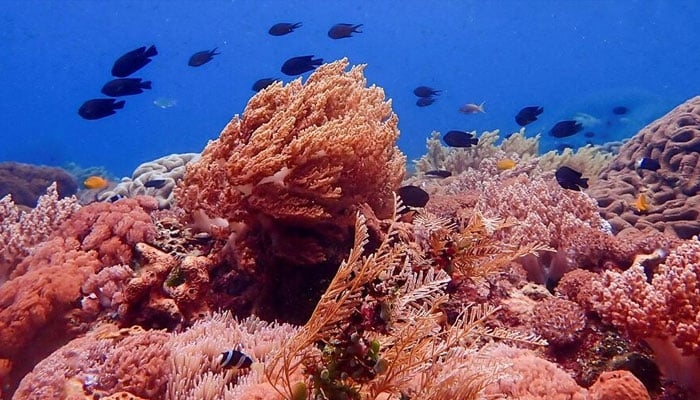
It’s the largest living structure on Earth, 3,000 individual reefs, 900 islands, 1,430 miles, and it may be collapsing. Alas, The Great Barrier Reef Annual Summary Report of Coral Reef Conditions, 2024-2025 presents a dire picture, the poorest condition ever, the worst report in recorded history. Moreover, mass bleaching of coral has been confirmed in 83 countries. Something is seriously wrong with the oceans; this is too anomalous, too massive to ignore as a passing one-off event.
Coral reefs have experienced bleaching events over the years because of ocean heatwaves and recovered, but nothing in the past compares to this onslaught. A new all-time record of ocean heatwaves was set in 2023-24-25 with 500 days of continuous excessive heatwaves, suggesting a dreaded ocean regime shift. The Oceans are Overheating – and Scientists Say a Climate Tipping Point May be Here, ScienceDaily d/d July 26, 2025.
Alarm bells should be ringing throughout the world, waking up the world’s leadership to an omen that nobody in their right mind wants to hear; Anthropogenic (human) generated greenhouse gas emissions, like CO2, have already heated up the oceans enough to threaten the survival of the world’s most iconic natural treasure, considered one of the “Seven Natural Wonders of the World.” Too much ocean heat is more than warm-water coral can handle. After all, over 90% of the heat trapped by greenhouse gas emissions is absorbed by the ocean.
The world of coral is on life support. Coral reefs, aka; the rainforests of the sea are crucial to marine life and importantly serve as an early warning signal of worldwide climate system trouble turning deadly serious. This new risk comes through loud and clear in the newest edition of the Global Tipping Report 2025 just released, a compilation of 160 authors from 23 countries and 87 institutions.
“Even under the most optimistic future warming scenario – one in which global warming does not exceed 1.5 degrees Celsius above pre-industrial times – all warm-water coral reefs are virtually certain to pass a point of no return. That makes this ‘one of the most pressing ecological losses humanity confronts.” (Coral Collapse Signals Earth’s First Climate Tipping Point, ScienceNews, October 12, 2025)
But humanity does not satisfactorily “confront pressing ecological losses.” It holds huge world conferences to talk about troubles and chit chats about this and that, but no major coordinated solutions ever play out. For example, at the Paris 2015 climate conference, the most significant climate meeting in history, the nations of the world committed to cutting CO2 emissions, taking mitigation measures, etc. to halt global warming.
Alas, 10 years later, it is universal knowledge that they are not even close to meeting Paris ’15 Nationally Determined Contributions (NDC) to stop global heat.
Not even close. In fact, CO2 emissions are up more than 200% since 2000, up from an annual rate of 1.25 ppm in 2000 to a soaring 3.75 ppm in 2024. As a result, all kinds of bells and whistles and alarms are going off with red lights flashing danger ahead on several global overheating fronts.
Indeed, coral reefs are the most sensitive natural ecosystems on the planet. Across the globe they are in deep trouble because of record ocean heat. And oceans do not generate heat, they absorb it. Now, it’s kicking back into the face of humanity. Enough is enough.
Excerpted: ‘The Great Barrier Reef, Collapsing?’. Courtesy: Counterpunch.org