
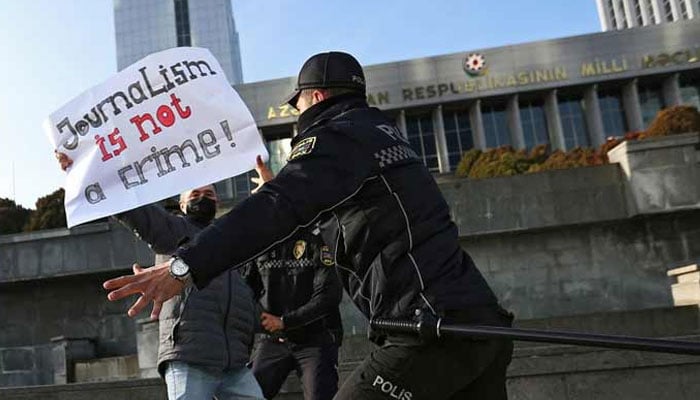
KARACHI: The International Press Institute (IPI) has passed resolutions calling on states and world leaders to reaffirm their commitment to press freedom, safeguard the role of human-made journalism in the age of artificial intelligence and end the global crisis of impunity for crimes against journalists.
Three resolutions were adopted unanimously by the IPI’s members at its 74th annual General Assembly on October 15, 2025, and presented at the IPI World Congress in Vienna on Saturday.
Founded in 1950, the International Press Institute is a global network of editors, media executives and leading journalists dedicated to promoting press freedom and defending the rights of journalists. Headquartered in Vienna, the IPI monitors violations of media freedom worldwide and advocates for independent journalism.
In one resolution, titled ‘States, world leaders must recommit to the value of independent media as the cornerstone of free societies”, the IPI warned that the institutions of free society were under “unprecedented attack worldwide”.
“IPI was founded 75 years ago on the belief that a free and independent press helps build a better, freer, and more peaceful world”, the resolution stated. “Over the past decades, we have stood together in the face of political pressure, censorship, and repression to defend the rights of journalists and the vital role they play in holding the powerful to account”.
Reaffirming the media’s place alongside other independent institutions such as the courts, academia and civil society, the IPI noted that “journalists inform the public, share ideas and opinions, and hold the powerful to account for actions and decisions that impact the public’s rights and freedoms”.
The organisation cautioned that “authoritarianism is on the rise” and that governments and political elites “openly seek to dismantle institutional checks on their power and brazenly flout the rule of law and accountability mechanisms designed to safeguard against abuse and overreach”.
It also expressed alarm that the term “independent media” had been “co-opted and distorted by pundits, influencers and politicians from across the political spectrum”, and that “the term ‘mainstream media’ has been turned into a slur, weaponised to delegitimise professional journalism and erode public trust in fact-based reporting”.
“These attacks”, the resolution warned, “are deeply dangerous tactics designed to erode public trust not only in the media but in all independent institutions”.
Calling on world leaders to “step up to defend the principles and institutions of free society”, the IPI urged them “to recognise and reaffirm the value of the media as an independent institution that is essential to safeguarding our rights and freedoms”. It added: “The rights of journalists to report on matters of the public interest, without fear or favor, is a bedrock of free society – and a free world”.
The second resolution, titled ‘In the age of AI, human-made journalism must be prioritised and protected’, acknowledged the potential of artificial intelligence while emphasising that it “is not a substitute for the essential human role in newsgathering, fact-checking, and holding power to account”.
“We, as a community of media professionals, embrace the transformative role of artificial intelligence in offering new tools to enhance reporting, aid investigations, and connect newsrooms to audiences in innovative ways”, the resolution stated. “When used responsibly, AI can make journalism more sustainable and improve access to reliable, independent news and information”.
However, the IPI cautioned that “AI-driven algorithms controlled by a handful of technology companies increasingly shape what people read, see, and share, often privileging divisive or sensational material over news of genuine public value”.
It expressed concern that “large language models and other generative AI systems are being trained on vast amounts of journalistic content without consent, credit, or compensation -- undermining copyright, devaluing original reporting, and threatening the economic sustainability of newsrooms”.
“In a world where fact and fabrication are increasingly difficult to distinguish”, the IPI said, “human-centred reporting is the antidote to disinformation, ensuring the media can continue to play its watchdog role”.
The organisation called on policymakers, technology companies and stakeholders “to prioritise and safeguard the conditions in which human-made journalism can survive and thrive, to promote media pluralism, and to ensure that independent journalism can function unhindered in the age of AI”.
In its third resolution, ‘States, world leaders must exercise political will to tackle the global crisis of impunity for crimes against journalists’, the IPI condemned the persistent failure of states to ensure accountability for attacks on the press.
“Around the world, journalists are threatened, attacked, and killed -- and in nearly all cases, these crimes go unpunished”, it said. “It is essential that states and political leaders exercise the political will to uphold the rule of law and the body of binding global commitments protecting the rights of journalists to carry out their work freely and safely”.
The resolution highlighted the situation in Gaza, where “at least 235 journalists have been killed by Israeli forces -- many deliberately targeted -- since the start of the war two years ago, making this the deadliest conflict for journalists on record”. It noted that “not a single case has been credibly and independently investigated”.
“Beyond Gaza”, the IPI said, “journalists in many parts of the world face growing attacks and risks to inform the public about conflict, political turmoil, corruption, and organised crime -- yet these attacks are rarely investigated or prosecuted”.
It cited examples from Haiti, Sudan, Somalia and Mexico, calling them evidence of a “global nature of the crisis of impunity and accountability in which blatant violations of laws and norms by the powerful have become routine”.
“Impunity for human rights abuses is like a contagion: eroding the rule of law, trust in democratic institutions, and fueling further violence”, the IPI warned. “What is clear is that laws and international agreements alone are not enough: it requires political will and political leaders who are committed to upholding the rule of law -- and who believe in the free societies and the rules and rights-based order -- to stand up for these commitments and principles in practice”.
The IPI concluded that governments must “investigate, prosecute, and punish crimes against journalists -- even when the pursuit of justice means holding political allies and powerful elites to account”.




-
 State institutions ‘fail’ to perform constitutional duties: KP CM
 -
 CTD orders psychological testing of police on VVIP security duty
 -
 Navy busts drug consignment valued at $130m
 -
 Three ex-secretaries in race for ETPB chief post
 -
 Punjab govt forms 71 JITs to probe cases against banned TLP
 -
 Some UNSC members ignoring broader reforms, seeking privilege: Pakistan
 -
 PAC body discusses non-recovery of Rs15bn gas cess
 -
 Pakistan received $2.29bn foreign loans in first 4 months of 2025