Flour and the federation
Punjab’s curbs on wheat and seed flows show that Pakistan’s food balance rests on trust, not coercion
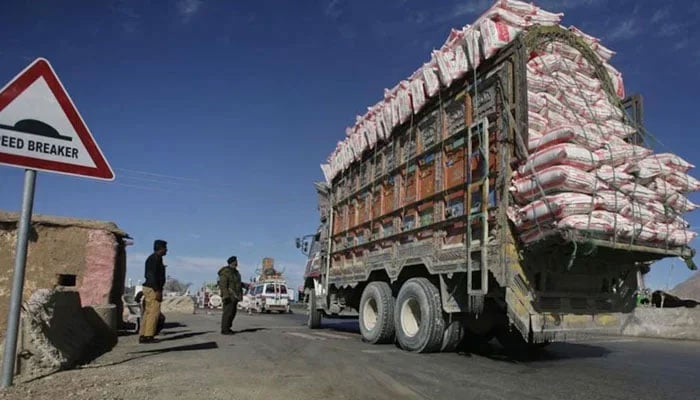
Pakistan’s federation tends to reveal its fragility not only in constitutional crises or secessionist slogans, but in the quieter frictions of bread-and-butter logistics as well.
The latest quarrel over wheat flows – Punjab restricting the movement of grain and flour to Khyber Pakhtunkhwa, and the supply of seed to Sindh – is a reminder that the political compact tying a food-producing heartland to food-deficient peripheries operates on confidence, not coercion. When that confidence weakens, even the traffic of flour becomes a constitutional argument. KP warns that the restrictions violate Article 151(1), which bars provinces from erecting internal trade barriers. Sindh alleges that Punjab has blocked seed shipments paid for in advance, jeopardising sowing and thus the province’s next harvest.
The language of protest – ‘attack on rights”, ‘anti-Sindh policy’, ‘economic exploitation’ – is familiar. So is the pattern: one province acts in protective self-interest; another frames it as predation; the federal response comes late and grudgingly, if at all.
In a rich and trusted federation, such disputes would be technical and brief. In a poorer, mistrustful one, they become symptoms of a deeper fear: that the union serves some provinces better than others, and that when scarcity arrives, the bigger partner will behave like a sovereign, not a sibling. Punjab’s dominance in the federal apparatus sharpens this perception. Nothing in a federation prohibits this. The imbalance may be accidental; the resentment is not. Provinces that already feel politically outvoted, fiscally constrained and institutionally marginalised interpret interruptions in commodity flows as proof that federal promises are contingent, not structural.
In theory, the post-18th-Amendment order promised greater autonomy and a more dignified provincial role in resource governance. In practice, provinces still depend on the centre for fiscal space and on Punjab for food supplies. Autonomy without redundancy is a fragile good: the moment the ‘supplier province’ closes the valve, the ‘autonomous’ unit discovers the limits of paper federalism. In the context of federal design, ‘redundancy’ means having alternative capacity so that a province is not ruined when one supplier or one actor fails or withholds. The dispute is particularly dangerous because the underlying material reality has shifted.
Pakistan is now a low-growth, high-inflation, high-unemployment federation in which food insecurity is no longer a peripheral phenomenon. KP is wheat-deficient; Balochistan is both food-deficient and fiscally deprived, keeping in mind its huge area; Sindh is structurally suspicious of Punjab's economic power; and Punjab – which produces the surplus others depend on – is increasingly tempted to securitise that surplus under pressure from its own needs and its own electoral incentives. When scarcity sharpens, federalism becomes a zero-sum market of protections rather than a cooperative insurance scheme. The episode also exposes the difference between constitutional intent and federal instinct.
Article 151(1) forbids provincial trade barriers, but no Pakistani province believes in frictionless internal commerce when its own stocks are tight. Provinces practise constitutionalism in surplus and protectionism in scarcity. What is being called a ‘ban’ is in reality something worse than illegality; it is normalisation. Once one province learns that it can restrict without consequence, every other province will reciprocate when its turn comes. A tit-for-tat federation is a slow-motion disunion.
Sindh’s protest over seed is structurally similar. Wheat seed, largely coming from Punjab, has been halted at source just as the sowing season opens. That is the conversion of a seasonal biological cycle into a political lever. The risk is not only economic. When KP or Sindh call such moves ‘anti-Sindh’ or ‘an attack on rights’, they re-activate a vocabulary that carries longer histories – from the One-Unit era to NFC quarrels to water disputes.
Even when the immediate issue is technical, the rhetoric is existential because the federation has never fully convinced its peripheries that core decisions are made with mutual rather than majoritarian rationality. Language hardens because trust is thin. The federal government, dominated by Punjab’s political and bureaucratic elite, appears defensive rather than reflexively conciliatory. That is precisely backwards for a fragile federation. In cohesive federations, the largest unit overcompensates to signal commitment; in brittle ones, the largest unit insists on entitlement and forgets that arithmetic strength does not convert to legitimacy without restraint.
When the state cannot visibly protect living standards, it must at least protect procedural fairness; otherwise, provinces translate economic pain into constitutional grievance. A hungry province is combustible; a hungry and humiliated province is unstable. That instability does not announce itself as secessionism. It first appears as non-compliance, inter-provincial obstruction, litigation and administrative veto.
A federation does not break when someone raises a flag – it breaks when units cease to behave as if they will need one another tomorrow. The wheat quarrel is precisely that: a loss of the presumption of future cooperation. It is not about flour but about doubt. Such doubt is magnified by the perception, fair or not, that Punjab’s dominance at the federal apex is now total. Top office holders from one province are constitutionally permissible but politically combustible in a federation with a long memory of centre–periphery asymmetry.
Federations are not only legal architectures; they are psychological contracts. KP’s protest language – calling the restriction ‘an attack on rights’ – is not accidental. In a centralised unitary state, a supply restriction would be called administrative misjudgment. In a federation, it is framed as a rights violation because the province views the centre and the dominant province not as supervisors but as co-equals. When a co-equal behaves unilaterally, the act is politicised by design. The same logic explains Sindh’s charge of ‘economic exploitation’ and ‘anti-Sindh policy’.
Material deprivation is translated into moral injury precisely because the federation has not earned emotional neutrality. The cumulative effect is corrosive. Provinces that already feel short-changed in fiscal transfers (via the NFC), in development expenditure, in federal employment shares, in resource extraction (from gas to minerals), now apprehend a new layer: vulnerability in basic commodities. When salt wounds meet empty shelves, the risk is not rebellion but disengagement – the quiet decision by smaller units that the centre is neither protector nor arbiter, merely another contender with a larger stick. Balochistan watches this from a still humbler vantage.
If KP, with numbers and pressure, cannot secure compliance with Article 151(1), what chance does a poorer, thinner, politically weaker province have when its turn comes? One province’s defeat becomes another province’s prophecy. The wheat quarrel has arrived in a country already stretched to the edge. Pakistan today is not merely an unequal federation; it is an impoverishing one. Food inflation has broken household arithmetic; unemployment has crushed mobility; and informal work has replaced upward ladders with survival rungs. In prosperous federations, disputes are buffered by surplus; in poor ones, every quarrel compounds despair.
When citizens cannot buy flour, they do not merely blame the market; they blame the government, and if the dispute is interprovincial, they blame the federation. This is why the episode matters: because it is a stress test of habits under scarcity. The formal constitution assumes trust; the living federation assumes suspicion. Between those assumptions lies the gap in which fragile states fail quietly before they fail visibly.
The writer holds a PhD from the University of Birmingham, UK. He tweets/posts @NaazirMahmood and can be reached at:
mnazir1964@yahoo.co.uk