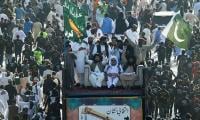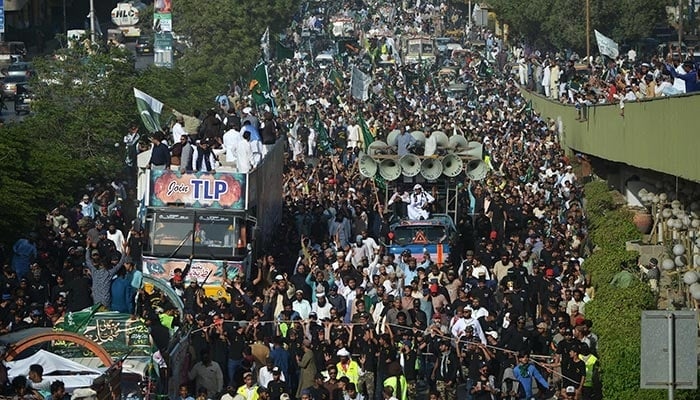
KARACHI: Legal and constitutional experts have weighed in on whether the government’s decision to ban the Tehreek-e-Labbaik Pakistan (TLP) under the Anti-Terrorism Act (ATA), 1997 can stand without a reference to the Supreme Court, saying that while the government can take temporary preventive action under the ATA, any permanent dissolution or deregistration of the political party would require following the constitutional route under Article 17(2) of the constitution and Section 212 of the Elections Act, 2017.
Reema Omer, a legal expert associated with the International Commission of Jurists, noted the distinction between the two legal frameworks in a post on X (Twitter): “The government has proscribed TLP under ATA, not the Elections Act/Art 17 of the constitution. There is no indication yet that the government also plans on dissolving TLP as a political party by making a declaration under [the] Elections Act/Art 17 and referring the matter to the SC”.
According to Reema (on X), there is a proper process to be followed if a political party is to be banned: “ATA empowers the federal government to proscribe ‘organisations’ that are ‘concerned with terrorism’ ex parte (without informing or hearing the organisation concerned). The banned organisation can file a review before the government within 30 days, after which it can appeal to the high court”. She also posted that action against proscribed organisations would “not include de-seating their MPs (TLP has one in Punjab) or barring them from contesting elections”.
To dissolve a political party, explained Reema in her post, the government would have to “make a declaration that a political party is ‘operating in a manner prejudicial to the sovereignty or integrity of Pakistan’ or is ‘indulging in terrorism’.” And then “within 15 days of making such a declaration, the matter has to be referred to the SC. If the SC upholds the declaration after hearing the party in question, the political party is dissolved. Its MPs are disqualified and it can no longer contest elections”.
Lawyer Abuzar Salman Khan Niazi echoed this interpretation, stating that the government’s action so far has not dissolved the political party itself: “Tehreek-e-Labbaik Pakistan (TLP) has been proscribed under the Anti-Terrorism Act, 1997 not dissolved or banned as a political party under the Election Act read with Article 17 of the constitution. The organisation is proscribed but the political party still exists”, he said.
Talking to The News on Friday night, Supreme Court advocate Basil Nabi Malik also underlined that the legal standards for banning a political party are higher than those for proscribing an organisation: “Article 17(2) of the constitution requires a reference to the Supreme Court within 15 days of the federal government’s declaration that a political party has been formed or is operating in a manner prejudicial to the sovereignty or integrity of Pakistan. The ATA, however, may seek to prescribe an ‘organisation’ on having reason to believe that such an organisation is concerned in terrorism. Even in this scenario, eventually, the prescription will end up in the superior courts”.
Malik added that, while the ATA deals with terrorism-related concerns and allows the government to impose restrictions on organisations suspected of such activity, “the dissolution of a political party is a process outlined specifically in the constitution, and the underlying law made thereunder. The matter of dissolution is considered a hugely significant measure, and perhaps even draconian, which is why a reference to the SC has been considered mandatory in it and a constitutional protection afforded to the political part”.
He cautioned that “if the government seeks to dissolve the political party in the garb of invoking Section 11-B of the ATA, it may be reasonably argued that such a dissolution would be in violation of Article 17(2) of the constitution, amongst other laws, which has provided a clear mechanism for achieving such ends”.
Citing Section 212 of the Elections Act, he noted that “a federal government may issue a declaration that a political party is foreign funded, a threat to the sovereignty and integrity of Pakistan, and/or indulges in terrorism, and within 15 days of that, the matter is referred to the SC for confirmation or rejection. As such, a proscription under the ATA invites certain restrictions on the organisation with concerns of terrorism, whereas you would have to invoke Article 17(2) of the constitution and Section 212 of the Elections Act to dissolve the political party itself”. Hafiz Ehsaan Ahmad Khokhar, an advocate of the Supreme Court, meanwhile, described the federal cabinet’s decision as an exercise of the state’s lawful powers to maintain public order. He told The News that the move was taken under Section 11B of the ATA on the recommendation of the Punjab government and the Ministry of Interior “in view of law and order concerns emerging from recent events”.
Khokhar explained that, while Article 17(2) guarantees citizens the right to form political parties, this right is subject to reasonable restrictions in the interest of Pakistan’s sovereignty and security. He added that the ATA provides for temporary administrative measures -- such as freezing assets, suspending activities or restricting assemblies -- once a group is proscribed by the government.
At the same time, he noted that the Elections Act, 2017 and the Political Parties Order, 2002 empower the Election Commission of Pakistan (ECP) to assess a party’s conduct and initiate proceedings for suspension or deregistration, but only after due notice and hearing.
Khokhar too emphasised that any long-term or permanent action, such as the dissolution of a political party, must follow the constitutional procedure. “Where the state seeks long-term dissolution or permanent deregistration of a political organisation, it must strictly follow the constitutional procedure under Article 17(2)... Only after such a declaration by the Supreme Court can the ECP lawfully cancel the registration of that political party under Section 212 of the Elections Act, 2017”, he stated.
Khokhar concluded that, while the cabinet’s decision to proscribe TLP under the ATA “appears to fall within the permissible legal framework”, any permanent dissolution would require a Supreme Court determination.
Essentially, legal experts seem to agree that the government’s current move amounts to a temporary proscription, not a permanent ban. The ATA provides the government with short-term powers to curb activities that threaten public order, but only the Supreme Court -- through the procedure laid down in Article 17(2) and Section 212 -- can decide whether a political party should be formally dissolved or not.


-
 Aurangzeb confirms Saudi Arabia $10bn interest, says B2B shift ongoing
 -
 Pakistan to build artificial island to boost oil exploration
 -
 Special pink bus service launched for women on Green Line route
 -
 Same number plates from other provinces lead to wrong e-challans for Karachiites
 -
 State institutions ‘fail’ to perform constitutional duties: KP CM
 -
 CTD orders psychological testing of police on VVIP security duty
 -
 Navy busts drug consignment valued at $130m
 -
 Three ex-secretaries in race for ETPB chief post