
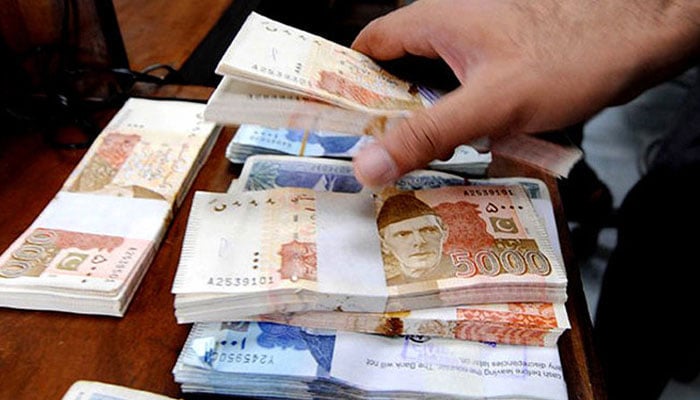
ISLAMABAD: Pakistan’s total public debt has increased by over 10 percent of GDP in the last decade, rising from 60 percent in 2016 to 71 percent in 2025. Alarmingly, debt servicing consumed 89 percent of total net federal revenue receipts in the financial year 2025, a slight improvement from the 120 percent recorded in the financial year 2023.
Although Japan’s debt-to-GDP ratio is significantly higher at around 200 percent, Pakistan’s situation is more challenging because the scale of its debt servicing poses a severe strain on federal revenues.
Economists projected that without intervention, the debt-to-GDP ratio could rise to 85 percent by 2035, far exceeding the targets set under the Fiscal Responsibility and Debt Limitation Act (FRDLA) approved by Parliament almost two decades ago. The Ministry of Finance has failed to curtail debt in line with the FRDLA targets. However, it was noted that achieving higher GDP growth and reducing the fiscal deficit could lower the debt-to-GDP ratio, aligning it with the FRDLA goals.
This was the essence of a presentation by the Finance Ministry’s economists and consultants, Dr Waseem and Aizaz Asif, before the National Assembly Standing Committee on Finance and Revenues. The committee met at Parliament House on Thursday under the chairmanship of Syed Naveed Qamar.
Dr Waseem informed the panel that external debt in rupee terms stood at Rs6tr in 2016 and has since surged to Rs26tr in 2025. Domestic debt was Rs13.6tr in 2016 and now stands at Rs54.5tr. Consequently, total public debt reached 70.8 percent of GDP in the financial year 2025, up from 60.1 percent in 2016.
With debt servicing claiming 89 percent of net federal revenue receipts in the financial year 2025, only 11 percent of revenues were left for all other federal expenditures, including defence, development, government operations such as salaries and pensions, as well as subsidies and grants.
The economists argued that Pakistan’s debt sustainability requires coordinated fiscal, monetary, and debt management policies anchored in credible institutions and transparent frameworks. The debt arithmetic suggests two strategic paths. If the nominal interest rate equals nominal GDP growth, the debt ratio depends on the primary balance; maintaining a 1.5 percent surplus could achieve the FRDL Act target by the financial year 2035. Conversely, debt will rise if interest rates exceed nominal growth or deficits persist. Alternatively, with a zero primary balance, keeping nominal GDP growth at least three percentage points higher than interest rates—supported by 5 percent real GDP growth and a 2 percent real interest rate—would yield similar results. Achieving these outcomes demands strong coordination among the Ministry of Finance, the State Bank of Pakistan (SBP), and related institutions.
It was recommended that the Ministry of Finance establish an in-house, model-based framework for forecasting interest rates and yield curves to improve debt sustainability analysis, fiscal risk assessments, and medium-term debt strategy formulation. Greater predictability in monetary policy, possibly through a flexible rule-based operational framework, would complement fiscal planning, reduce uncertainty, and strengthen policy credibility.
Debt management should focus on lowering external borrowing costs, lengthening maturities, and prioritising concessional and long-term financing over short-term commercial loans. The Ministry should also publish regular debt-sustainability simulations and contingency plans to improve market confidence and policy credibility.
In a separate briefing, the Secretary for Industries, Saif Anjum, informed the NA panel about the Electric Vehicle Policy for 2026-30. He stated that the federal government, with the consent of the IMF, has approved a subsidy of Rs 100 billion for electric vehicles over five years. Under the EV policy, the government has granted a subsidy of Rs 53 per unit for charging stations, reducing their electricity tariff from Rs92 to Rs39 per unit.
Secretary Anjum stated that the government’s EV policy is expected to save up to $1bn annually in oil import costs by 2030, while reduced fuel consumption will also lead to an estimated $450m in health-related savings by lowering pollution and respiratory diseases.
The Industries Secretary admitted that the targets set under the previous EV policy could not be achieved but said the revised policy includes practical incentives to encourage electric mobility. “Pakistan currently has more than 76,000 electric vehicles, and the target is to ensure that 30 percent of new vehicle sales are electric by 2030,” he told the committee. He added that the government plans to establish 3,000 EV charging stations across the country by 2030, with all such stations regulated by Nepra. The policy also includes an Rs80,000 subsidy on the purchase of electric motorcycles priced around Rs250,000 to make EV adoption more affordable for middle-income consumers.
During the meeting, Committee Chairman Syed Naveed Qamar observed that while taxes have been imposed on hybrid vehicles, exemptions have been given to two- and three-wheel electric vehicles.
Officials further informed the committee that the IMF has proposed an increase in taxes and duties on EVs. However, the IMF has not yet agreed to Pakistan’s proposal to impose withholding tax based on the vehicle’s market value rather than battery size or to raise the taxable value threshold from Rs5m to Rs 10m.


-
 State institutions ‘fail’ to perform constitutional duties: KP CM
 -
 CTD orders psychological testing of police on VVIP security duty
 -
 Navy busts drug consignment valued at $130m
 -
 Three ex-secretaries in race for ETPB chief post
 -
 Punjab govt forms 71 JITs to probe cases against banned TLP
 -
 Some UNSC members ignoring broader reforms, seeking privilege: Pakistan
 -
 PAC body discusses non-recovery of Rs15bn gas cess
 -
 Pakistan received $2.29bn foreign loans in first 4 months of 2025