Senate climate body orders closing of gap between people, policies
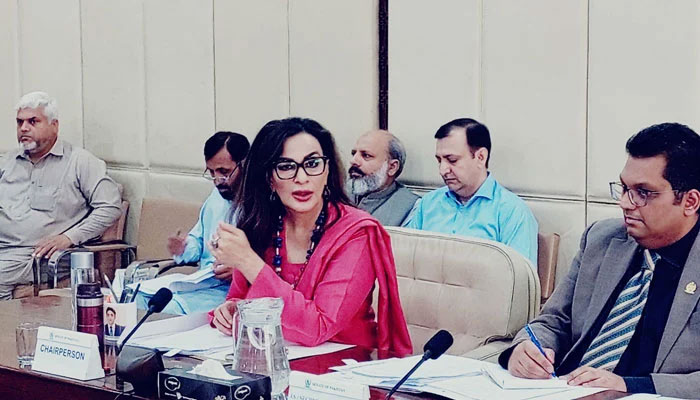
ISLAMABAD: The Senate Standing Committee on Climate Change and Environmental Coordination has urged the government to close the widening gap between people and climate policies, warning that Pakistan was “sleepwalking into a resilience nightmare.”
The committee met at the Parliament House, with Senator Sherry Rehman in the chair, to review Pakistan’s preparations for the upcoming COP30 in Brazil, assess the country’s climate finance strategy, and evaluate progress on the implementation of the Single-Use Plastics (Prohibition) Regulations, 2023.
Presiding the committee meeting, Senator Sherry Rehman stressed that climate finance, resilience, and accountability must remain at the centre of Pakistan’s national agenda.
“We cannot afford to be reactive anymore — the next climate disaster will not wait for us to coordinate. We need to move from policy to practice, from silos to synergy.”
Senator Sherry Rehman observed that Pakistan’s Number 1 position in 2022 among climate-vulnerable countries stemmed from the catastrophic 2022 floods, and cautioned that the country is “sleepwalking into a resilience nightmare.”
She emphasized that participation at COP30 must go beyond attendance and symbolic representation, “You go there for climate financing — not just to be seen. Pakistan must reclaim the climate leadership it once demonstrated when we successfully secured the Loss and Damage fund three years ago,” she said.
She expressed concern that Pakistan had lost traction on the international stage regarding loss and damage and climate finance since its landmark advocacy in 2022:
“We created enormous goodwill and built the operational committee for Loss and Damage, but since then, we have come crashing down. We must revive Pakistan’s climate diplomacy — especially on adaptation finance. This is not just about NDCs; it’s about survival.”
She termed the global disparity in climate funding “climate colonialism,” noting that $7 trillion continues to be spent annually on fossil fuel subsidies, while developing nations like Pakistan struggle for grants.
She noted that according to the World Bank, Pakistan requires $348 billion by 2030 to cope with climate impacts and of this, $152 billion is needed specifically for adaptation and resilience.
“By 2050, climate inaction could cost Pakistan $1.2 trillion, while flooding alone may cost $90 billion and displace up to 400 million people, mostly in Punjab,” she said.
Current spending on adaptation is just 6% of what is required, creating a 16-fold gap in financing. In 2021, the domestic private sector contributed only 5% of total tracked climate finance, of which a mere 0.7%supported adaptation. Over 80% of all climate finance went to mitigation projects such as renewable energy.
Briefing the Committee, secretary climate change said the upcoming COP30, to be hosted by Brazil, will focus on Nationally Determined Contributions (NDCs) and climate finance, as well as forests and oceans.
Senator Sherry noted that Pakistan remains the lowest in South Asia in forest cover, while its coastline is extremely polluted.
She stressed the need for post-COP30 accountability and said “After COP30, this Committee will ask for a full assessment of Pakistan’s forest cover. During the floods, we saw entire regions like Chitral turn brown — that should never happen again. We should ask for Internationally Determined Contributions, along with submission of NDCs 3.0”
The secretary apprised the committee that Pakistan will be engaging in negotiations at COP30 from November 10 to 21, including on carbon credit trading with Korea.
Committee members Senator Quratulain Marri and Senator Kakar raised concerns about weak coordination and questioned whether provinces were receiving sufficient climate funding.
The committee discussed the performance of the Meteorological Department, particularly during the August 19 heavy rainfall in Karachi.
Senator Quratulain said that despite forecasts predicting a weakening monsoon, Karachi experienced one of its heaviest downpours of the year.
“The Meteorological Department even listed ‘Sindh’ as a district in its forecast — which shows how outdated its systems are.”
Senator Sherry Rehman added that the department’s grants were never properly utilized by previous governments, and that accountability was necessary for recurring forecasting failures.
She proposed that NDMA and private weather platforms be engaged to strengthen early warning systems nationwide. “Everyone is entitled to an early warning system. If the state can’t deliver timely alerts, we should work with those who can.”


-
 Aurangzeb confirms Saudi Arabia $10bn interest, says B2B shift ongoing
 -
 Pakistan to build artificial island to boost oil exploration
 -
 Special pink bus service launched for women on Green Line route
 -
 Same number plates from other provinces lead to wrong e-challans for Karachiites
 -
 State institutions ‘fail’ to perform constitutional duties: KP CM
 -
 CTD orders psychological testing of police on VVIP security duty
 -
 Navy busts drug consignment valued at $130m
 -
 Three ex-secretaries in race for ETPB chief post