Multinational firms’ exit part of global strategy, not economic distress: Aurangzeb
"If some companies are leaving, new ones are also arriving," says finance minister
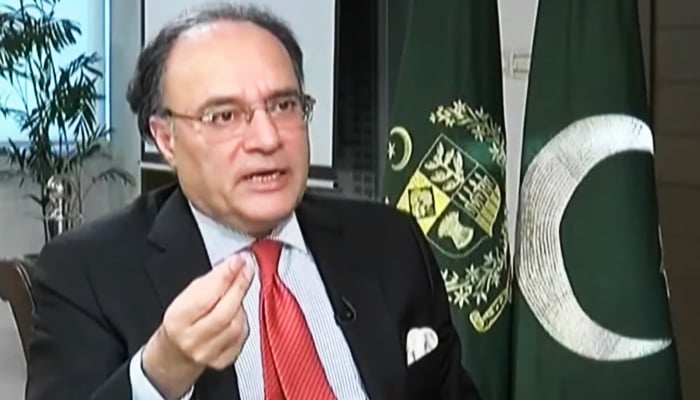
ISLAMABAD: Finance Minister Muhammad Aurangzeb on Wednesday said that the exit of some multinational companies from Pakistan was driven by global corporate decisions rather than local economic challenges, asserting that the country’s macroeconomic stability continues to attract new foreign investors.
Speaking on Geo News programme 'Capital Talk', the finance minister noted that while some multinational companies have exited Pakistan, several new investors are entering the market.
“Such decisions are often part of global corporate strategies… if some companies are leaving, new ones are also arriving, particularly in the energy and digital services sectors,” he noted.
Aurangzeb admitted that some challenges for foreign investors persist, such as delays in repatriating dividends, but Pakistan has made significant progress. “As economic stability has returned, we have cleared $4 billion of backlog in the last two years,” he said.
The minister acknowledged that climate change is impacting Pakistan’s economy, noting that the frequency of floods and smog events has increased.
“Before the recent floods, GDP growth was projected at 4.2%, but at least 0.4 to 0.5 percentage points will now be shaved off due to flood-related damage, of which 80% occurred in Punjab’s agriculture sector, particularly rice and cotton,” he said.
Aurangzeb said the government was focused on self-reliance, adding that relief and rescue operations were being conducted from domestic resources.
“We are standing on our feet today. Reconstruction might require global support, but rescue and relief are entirely managed through local means,” he said.
He said Prime Minister Shehbaz Sharif had instructed the Climate Change Minister Musadik Malik to prepare a 300-day plan for climate resilience, noting that the next monsoon may arrive two weeks earlier than usual.
Highlighting fiscal progress, Aurangzeb said tax collection from wholesalers and retailers rose by 100% last year, with additional recovery made from the sugar, cement, and tobacco industries.
He added that income tax relief had been extended to the lower and middle-income salaried classes, with plans to expand it to other segments.
He also confirmed that the government is moving towards deregulation of wheat and sugar prices, with a comprehensive wheat deregulation policy expected in 2026, which would end inter-provincial movement restrictions.
He added that the World Bank had appreciated Pakistan’s tax reform presentation, and Egypt’s finance minister had offered to send a team for knowledge-sharing.


-
 Bombardier shares rise as Trump drops threat to block aircraft sales in US
 -
 OpenAI seek to raise $30 billion at $1.4 trillion valuation ahead of Anthropic IPO
 -
 Supreme Court rejects Google challenge to patent office review policy: Here's why
 -
 Netflix faces scrutiny over user engagement ahead of Q3 report
 -
 Meta and Tesla are set to report earnings next week: What to know
 -
 SpaceX sets Q3 2026 earnings release date: What to know
 -
 Hyundai to recall nearly 100,000 US vehicles over fire risk from overheating
 -
 Will Tesla and SpaceX merge? Barclays expects announcement ahead of December meeting