Full court plea untenable without proof bench not competent: Justice Aminuddin
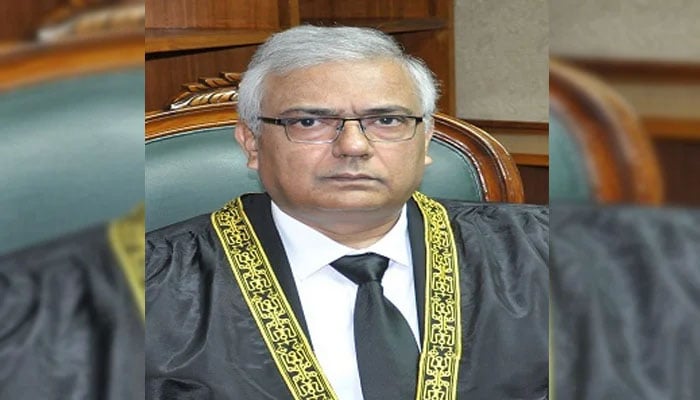
ISLAMABAD: The Supreme Court (SC) Constitutional Bench was requested on Monday to constitute a full court comprising all 24 judges to hear multiple petitions challenging the validity of 26th Constitutional Amendment.
An eight-member Constitutional Bench of the SC, headed by Justice Aminuddin Khan, heard the petitions filed against 26th Constitutional Amendment. Other bench members included Justice Jamal Khan Mandokhail, Justice Muhammad Ali Mazhar, Justice Ayesha A Malik, Justice Hassan Azhar Rizvi, Justice Musarat Hilali, Justice Naeem Akhtar Afghan and Justice Shahid Bilal Hassan.
Around three dozen petitioners including Pakistan Tehreek-e-Insaf (PTI, Jamaat-e-Islami (JI), Sunni Ittehad Council (SIC), Lahore High Court Bar Association, Lahore Bar Association, Karachi Bar Association as well as former seven presidents of Supreme Court Bar Association (SCBA) and various individuals in personal capacity had challenged the validity of the 26th Constitutional Amendment.
During the course of hearing, senior lawyer and counsel for the petitioners, Muhammad Akram Sheikh, appeared in-person and contended that a full court comprising all 24 judges of the apex court, should be constituted for hearing the identical petitions, challenging the 26th Constitutional Amendment.
The counsel submitted that the Constitutional Bench was not a separate court like the Federal Shariat Court, adding that it is a ‘bench’ of the Supreme Court itself. He submitted that judges sitting on the bench were members of the Supreme Court as well as members of the Constitutional Bench.
“They are, in a way, wearing two hats – one in their capacity as judges of the Supreme Court, and the other in their capacity as members of the Constitutional Bench,” Akram Sheikh contended.
The counsel further contended that in their capacity as members of the Constitutional Bench, it is logically and legally impossible for the Bench to effectively declare that the 26th Amendment was void. He submitted that an effective declaration can be issued only by court of competent jurisdiction. “If the 26th Amendment is held to be void then the very foundation on which the bench has been raised will disappear,” Sheikh submitted adding that if the amendment is void, then the constitution of the bench pursuant to it is also legally ineffective.
In that case, Akram Sheikh submitted that the very source of the judicial power of the bench to issue any declaration would cease to exist. He further submitted that in legal terms, the Constitutional Bench would have no legitimate existence in the eyes of law.
The bench cannot possibly cut the very branch on which it is sitting,” Akram Sheikh added. Therefore, he submitted that the only hat that is available to the Court for issuing an effective declaration and provide a remedy is the hat of the Supreme Court judges, while the other hat would stand dissolved in thin air.
Citing cases where matters were referred to Full Court, Akram Sheikh submitted that in previous instances involving the constitutional validity of constitutional amendments and in landmark cases, the Supreme Court constituted a larger or full bench to adjudicate upon such grave constitutional questions.
He contended that the present matter also pertains to the validity of a constitutional amendment, namely the 26th Amendment. He stressed that in the interest of justice, this case should also be placed before a full bench of the Supreme Court.
Akram Sheikh cited past judgments delivered by the Supreme Court including District Bar Association, Rawalpindi (PLD 2015 SC 401, PLD 1998 SC 161, Malik Asad Ali, PLD 2010 SC 61, Iftikhar Muhammad Chaudhry. PLD 2009 SC 879, Sindh High Court Bar. PLD 2010 SC 265 and Mubashir Hassan, PLD 2010 SC 1165, Nadeem Ahmad.)
At the outset of hearing, Justice Aminuddin Khan asked the counsel to tell any constitutional way to form a full court, as they are bound by their oath. “So far, no lawyer has presented arguments in accordance with the Constitution — one even went so far as to say that we should set aside the Constitution,” Justice Aminuddin Khan added.
Akram Sheikh responded that the SC full bench, comprising all 24 judges, should be formed, and maintained that the current Constitutional Bench is not competent to hear this case, as the 26th Amendment itself is controversial.
“Even dictators had never caused such a deep dent in the Constitution as the 26th Amendment,” Sheikh contended, adding that since this eight-member bench was itself constituted under the 26th Amendment, it cannot declare that amendment null and void.
Justice Muhammad Ali Mazhar, however, observed that this is a new matter, adding that a Constitutional Bench has now been constituted. Justice Mazhar advised Akram Sheikh to present his arguments in light of the new situation. “You say this bench cannot annul the 26th Amendment due to conflict of interest, yet you also suggest forming a full court of twenty-four judges,” Justice Mazhar told the counsel.
“Wouldn’t there also be a conflict of interest there,” he questioned. Justice Aminuddin Khan reiterated that unless the petitioners prove this bench is not competent to hear the case, their request cannot be accepted.
Akram Sheikh responded that he wants to settle the issue once and for all and that’s why he stresses constituting a full court comprising all 24 judges of the apex court. “This is my personal view that a full court including all 24 judges should hear the instant petitions,” Sheikh added.
Similarly, he submitted that his position was that if a judge’s conscience is disturbed then he should not hear the case. “But I have not asked for the recusal of any judge as well,” Akram Sheikh clarified.
Justice Naeem Akhtar Afghan, addressing the counsel, said: “You have expressed a desire that all twenty-four judges of the Supreme Court hear this case, but you haven’t explained how that wish can be fulfilled.
“Your wish is like a spoiled child asking for the moon,” the judge added. Akram Sheikh further submitted that lots have been done and lots have been faced with. Let us make this institution envisioned by father of the nation Quaid-e-Azam and envisioned by the Constitution.
Justice Jamal Mandokhail remarked that Father of the Nation Quaid-e-Azam was also the founding father of the Parliament and his portrait was also present in the Parliament House and the Parliament is also following the Quaid as well.
At this, Akram Sheikh responded and asked as to whether the Parliament can destroy one organ of the State, adding that can the Parliament go beyond the salient features of the Constitution and can the Parliament go beyond the basic structure of the Constitution.
Akram Sheikh concluded his arguments with a verse of poet Mirza Ghalib. Meanwhile, Shabbar Raza Rizvi, counsel for another petitioner, came to the rostrum and argued that the case should be heard by the Supreme Court as constituted under Articles 176 and 191(A) of the Constitution. He submitted that like any other bench, this bench can refer the matter to the Chief Justice or to the three-member committee responsible for bench formation.
Justice Jamal Mandokhail asked him: “If the Supreme Court (Practice and Procedure) Committee orders for formation of a full court, then what would become of Article 191(A)(3), which states that no other bench is authorised to hear constitutional matters.”
In response, the lawyer said this is a matter concerning the independence of the judiciary, and that this bench must bear some pain. Justice Muhammad Ali Mazhar remarked that the Constitution already provides sufficient clarity — only the Constitutional Bench can hear constitutional matters. Later, the court adjourned the hearing for Tuesday (today) while Advocate Shabbar Raza Rizvi will continue his arguments.


-
 Aurangzeb confirms Saudi Arabia $10bn interest, says B2B shift ongoing
 -
 Pakistan to build artificial island to boost oil exploration
 -
 Special pink bus service launched for women on Green Line route
 -
 Same number plates from other provinces lead to wrong e-challans for Karachiites
 -
 State institutions ‘fail’ to perform constitutional duties: KP CM
 -
 CTD orders psychological testing of police on VVIP security duty
 -
 Navy busts drug consignment valued at $130m
 -
 Three ex-secretaries in race for ETPB chief post