In setback to Indian designs, Islamabad, Kabul agree to ceasefire after Doha talks
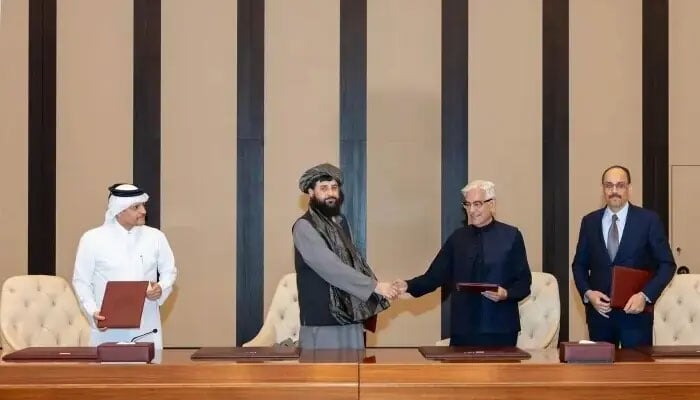
PESHAWAR: Thwarting the nefarious designs of India seeking to inflame tensions, Pakistan and Afghanistan on Sunday reached an immediate ceasefire agreement in Doha after nearly 12 hours of intensive negotiations.
Mediated by Qatar and Turkiye, the accord marks a decisive step toward de-escalating a week of fierce cross-border hostilities that claimed dozens of lives and left hundreds injured.
The breakthrough accord, led by Pakistan’s Defence Minister Khawaja Muhammad Asif and Afghanistan’s Acting Defence Minister Mawlawi Muhammad Yaqoob Mujahid, marks the most significant diplomatic development between the two neighbours since the Taliban’s takeover of Kabul in 2021.
The Doha negotiations — hosted by Qatari intelligence chief Abdullah bin Mohammed Al-Khalifa and supported by Turkish representatives — brought together senior officials from both sides. The Pakistani delegation was headed by Defence Minister Khawaja Muhammad Asif, while the Afghan side included Acting Defence Minister Mawlawi Muhammad Yaqoob Mujahid, Director-General of Intelligence (GDI) Mawlawi Abdul Haq Wasiq, and Deputy Interior Minister Haji Najib.
Described as frank and substantive, the talks concluded on Sunday with both delegations signing an understanding to cease hostilities and to resume dialogue on a sustained and structured basis.
Announcing the outcome on his official X account, Khawaja Asif said the ceasefire had been “finalised”, adding that both sides had agreed to reconvene in Istanbul on October 25 to discuss the operational details and monitoring framework of the agreement. He confirmed the ceasefire agreement under which “terrorism from Afghanistan on Pakistani soil will stop immediately”.
“Pakistan and Afghanistan have agreed to an immediate cessation of hostilities. Both countries will honour each other’s sovereignty and ensure that their territories are not used for terrorist activities,” he said in his statement.
Afghan Taliban spokesperson Zabihullah Mujahid also confirmed the agreement on his X account, describing it as a “complete and meaningful ceasefire”. He said both sides had reaffirmed their commitment to peace, mutual respect and the principle of non-interference. “It was decided that neither country will take hostile actions against the other, and no support will be provided to groups operating against the Government of Pakistan,” he stated, adding that both nations had pledged to refrain from targeting civilians, security forces or key infrastructure.
In a statement issued on Sunday, Qatar’s Ministry of Foreign Affairs said the negotiations had led to “an immediate ceasefire and the establishment of mechanisms to consolidate lasting peace and stability between the two countries.” The statement expressed the hope that this step would “contribute to ending tensions on the border between the two brotherly nations and form a solid foundation for sustainable peace in the region.”
The Doha negotiations followed a week of escalating clashes along the 2,600-kilometre border between Pakistan and Afghanistan, triggered after Pakistan urged Afghanistan to curb militant groups launching attacks from sanctuaries inside the Afghan territory. Islamabad has long accused the banned Tehreek-e-Taliban Pakistan (TTP) and Baloch Liberation Army (BLA) of operating from the Afghan soil to target Pakistani security installations and civilians.
Following the Doha understanding, the Islamic Emirate of Afghanistan released a statement confirming that both sides had agreed not to undertake any hostile actions against one another and to avoid supporting groups acting against the Government of Pakistan. It further said that a review mechanism would be created under the oversight of intermediary countries to handle future complaints and ensure compliance with the ceasefire.
Officials in Pakistan said the outcome of the talks represented a major diplomatic success achieved “from a position of strength”, as Islamabad’s demand for an end to terrorism support from Afghan territory was recognised. “Pakistan’s security concerns were legitimate and had to be addressed. Afghanistan has been given space for continued dialogue, but the message remains clear that facilitation of terrorism will not be tolerated,” a senior Pakistani official said.
Both governments expressed gratitude to Qatar and Turkey for their constructive facilitation and reaffirmed their shared commitment to maintaining regional peace and stability.
Meanwhile, Deputy Prime Minister (DPM) and Foreign Minister Ishaq Dar Sunday welcomed the ceasefire agreement inked between Pakistan and Afghanistan. “Welcome the agreement finalised late last night in Doha. It is the first step in the right direction,” he said in a post on X while reacting to the truce.
“We look forward to the establishment of a concrete and verifiable monitoring mechanism, in the next meeting to be hosted by Turkiye, to address the menace of terrorism emanating from Afghan soil towards Pakistan. It is important to put all efforts in place to prevent any further loss of lives,” Dar added while appreciating the constructive role played by brotherly Qatar and Turkiye.
Separately, reacting to the truce announcement, Turkiye’s embassy in Pakistan vowed to “continue to support the efforts for achieving lasting peace and stability between the two brotherly countries and in the region”.


-
 Aurangzeb confirms Saudi Arabia $10bn interest, says B2B shift ongoing
 -
 Pakistan to build artificial island to boost oil exploration
 -
 Special pink bus service launched for women on Green Line route
 -
 Same number plates from other provinces lead to wrong e-challans for Karachiites
 -
 State institutions ‘fail’ to perform constitutional duties: KP CM
 -
 CTD orders psychological testing of police on VVIP security duty
 -
 Navy busts drug consignment valued at $130m
 -
 Three ex-secretaries in race for ETPB chief post