Sindh halts oil cargo clearances over new bank guarantee policy
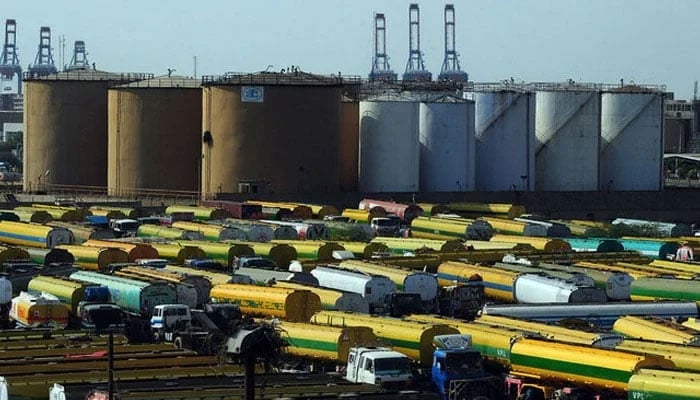
KARACHI: The Sindh government has withheld the import clearance of cargoes belonging to several oil companies, including Pakistan State Oil (PSO), following the provincial administration’s new policy requiring oil importers to submit bank guarantees for consignments.
“The Sindh excise, taxation and narcotics control department, stationed at Karachi’s Port Qasim, has withheld the processing of import clearance for PSO’s High-Speed Diesel (HSD) cargo Al-Salam II (IGM No PQIB-0804 dated October 13, 2025), in compliance with the Sindh government’s directive,” PSO stated in a letter addressed to the secretary of the Petroleum Division.
PSO warned that implementation of the new directive will have serious operational and financial implications, potentially delaying product clearance and causing nationwide supply chain disruptions.
The state-run company sought the secretary’s intervention, urging him to take up the matter with the Sindh government and allow the continuation of the existing arrangement — permitting clearance of petroleum cargoes against undertakings already submitted by oil marketing companies (OMCs) — until the Supreme Court delivers its final decision.
Sources told The News that the provincial government has also withheld imported oil cargoes of Hascol, Wafi Energy and another company, seeking bank guarantees from them as well. They said the federal government is trying to resolve the issue.
A PSO source revealed that while the company’s cargo has been discharged from the vessel, it remains held in bonded storage and cannot be utilised.
The Sindh government recently made it mandatory for petroleum importers to provide bank guarantees for the release of consignments, replacing the earlier practice of submitting undertakings for the collection of infrastructure cess.
The provincial excise department directed PSO and all petroleum product importers to submit bank guarantees against their consignments without delay, in line with a provincial cabinet decision.
Industry officials warned that the new policy could threaten the country’s oil supply chain if the issue is not resolved urgently.
Meanwhile, the Oil Companies Advisory Council (OCAC) has called for the petroleum minister’s immediate intervention, urging him to direct the Federal Board of Revenue (FBR) and Customs to allow the clearance of all petroleum cargoes without requiring bank guarantees or inclusion of the infrastructure development cess (IDC). This, it said, will ensure uninterrupted fuel supplies nationwide.
“We also request a policy intervention to incorporate the IDC in the pricing of petroleum products and establish a mechanism for the recovery of past IDC dues through pricing,” said Adil Khattak, chairperson of the OCAC, in a letter to the petroleum minister.
He warned that the policy poses severe financial and operational risks to the downstream sector. “The submission of bank guarantees worth billions of rupees per cargo — a single 50,000 metric tonne vessel costs around $40 million — is unsustainable given the industry’s limited credit lines and thin margins,” he said. “The imposition of IDC at 1.8 per cent adds over Rs3 per litre to product costs, which will ultimately burden consumers, as petroleum prices are regulated.”
Khattak further noted that petroleum cargoes recently discharged, or currently being offloaded at ports, require immediate customs clearance.
He added that motor spirit (MS) stocks at Keamari are depleting, while two MS cargoes recently discharged at KPT-PGL’s MT UOG Harriett and PSO’s MT Khairpur need urgent customs clearance to maintain nationwide fuel supply continuity. Wafi Energy’s MS cargo and Parco’s crude shipment, both expected to arrive at KPT on October 21, could also face delays if the issue persists.
“Any disruption at this critical juncture, amidst the ongoing agricultural season, risks a nationwide halt in the petroleum supply chain, with recovery likely to take over two weeks,” Khattak warned.


-
 Aurangzeb confirms Saudi Arabia $10bn interest, says B2B shift ongoing
 -
 Pakistan to build artificial island to boost oil exploration
 -
 Special pink bus service launched for women on Green Line route
 -
 Same number plates from other provinces lead to wrong e-challans for Karachiites
 -
 State institutions ‘fail’ to perform constitutional duties: KP CM
 -
 CTD orders psychological testing of police on VVIP security duty
 -
 Navy busts drug consignment valued at $130m
 -
 Three ex-secretaries in race for ETPB chief post