
SJC restricts judges from media interaction in amended code of conduct
ISLAMABAD: The Supreme Judicial Council (SJC) has amended the judges’ code of conduct, barring members of the judiciary from engaging with the media or commenting publicly on political matters.
According to an amended code of conduct issued on Saturday, a judge “should not engage in any public controversy, whether by way of speech, writing, debate or comment at any forum, and least of all on political questions, even if such questions involve a question of law”.“[Judges] shall not have any interaction with the media, especially in relation to issues which may give rise to public debate or adversely affect institutional collegiality and discipline,” read the statement.
Where, however, an allegation is made public against a Judge, he may place the matter in writing before Committee comprising of the Chief Justice of Pakistan and four Senior Judges of Supreme Court of Pakistan through its Registrar for an appropriate institutional response.
The new provisions reverse an amendment made during the tenure of former chief justice Qazi Faez Isa, which had allowed judges to respond to public allegations.
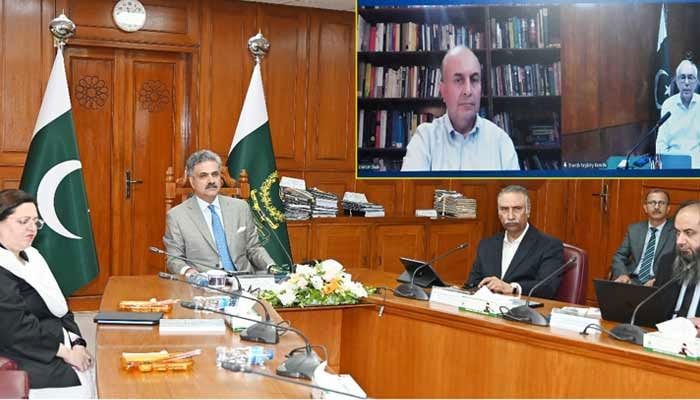
A meeting of the Supreme Judicial Council (SJC) was held at the Supreme Court, chaired by Chief Justice of Pakistan Yahya Afridi in his capacity as chairman of the council. The meeting was attended virtually by Supreme Court judges Syed Mansoor Ali Shah and Munib Akhtar via video link, while Lahore High Court Chief Justice Miss Aalia Neelum and Islamabad High Court Chief Justice Sardar Muhammad Sarfraz Dogar attended in-person.
Following a decision taken by the council on July 12, 2025, the chair proposed some amendments to the code of conduct for judges of the Supreme Court and high courts.
The proposed amendments were thoroughly deliberated upon and, with some modifications, were approved by a majority decision of the council. They were subsequently directed to be notified in the official gazette, circulated to all judges of superior courts, and posted on the website of the Supreme Court.
During the meeting, the SJC examined 67 complaints filed by different individuals under Article 209 of the Constitution.
It was unanimously decided to file 65 of these complaints, while one complaint was unanimously deferred. By a majority decision, one complaint was decided to be processed further.
At a later stage, the council was re-constituted as per Article 209 (3) (b) of the Constitution with the inclusion of Peshawar High Court Chief Justice S M Attique Shah as the IHJC chief justice had shown his inability to attend the meeting for certain agenda items.
The re-constituted SJC examined seven complaints under Article 209 of the Constitution filed by different individuals. Five complaints were unanimously decided to be filed, while two complaints were decided to be processed further by a majority decision.
“After the decision on the present 74 complaints, the total pending cases requiring initial consideration are 87, and the SJC has attended to 155 since October, 2024,” stated a press release issued by the council secretary.
According to the code of conduct for judges of the Supreme Court and High Courts—framed by the SJC under Article 128 (4) of the 1962 Constitution as amended up to October 18, 2025, under Article 209 (8) of the 1973 Constitution—the prime duty of a judge as an individual is to present before the public an image of justice of the nation.
As a member of his court, that duty is brought within the disciplines appropriate to a corporate body. The Constitution, by declaring that all authority exercisable by the people is a sacred trust from Allah Almighty, makes it plain that justice of this nation is of divine origin.
It connotes full implementation of the high principles which are woven into the Constitution, as well as the universal requirements of natural justice.
The oath of a judge implies complete submission to the Constitution, and under the Constitution to the law. Subject to these governing obligations, his function of interpretation and application of the Constitution and the law is to be discharged for the maintenance of rule of law over the whole range of human activities within the nation.
To be a living embodiment of these powers, functions and obligations calls for possession of the highest qualities of intellect and character. Equally, it imposes patterns of behaviour which are the hallmark of distinction of a judge among his fellowmen.
In this code, an attempt is made to indicate certain traditional requirements of behaviour in the judges of the superior courts, conducive to the achievement of a standard of justice worthy of the nation.
ARTICLE-I (General): On equiponderance stand the heavens and the earth. By equiponderance, oppression—meaning unjust and unequal burdens—is removed. The judge’s task is to secure that such equality should prevail in all things.
ARTICLE-II (Judicial qualities): A judge should be God-fearing, law-abiding, abstemious, truthful of tongue, wise in opinion, cautious and forbearing, blameless and untouched by greed.
While dispensing justice, he should be strong without being rough, polite without being weak, inspiring in his warnings and faithful to his word, always preserving calmness, balance and complete detachment for the formation of correct conclusions in all matters coming before him.
In the matter of taking his seat, in his personal behaviour when seated, and of rising from his seat, he shall be punctilious in point of time, mindful of the formal courtesies, and careful to preserve the dignity of the court, while maintaining an equal aspect towards all litigants as well as lawyers appearing before him.




-
 State institutions ‘fail’ to perform constitutional duties: KP CM
 -
 CTD orders psychological testing of police on VVIP security duty
 -
 Navy busts drug consignment valued at $130m
 -
 Three ex-secretaries in race for ETPB chief post
 -
 Punjab govt forms 71 JITs to probe cases against banned TLP
 -
 Some UNSC members ignoring broader reforms, seeking privilege: Pakistan
 -
 PAC body discusses non-recovery of Rs15bn gas cess
 -
 Pakistan received $2.29bn foreign loans in first 4 months of 2025