
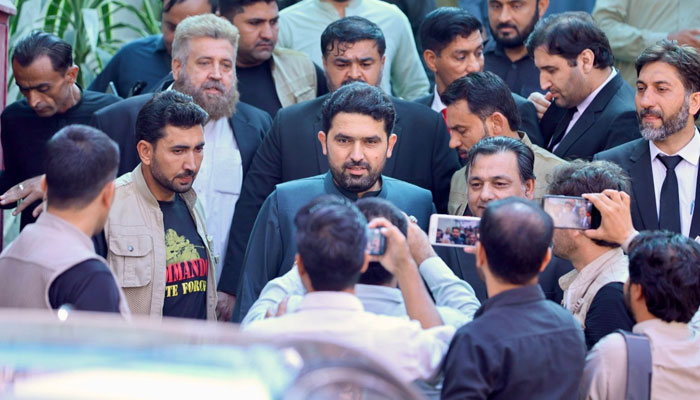
PESHAWAR: While emphasizing the need to involve the provincial government in restoring peace, Khyber Pakhtunkhwa Chief Minister Sohail Afridi said on Saturday that his government opposes military operations, and questioned who brought terrorists back once the areas were cleared.
In an informal conversation with senior journalists, accompanied by former minister Meena Khan, the chief minister said the Pakistan Tehreek-e-Insaf (PTI) stands shoulder to shoulder with the army against any aggression.
Commenting on Afghanistan, Afridi said whoever attacks Pakistan, including from across the border, would receive a strong response. “We are with our army against any foreign aggression,” he added.
Afridi said his government is against military operations as they cause more losses and create additional problems. He questioned, “How can there be peace without taking the provincial government into confidence?”
The chief minister said he wanted to consult the party founder, Imran Khan, regarding the formation of the provincial cabinet but was not being allowed to meet him. He added that Imran Khan had directed that Muzammil Aslam be included in the cabinet. There had been no discussion about Barrister Muhammad Ali Saif, he clarified. The chief secretary and the inspector general of police would not be changed for now, he added, while new faces would also be included in the cabinet.
Afridi said the PTI would stand shoulder to shoulder with the army against any aggression and that the provincial government must be taken into confidence on all policies regarding Afghanistan. He added that the decision to end the “Action in Aid of Civil Power” law in the province would be taken at the first cabinet meeting. He agreed that the government should not interfere in party affairs.
He said hundreds of thousands of Afghan refugees had already returned, while 1.2 million still remain in the country and would be repatriated with dignity. The return process, he added, would be expedited. He stressed that Afghan refugees should not be forcibly sent back.
Afridi said the province belongs to all of us. He admitted that the previous government was relatively weak but added that while it is fair to criticise mistakes, such criticism should not come at the cost of harming the province.
He said that no one had brought him against anyone and his government stood firmly for the rule of law. “We are fighting our battles in courts, but if justice is denied, we will protest,” he warned. Referring to the security situation, he said the army operates under Article 245 of the Constitution. “Once the areas were cleared, who allowed the terrorists to return?” he asked again. Referring to the resurgence of militancy, he said that after their resettlement, both large and small operations were carried out, which caused further losses and complications. Afridi reiterated his opposition to such operations, questioning how peace could be restored without taking the provincial government into confidence.
On the Sanam Javed case, Afridi said the report he received from police was unsatisfactory. He explained that there were no specific directives regarding her case; rather, the general instruction was that no political worker should be arrested. However, since the report about Sanam Javed did not convince him, he would seek a revised report.
The chief minister said he had not come merely to run the government but to bring change. If he was not given time to meet Imran Khan, he would finalise the cabinet after consultation with other senior leaders.
Afridi said he had been targeted earlier and then the constitutional process was blocked, questioning whether this was the right way to proceed. He said he had written a letter to the Chief Justice of Pakistan and filed a petition in the High Court, which he planned to refile on Monday after addressing the objections raised.
The chief minister warned that if they were not given a way forward, they would resist. He said the Punjab government had blocked their route, prompting them to stage a protest. His focus, he said, would remain on law and order, development projects and good governance.
Afridi said that if there was justice in the country, the party founder would not be in jail. He clarified that the issue of the advisory council had neither been discussed within the party nor proposed by anyone. As a worker, party organiser, and chief minister, he said he was accountable only to the founder. “Whoever Imran Khan names will be part of the cabinet,” he stated, adding that he would inform the founder about both deserving and undeserving cabinet members. So far, he said, Imran had only confirmed Muzammil Aslam’s inclusion.


-
 State institutions ‘fail’ to perform constitutional duties: KP CM
 -
 CTD orders psychological testing of police on VVIP security duty
 -
 Navy busts drug consignment valued at $130m
 -
 Three ex-secretaries in race for ETPB chief post
 -
 Punjab govt forms 71 JITs to probe cases against banned TLP
 -
 Some UNSC members ignoring broader reforms, seeking privilege: Pakistan
 -
 PAC body discusses non-recovery of Rs15bn gas cess
 -
 Pakistan received $2.29bn foreign loans in first 4 months of 2025