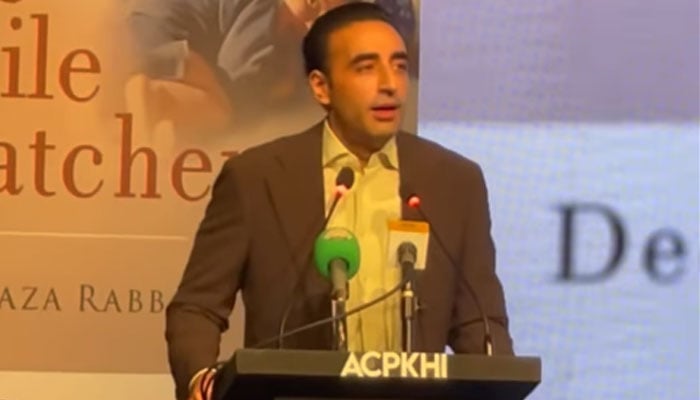
Given the legacy of the Pakistan People’s Party in an intellectual context, it seemed fitting for the young chairman of the party, Bilawal Bhutto Zardari, to preside over the ‘dedication ceremony’ of a book. This is what happened at the Arts Council of Pakistan, Karachi, on Tuesday.
Interestingly, the book being honoured is not on politics or national affairs. It is a work of fiction, a novella penned by a senior leader of the party, Mian Razza Rabbani. Its title: ‘The Smile Snatchers’.
The ceremony was formally hosted by Mohammad Ahmed Shah, president of the Arts Council and I was thrilled to have been invited as one of the speakers. It was an opportunity to underline the importance of reading books, particularly fiction, to create an enabling environment for social as well as political emancipation of the country.
I think it is important for our political leaders to be reminded of the crucial deficits that exist in our educational and intellectual domains. Our poor reading habits can easily be measured in the verifiable facts relating to the publication and sale of books and the absence of any public library system in our major cities.
We know how dismal our rankings are in social indicators that are compiled by the relevant international agencies. An investigation of reading habits, I am sure, will reveal that we are at a lower level, including in comparison with other developing countries. We cannot find an excuse in the fact that the digital world has conquered our minds, because many other countries may be ahead of us in this technology.
Anyhow, let me return to Tuesday’s ceremony. As I said, the celebration of a book of fiction in the presence of a leading political leader of the country could be meaningful in some ways. It would allow a discussion of how literature can be an instrument for social change by encouraging critical and innovative thinking. Asking for a political priority to create an intellectual infrastructure with the same zeal that was invested in building, say, motorways could be a literary equivalent of telling truth to power.
Having said so much about a potentially literary event that was presided over by one of the most charismatic politicians of the country, I need to refer to the book itself and the reason why it was under the spotlight. Actually, the novella was published in 2020, and it told the story of an artist who is haunted by the vision of suffering children from around the world, mainly from war zones and conflict areas.
This artist is struggling to paint a smile on the face of a little girl. But he just cannot. In the process, images of children who had suffered in the real world, such as the civil war in Syria, vacillate in his mind, leaving him in great mental anguish. The message obviously is: what is this world coming to, if children are unable to smile? Raza Rabbani, in a literary flourish, has also invoked the children who were massacred by terrorists in the Army Public School, Peshawar, in 2014.
Though the book was published before the Gaza tragedy, which starkly projected the death of children, it was thought that it should now be dedicated to the children of Gaza. It made sense. Besides, this dedication also brought Raza Rabbani’s creative accomplishment into focus. And he deserves this.
Raza Rabbani’s first book, ‘Invisible People’, a collection of short stories, was published in 2017. I had written a comment for its dust cover and had traveled to Islamabad to attend its launch. Thematically, ‘The Smile Snatchers’ is very unlike ‘Invisible People’. His short stories were harshly realistic in portraying the plight of Pakistan’s destitute citizens. But the novella is drawn on a global canvas and delves into the realm of fantasy. Raza Rabbani has also experimented with the literary device of magical realism.
It goes to Raza Rabbani’s credit that ‘The Smile Snatchers’ was shortlisted for the 2021 Karachi Literature Festival’s Getz Pharma Fiction Prize. This means that now he is a certified writer of fiction. One knows of many political leaders who have written books, but I am unable to name any who have written fiction.
However, Tuesday’s function lapsed into a political event because of the presence of Bilawal Bhutto Zardari, though the chairman profusely applauded Raza Rabbani’s book and also talked about Gaza. But the ‘breaking news’ was his political remarks.
I think I was naive in not expecting the political spectacle it would become just because Bilawal Bhutto Zardari was there. In the first place, the security arrangements were extensive. At the same time, the presence of PPP leaders and workers was overwhelming.
There was, thus, no time for me to argue in some detail why our politicians need to read fiction. One important contribution of literature is that it creates empathy and develops communication skills. Politicians need these qualities. When you hear them on talk shows, you can easily deduce that they are not readers of books.
To sum it up, I would say that we need fiction to be able to understand and deal with the reality of our lives. In a larger setting, reading books – and reading them for pleasure – can help us lead a good life. Books should be an integral part of our collective existence.
Some of these thoughts were revived on Friday morning when I attended a session at Hamdard University to pay homage to Hakim Mohammad Said on the 27th anniversary of his assassination. Hakim Said, in addition to his onerous responsibilities as the founder of an institution, was keenly interested in the education and well-being of children. The children’s magazine he launched – Naunehal – had once considerable circulation.
I remember one conversation with him more than 30 years ago. He was talking about a study he had read about that found that reading poetry, including sad poetry, was an antidote to loneliness and depression. Why shouldn’t that be valid now?
The writer is a senior journalist. He can be reached at: ghazi.karachi@gmail.com