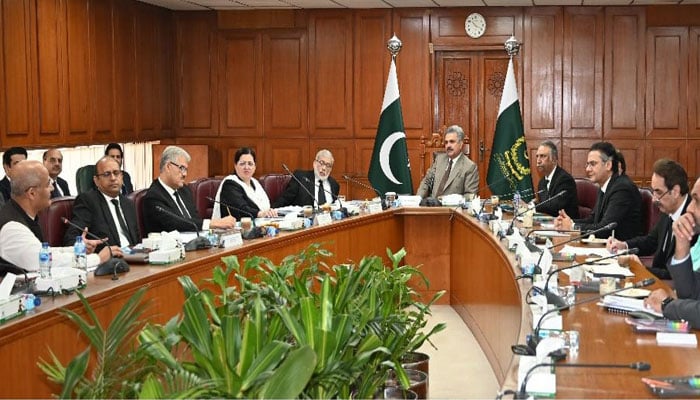
ISLAMABAD: The National Judicial (Policy Making) Committee (NJPMC) has reiterated its resolve to strengthen institutional capacity, accelerate access to justice, and ensure efficient and effective justice delivery.
The committee, in its 55th meeting, held here on the Supreme Court premises, made a number of significant decisions.
The meeting was chaired by Chief Justice of Pakistan (CJP) Yahya Afridi and attended by the chief justices of the Federal Shariat Court and all high courts, while the Attorney General for Pakistan (AGP) participated on special invitation.
The panel appreciated the collective efforts of all high courts, the Ministry of Law and Justice, and the Law and Justice Commission Secretariat for promoting institutional coherence and enhancing public confidence in the justice system.
It unanimously endorsed proposed amendments to the Code of Conduct for Judges aimed at strengthening safeguards for judicial independence.
The CJP observed that while high courts had already framed SOPs to shield district judiciary from external influence, similar institutional mechanisms were needed for the superior judiciary.
He informed the committee that amendments had been proposed to the code of conduct to formalise such mechanisms.
The additions, originally approved by the Supreme Judicial Council in 1967 and 2003 but never notified, would now be placed before the council for consideration and approval.
All high court chief justices endorsed the proposal, noting it would reinforce judicial integrity and public confidence in the independence of the judiciary.
The AGP briefed the committee on the government’s coordinated response to enforced disappearances and informed that the issue had “almost been resolved” following recent amendments to Section 11EEEE of the Anti-Terrorism Act, 1997, which now requires the production of a detained person before a magistrate within 24 hours.
He added that a comprehensive redress mechanism for cases of non-compliance was being developed and would be presented in the committee’s next meeting. The NJPMC appreciated the assurance and progress reported by the attorney general.
The forum reviewed major initiatives aimed at improving judicial efficiency, including the launch of double-docket courts, model courts and performance-based district judiciary reforms.
It lauded the Peshawar High Court for introducing Pakistan’s first double-docket court at Abbottabad, and the Lahore High Court for disposing of over 12,000 cases through model civil trial courts within 45 days.
It also appreciated the Balochistan High Court for disposing of 586 cases and the Sindh High Court for improving facilities for differently abled persons in 18 districts.
The meeting considered proposals for harmonised reforms, including uniform recruitment rules, judicial training models, KPIs for judges, and the creation of independent Judicial Recruitment Directorates in all high courts.
A committee comprising all chief justices was formed to finalise recommendations.
The panel reviewed progress on the National Prison Reform Action Plan and the ongoing digital transformation of the judicial system.
The Lahore, Sindh and Peshawar high courts endorsed the reform proposals, while the Islamabad High Court emphasised early completion of the model jail project.
The chief justices were directed to engage provincial governments for legislative and administrative measures to advance the plan.
The committee was also informed that draft ethical guidelines for the use of Generative Artificial Intelligence (AI) in the judiciary have been finalised.
The framework, prepared by the National Judicial Automation Committee, aims to ensure responsible and transparent integration of AI in the judicial process.
In addition, the Ministry of IT briefed the committee on the digital transformation roadmap, covering nationwide connectivity and digitisation of district courts.
The NJPMC also decided to develop a professional communication strategy to enhance public understanding and transparency in justice sector reforms.
A committee comprising the chief justices of the Lahore and Sindh high courts and the secretary, Law and Justice Commission of Pakistan, has been tasked to prepare the strategy and present it in the next meeting.
Meanwhile, the Law and Justice Commission of Pakistan (LJCP) has emphasised the need for legal reforms, particularly in the Code of Criminal Procedure and Family Laws, stressing that such reforms are essential to ensure the justice system remains relevant and effective in addressing society’s evolving needs.
These reforms aim to streamline legal processes, protect citizens’ rights, and promote fairness in the dispensation of justice.
The 46th meeting of the LJCP was held at the Supreme Court of Pakistan (SCP) with Justice Yahya Afridi, Chief Justice of Pakistan and Chairman of the LJCP, in the chair.
The meeting was attended by the chief justices of the Federal Shariat Court and all high courts, the attorney general, the secretary of the Ministry of Law and Justice, and the interim chairperson of the National Commission on the Status of Women. Senior advocates of the Supreme Court—Khawaja Haris Ahmed, Kamran Murtaza, and Muhammad Munir Paracha—also participated.
The commission appreciated the proposed legislative amendments in family laws, acknowledging that they would help ensure early resolution of family disputes and improve the efficiency of family courts.
The LJCP also stressed the need to amend the Qanoon-e-Shahadat Order, 1984, to make evidence obtained through modern devices and technologies admissible in court.
The commission discussed the issue of conflicting judgments on similar legal questions, observing that such contradictions create confusion and undermine the principle of precedent that subordinate courts are bound to follow.
It also reviewed the draft LJCP Employees (Terms and Conditions of Service) Rules, 2025, and constituted a committee comprising the chief justice of the Islamabad High Court and Muhammad Munir Paracha, senior advocate and member of the commission, to review the draft rules and submit a report to the Commission.
Earlier, the chief justice of Pakistan, in his capacity as chairman of the governing body of the Access to Justice Development Fund (AJDF), presided over the 21st meeting of the governing body.
The governing body reviewed the fund’s overall performance, implementation status of previous decisions, and the utilisation of funds released under various windows of the AJDF.
It was informed that since the fund’s inception in 2005, Rs904.7 million have been released to the high courts for the infrastructure development of the district judiciary, while Rs166.5 million have been allocated for special projects in underdeveloped districts.
During the last 14 months—from July 2024 to September 2025—the fund witnessed a substantial surge in activity, disbursing Rs1,462.3 million for infrastructure development and the provision of court-related amenities for litigants, lawyers, and judicial officers. Similarly, Rs151 million were released to underdeveloped districts.
This remarkable increase in fund disbursements reflects renewed momentum in strengthening judicial infrastructure across the country. The chief justice of Pakistan commended the LJCP Secretariat for its outstanding performance in managing the fund.


-
 Aurangzeb confirms Saudi Arabia $10bn interest, says B2B shift ongoing
 -
 Pakistan to build artificial island to boost oil exploration
 -
 Special pink bus service launched for women on Green Line route
 -
 Same number plates from other provinces lead to wrong e-challans for Karachiites
 -
 State institutions ‘fail’ to perform constitutional duties: KP CM
 -
 CTD orders psychological testing of police on VVIP security duty
 -
 Navy busts drug consignment valued at $130m
 -
 Three ex-secretaries in race for ETPB chief post