
Balochistan cabinet approves industry status for mines sector
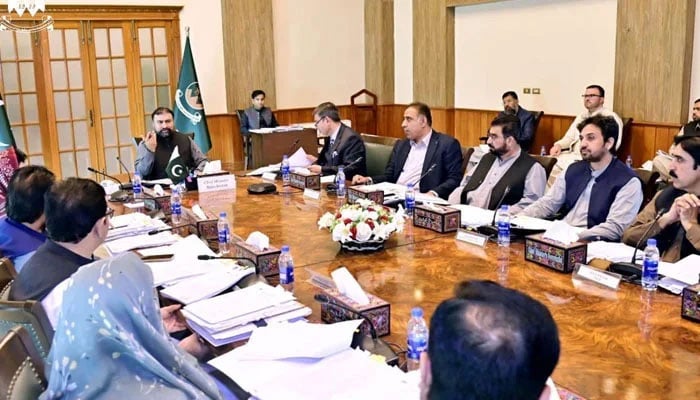
QUETTA: The Balochistan provincial cabinet, chaired by Chief Minister Mir Sarfraz Bugti on Thursday, reviewed a wide range of political, administrative, and legislative matters and approved several major decisions, including granting industry status to the Mines and Minerals sector and revising the powers related to the imposition of Section 144.
Under the new policy, Deputy Commissioners can now enforce Section 144 for 30 days, Commissioners for 60 days, and the Additional Chief Secretary (Home) for 90 days — a move aimed at streamlining administrative powers and improving law enforcement efficiency. In a landmark development, the cabinet approved industry status for the Mines and Minerals sector to attract investment, boost mineral development, and create new employment opportunities across the province. The cabinet also strongly condemned recent Afghan aggression and expressed complete satisfaction over the prompt and professional response of Pakistan’s armed forces. Members paid glowing tributes to the martyrs who laid down their lives for the defence of the country and offered prayers for their eternal peace. A special prayer was also offered for the late mother of Provincial Education Minister Raheela Hameed Khan Durrani.
Speaking at the meeting, Chief Minister Bugti said, “Every government that came to power in Afghanistan maintained the same hostile posture. From 1947 till today, Afghan rulers have shown no positive change in their attitude.” He added that Pakistan hosted millions of Afghan refugees for decades with generosity, “yet regrettably received hostility instead of gratitude.”
The chief minister reiterated that the repatriation of Afghan refugees is a final decision of the federal government and assured that the provincial administration will fully implement the policy. In a step towards environmental conservation, the cabinet approved the expansion of the Mangrove Forest Area along Balochistan’s coastal belt to enhance ecological protection and combat the effects of climate change.
To strengthen women’s safety and justice mechanisms, the cabinet approved the establishment of Anti-Sexual Crimes Units to investigate cases of abuse, and a Special Women’s Protection Force to provide immediate assistance and legal support to victims of harassment. A cabinet committee, headed by Provincial Minister Mir Zahoor Buledi, was formed to finalise recommendations for the Balochistan Sustainable Fisheries and Aquaculture Bill, promoting sustainable growth in the fisheries sector. Additionally, the cabinet approved the Balochistan Control of Narcotics Substances Bill 2025, aimed at curbing drug trafficking and promoting social reforms, and endorsed amendments to the Nikah Nama (Marriage Registration Form-II) in compliance with Supreme Court directives. The meeting also passed the Balochistan Overseas Pakistanis Commission Bill 2025 to establish an institutional mechanism to address issues faced by overseas Baloch citizens.
Funds were approved for the implementation of the Youth Policy. Chief Minister Bugti congratulated Adviser on Youth Affairs Meena Majeed Baloch, Secretary Dara Baloch, and their team for successfully organising the National Youth Summit, and also appreciated Parliamentary Secretary Nawabzada Zareen Khan Magsi, Secretary Culture Sohail-ur-Rehman Baloch, and their team for organising the Cultural and Tourism Festival in Islamabad.
The cabinet further approved the Balochistan Land Lease Policy 2025, ensuring transparent, equitable, and sustainable use of state land, and also sanctioned the establishment of a Journalists’ Housing Colony for members of the Gwadar Press Club to provide improved residential facilities.
Concluding the session, Chief Minister Mir Sarfraz Bugti reaffirmed his government’s commitment to public welfare, transparent governance, and institutional reforms. “Our goal is to make Balochistan an economically stable, peaceful, and empowered province through practical measures across all sectors,” he said, adding that the cabinet’s decisions reflect the government’s strong resolve for a prosperous future and the strengthening of public trust.




-
 State institutions ‘fail’ to perform constitutional duties: KP CM
 -
 CTD orders psychological testing of police on VVIP security duty
 -
 Navy busts drug consignment valued at $130m
 -
 Three ex-secretaries in race for ETPB chief post
 -
 Punjab govt forms 71 JITs to probe cases against banned TLP
 -
 Some UNSC members ignoring broader reforms, seeking privilege: Pakistan
 -
 PAC body discusses non-recovery of Rs15bn gas cess
 -
 Pakistan received $2.29bn foreign loans in first 4 months of 2025