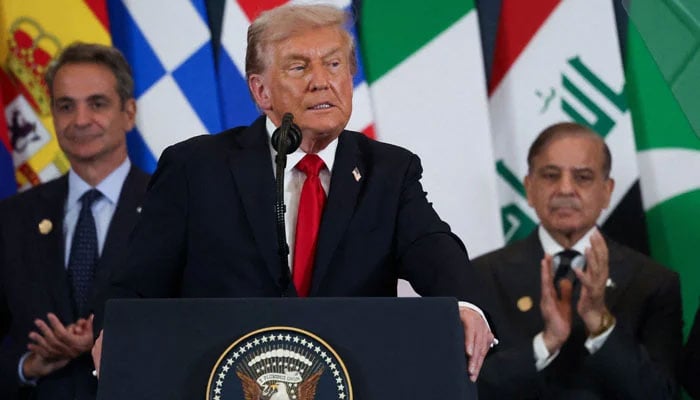
RIYADH: When President Trump spoke in Israel on Monday to celebrate the cease-fire in Gaza, he declared that it was time to seek “the ultimate prize of peace and prosperity” for the entire region.
The moment carried strong echoes of another speech that he gave in 2020, announcing the Abraham Accords — a series of diplomatic deals that saw Israel establish relations with several Arab countries. Praising the accords, Trump said that his son-in-law, Jared Kushner, “did something very special” when he helped to broker them. He also hinted at his longstanding wish to expand them, suggesting that Israel could even make a deal with Iran, its archenemy in the region. Though a comprehensive end to the war between Israel and Hamas has yet to be hammered out, Trump said the cease-fire meant “the historic dawn of a new Middle East.”
What are the Abraham Accords?
Signed in 2020 on the White House lawn, the first of the deals known as the Abraham Accords established diplomatic ties between Israel and two Gulf Arab states, Bahrain and the United Arab Emirates.
A similar agreement with Morocco soon followed. Until then, the only Arab states that had formally recognized Israel were Egypt and Jordan. Until the Abraham Accords, most Arab countries, including the UAE, withheld diplomatic relations with Israel pending a Palestinian state, banning travel, direct calls, and open trade or security cooperation.
What impact have the deals had?
The Abraham Accords have created an opportunity for expanded trade, security cooperation and tourism between the countries that signed them. Israeli tourists and investors have poured into Dubai, and technology and energy companies have signed new deals. In 2024, trade between the two countries exceeded $3 billion, and regular flights continue to ferry travelers between the Emirates and Tel Aviv.
Morocco has also seen an influx of Israeli tourists. And to sweeten its incentives to sign the deal, the United States agreed to recognize the disputed Western Sahara territory as a sovereign part of Morocco. The impact in Bahrain has been more modest, and protests against the accords have become a regular occurrence in the Gulf nation.
The accords have done nothing to resolve the Israeli-Palestinian conflict. Israel’s occupation of the West Bank has deepened, rather than eased, contrary to the hopes of Emirati officials when they signed the deal. The current prospects for a Palestinian state in the West Bank and Gaza appear dim, even though several European countries have recently recognized Palestine. Over the five years since the Abraham Accords were signed, Trump and Benjamin Netanyahu of Israel, along with other American and Israeli officials, have repeatedly referred to the agreements as a “peace deal.” Scholars note the Abraham Accords’ “new Middle East” claim exaggerates, as Israel never fought the UAE, Bahrain, or Morocco, which largely avoided Arab-Israeli conflicts, bypassing the core Israel-Palestinian issue.
Will the Abraham Accords expand?
American and Israeli officials have frequently stated their desires, and expectations, for other countries to sign the accords. So far, that has fallen flat. The biggest prize for supporters of the accords would be Saudi Arabia. But years of overtures to persuade Saudi Arabia to recognize Israel have so far failed. The Biden administration took up that mantle fervently.
Analysts say that Israel’s conduct of the war in Gaza, with the immense suffering of Palestinian civilians, has made joining the accords a much harder sell for Arab nations. Saudi officials have insisted recently that they would be unable to recognize Israel without the establishment of a Palestinian state with East Jerusalem as its capital. Israel insists that it will never cede East Jerusalem, which it seized in the 1967 war and formally annexed in 1980. Even if the war in Gaza ends permanently, the views of Saudi citizens toward dealing with Israel are overwhelmingly negative. That limits the space that the kingdom’s crown prince and de facto ruler, Mohammed bin Salman, has to maneuver for a deal.


-
 Aurangzeb confirms Saudi Arabia $10bn interest, says B2B shift ongoing
 -
 Pakistan to build artificial island to boost oil exploration
 -
 Special pink bus service launched for women on Green Line route
 -
 Same number plates from other provinces lead to wrong e-challans for Karachiites
 -
 State institutions ‘fail’ to perform constitutional duties: KP CM
 -
 CTD orders psychological testing of police on VVIP security duty
 -
 Navy busts drug consignment valued at $130m
 -
 Three ex-secretaries in race for ETPB chief post